AP SSC 10th Class Physics Solutions Chapter 12 Electromagnetism

AP State Board Syllabus AP SSC 10th Class Physics Solutions Chapter 12 Electromagnetism Textbook Questions and Answers.

AP State Syllabus SSC 10th Class Physics Solutions 12th Lesson Electromagnetism

10th Class Physics 12th Lesson Electromagnetism Textbook Questions and Answers

Review of Your Previous Knowledge

Question 1.
How do electric appliances work?
Answer:
Electrical appliances work due to the electric force. Electrical force works in displacing the charges. Electric force is independent of the state of rest or the motion of the charged particle. Electric motor, washing machine are some of the examples of electric appliances.

Question 2.
How do electromagnets work?
Answer:
An electromagnet acquires the magnetic properties only when electric current is passed through the solenoid. Once the current is switched off, it almost loses its magnetic properties as retentivity of soft iron is very low. The strength of the electromagnet depends upon number of turns per unit length of the solenoid and the current through the solenoid.

AP SSC 10th Class Physics Solutions Chapter 12 Electromagnetism

Question 3.
Is there any relation between electricity and magnetism?
Answer:
The first evidence that there exists such a relationship between electricity and magnetism was observed by Oersted. When current carrying conductor was parallel to the axis of the needle, and the needle was deflected. This was much against his expectations. On reversing the direction of the current the needle moved in opposite direction.

Question 4.
Can we produce magnetism from electricity?
Answer:
We can produce magnetism from electronic current. Ampere with his Ampere’s swimming rule explained the direction of electric current and the deflection of magnetic needle.

Improve Your Learning

Question 1.
Are the magnetic field lines closed? Explain. (AS1)
Answer:
AP SSC 10th Class Physics Solutions Chapter 12 Electromagnetism 1

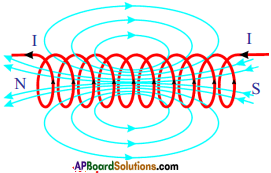
  • Magnetic field lines are closed.
  • If we observe the field lines formed by a current carrying straight wire, circular field lines are formed. They are closed circles.
  • If we observe the field lines by a current carrying solenoid the field lines out side the solenoid are continuous with those inside.
  • Thus the magnetic field lines are closed loops.
AP SSC 10th Class Physics Solutions Chapter 12 Electromagnetism 2

Question 2.
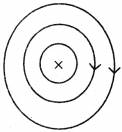
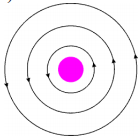
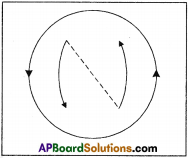
See figure, magnetic lines are shown. What is the direction of the current flowing through the wire? (AS1)
AP SSC 10th Class Physics Solutions Chapter 12 Electromagnetism 3
Answer:
If field lines are in anti-clockwise direction as shown in the diagram, the direction of current is vertically upwards. This can be demonstrated with right hand thumb rule.

Question 3.
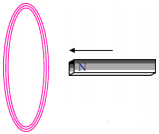
A bar magnet with north pole facing towards a coil moves as shown in figure. What happens to the magnetic flux passing through the coil? (AS1)
AP SSC 10th Class Physics Solutions Chapter 12 Electromagnetism 4
(OR)
Why would induced current be generated in the coil when a north pole of a bar magnet pushed into it ?
Answer:
If north pole of the magnet moves towards the coil, there is a continuous change of magnetic flux linked with closed coil, then current is generated in the coil.

AP SSC 10th Class Physics Solutions Chapter 12 Electromagnetism

Question 4.
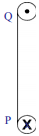
A coil is kept perpendicular to page. At P, current flows into the page and at Q it comes out of the page as shown in figure. What is the direction of magnetic field due to the coil? (AS1)
AP SSC 10th Class Physics Solutions Chapter 12 Electromagnetism 5
Answer:
At the top, anti-clockwise direction.
At the bottom, clockwise direction.
Try This:
AP SSC 10th Class Physics Solutions Chapter 12 Electromagnetism 23
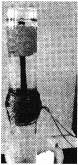
Take a test tube and wound minimum 50 turns of 24 guage insulated copper wire with 2cms length at the centre of test tube as shown in figure, ‘l Now solenoid is ready. Take 3cms length of iron nail and make it floats on water with appropriate foam (thermocol) on the water. Now connect the j two ends of solenoid two 3-6 volts battery eliminator and switch on the eliminator. You can observe the motion of the nail towards the solenoid. (If not move decrease the water level or increase the potential).
Try to explain motion of the nail into the water using solenoid concept.

Question 5.
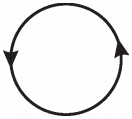
The direction of current flowing in a coil is shown in the figure. What type of magnetic pole is formed at the face that has flow of current as shown in the figure? (AS1)
AP SSC 10th Class Physics Solutions Chapter 12 Electromagnetism 6
Answer:
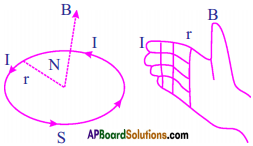
North. Since the current in the coil flows in anti-clockwise direction, north pole is formed at the face we are watching. AP SSC 10th Class Physics Solutions Chapter 12 Electromagnetism 9
Question 6.
Why does the picture appear distorted when a bar magnet is brought close to the screen of a television? Explain. (AS1)
(OR)
Explain magnetic force on moving charge and current carrying wire.
(OR)
What happens when you bring a bar magnet near a picture of TV screen ? What inference do you conclude from this activity?
Answer:
This is due to the fact that magnetic field exerts a force on the moving charge.

TV screen Activity :

  • Take a bar magnet and bring it near the TV screen.
  • Then the picture on the screen is distorted.
  • Here the distortion is due to the motion of the electrons reaching the screen are affected by the magnetic field.
  • Now move the bar magnet away from the screen.
  • Then the picture on the screen stabilizes.
  • This must be due to the fact that the magnetic field exerts a force on the moving charges. This force is called magnetic force.
  • The magnitude of the force is F = Bqv where B is magnetic induction, ‘q’ is the charge and v is the velocity of the charged particle.

AP SSC 10th Class Physics Solutions Chapter 12 Electromagnetism

Question 7.
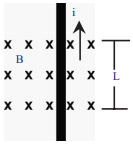
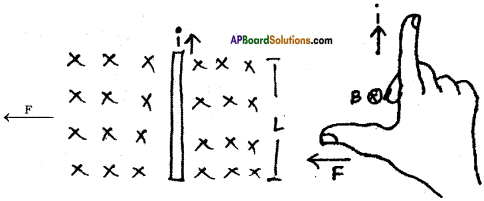
Symbol ‘X’ indicates the direction of a magnetic held into the page. A straight long wire carrying current along its length is kept perpendicular to the magnetic field. What is the magnitude of force experienced by the wire? In what direction does it act? (AS1)
AP SSC 10th Class Physics Solutions Chapter 12 Electromagnetism 7
Answer:
1) Magnetic force (F) experienced by the wire with the magnitude of ILB :
Here I = Current, L = Length of the wire B = Magnetic field

2) Direction of the magnetic force (F) :
AP SSC 10th Class Physics Solutions Chapter 12 Electromagnetism 15
1) The direction of force can be find by using Right hand rule.
2) Fore finger → i (North)
Middle finger → B (into the page)
Thumb → F (Towards west parallel to the paper)

Question 8.
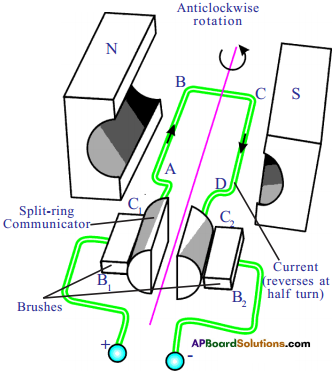
Explain the working of electric motor with a neat diagram. (AS1)
(OR)
Which device converts electrical energy into mechanical energy? Explain the working of that device with a neat diagram.
Answer:
Electric motor converts electrical energy into mechanical energy.
Electric motor:
It is a device which converts electrical energy into mechanical energy.

Principle :
It is based on the principle that a current carrying conductor placed perpendicular to the magnetic field experiences a force.

Construction :
a) Armature coil:
It contains a single loop of an insulated copper wire in the form of a rectangle.

b) Strong magnetic field :
Armature coil is placed between two permanent poles (N & S) of a strong magnet.

c) Slip-ring Commutator:
It consists of two halves (C1 and C2) of a metallic ring. The two ends of the armature coil are connected to these two halves of the ring. Commutator reverses the direction of current in the armature coil.

d) Brushes:
Two carbon brushes B1 and B2 press against the commutator. These brushes act as the contact between the commutator and terminals of the battery.

e) Battery :
A battery is connected across the carbon brushes. The battery supplies the current to the armature coil.
AP SSC 10th Class Physics Solutions Chapter 12 Electromagnetism 10
Working and Theory :

  1. When current flows through the coil, AB and CD experience magnetic force.
  2. In the arm, AB of the coil experiences a force in one direction, similarly, in CD it experiences in opposite direction.
  3. These two equal and opposite forces constitute a couple; which rotates the coil.
  4. At this position, the supply of current to the coil is cut off because contacts of commutator and brushes break.
  5. Hence no force acts on the arms of the coil.
  6. The coil will not come to rest because of rotational inertia of motion, till the commutator again comes in contact with the brushes B1 and B2.
  7. Now the direction of the current in the arms AB and CD is reversed.
  8. Then the couple again rotates in opposite direction.
  9. The coil of DC motor continues to rotate in the same direction. Hence electrical energy is converted into mechanical energy.
  10. The speed of rotation of the motor depends on
    a) current through the armature
    b) number of turns of the coil
    c) area of the coil
    d) magnetic induction.

AP SSC 10th Class Physics Solutions Chapter 12 Electromagnetism

Question 9.
Derive Faraday’slaw of induction from law of conservation of energy. (AS1)
Answer:
Faraday’s law :
Whenever there is a continuous change in magnetic flux linked with coil closed the current is generated in the coil.
AP SSC 10th Class Physics Solutions Chapter 12 Electromagnetism 16

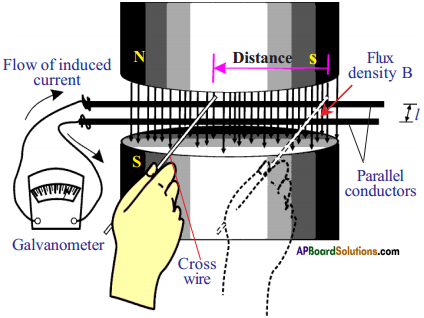
  • Consider a pair of parallel bare conductors which are separated by 7′ meters.
  • They are placed in uniform magnetic field of induction ‘B’ supplied by ‘N’ and ‘S’ poles of the magnet.
  • A galvanometer is connected to the ends of the parallel conductors.
  • We can close the circuit by touching the parallel conductor with another bare conductor which is taken in our hand.
  • If we move our hand to the left, the galvanometer needle will deflect in one direction.
  • If we move our hand to the right, the needle in the galvanometer moves in opposite direction.
  • A current will be set up in the circuit only when there is an EMF in the circuit. Let EMF be ‘ε’.
  • The principle of conservation energy tells us that this electric energy must come from the work that we have done in moving the cross wire.

Question 10.
The value of magnetic field induction which is uniform is 2T. What is the flux passing through a surface of area 1.5 m2 perpendicular to the field? (AS1)
Answer:
B = 2T ; Φ == ? ; A = 1.5 m²
We know B = [latex]\frac{\phi}{\mathrm{A}}[/latex]
or Φ = BA = 2 × 1.5 =3 Webers

Question 11.
An 8N force acts on a rectangular conductor 20 cm long placed perpendicular to a magnetic field. Determine the magnetic field induction if the current in the conductor is 40 A. (AS1)
Answer:
F = 8N ; l = 20 cm or 20 × 10-2 m ; B = ? ; i = 40 Amp

AP SSC 10th Class Physics Solutions Chapter 12 Electromagnetism 33

Question 12.
Explain with the help of two activities that current carrying wire produces magne tic field. (AS1)
(OR)
How can you verify that a current carrying wire produces a magnetic field with the help of experiment?
Answer:
Activity – 1
AP SSC 10th Class Physics Solutions Chapter 12 Electromagnetism 17

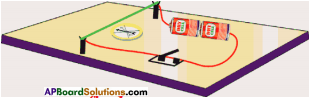
  • Take a thermocole sheet and fix two thin sticks ol height 1cm.
  • Join the two sticks with the help of copper wire.
  • Take a battery, tap key and connect them in series with the copper wire which is thin.
  • Keep a marine compass needle beneath the wire.
  • If you press the tap key, current flows in the copper wire.
  • Immediately the magnetic needle gets deflected.
  • This indicates that the magnetic field is increased when current flows through the conductor.

Activity – 2
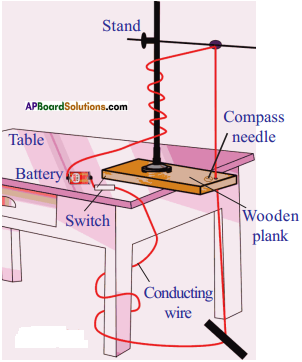
AP SSC 10th Class Physics Solutions Chapter 12 Electromagnetism 18

  • Take a wooden plank and make a hole.
  • Place the plank on the table.
  • Place the retort stand on it.
  • Pass copper wire through the hole.
  • Connect the two ends of the wire with battery through switch.
  • Place some compass needle around the hole.
  • When the current flows the magnetic needle deflects.
  • We can verify this by changing the direction of current.
  • So we can conclude the magnetic field surrounds a current carrying conductor.

Question 13.
How do you verify experimentally that the current carrying conductor experiences a force when it is kept in magnetic field? (AS1)
Answer:
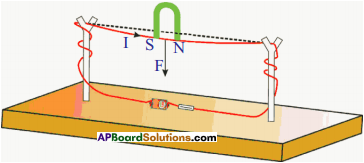
AP SSC 10th Class Physics Solutions Chapter 12 Electromagnetism 11

  1. A copper wire is passed through splits of wooden sticks.
  2. Connect the wire to 3 volts battery.
  3. Close the switch of the battery and pass the current.
  4. Bring the horse-shoe magnet near the wire.
  5. Then a force is experienced on the wire.
  6. Reverse the polarities of the magnet, then the direction of the force is also reversed.
  7. The right hand rule helps the direction of flow of current and the direction of current.

Question 14.
Explain Faraday’s law of induction with the help of an activity. (AS1)
(OR)
Write an activity which proves changing magnetic flux produces induced current in the circuit.
Answer:
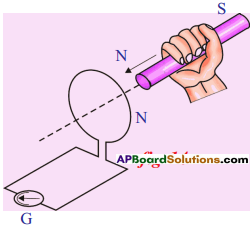
AP SSC 10th Class Physics Solutions Chapter 12 Electromagnetism 12

  • Connect the terminals of a coil to a sensitive ammeter.
  • Push a bar magnet towards the coil, with its north pole facing the coil, the needle in the galvanometer deflects.
  • It shows that a current is set up in the coil.
  • The galvanometer does not deflect if the magnet is at rest.
  • If the magnet is moved away from the coil, the needle in the galvanometer again deflects in opposite direction.
  • Further this experiment enables us to understand that the relative motion of the magnet and coil set up a current in the coil. It makes no difference whether the magnet is moved towards the coil. This is one form of Faraday’s law.

AP SSC 10th Class Physics Solutions Chapter 12 Electromagnetism

Question 15.
Explain the working of AC electric generator with a neat diagram. (AS1)
(OR)
Which device converts mechanical energy into electrical energy? Explain the working of that device with a neat diagram.
Answer:
Generator converts mechanical energy into electrical energy.
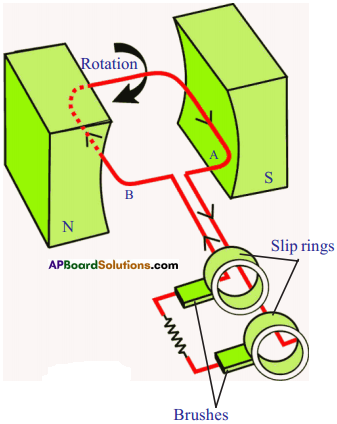
AP SSC 10th Class Physics Solutions Chapter 12 Electromagnetism 13

  • As armature is rotated about an axis, the magnetic flux linked with armature changes. Therefore, an induced current is produced in the armature.
  • If the armature rotates in anti-clockwise direction, from Flemming’s right hand rule the direction of current and deflection of the coil are noted.
  • Alter armature has turned through 180°, it occupies another position.
  • By applying Flemming’s right hand rule we can find the direction of current and deflection of the needle.
  • Hence we can conclude the induced current is alternating in nature.

Question 16.
Explain the working of DC generator with a neat diagram. (AS1)
Answer:
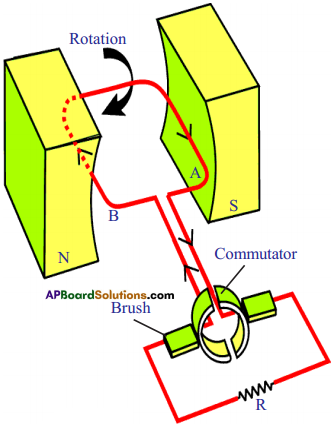
AP SSC 10th Class Physics Solutions Chapter 12 Electromagnetism 14

  • The principle and working of D.C generator is same as that of AC generator except that in place of slip – rings as sliding contacts, we have a slip-ring or a commutator.
  • In a slip ring, there are two half rings.
  • The ends of armature coil are connected to these rings and these rings rotate the armature.
  • By using slip-ring, the direction of induced current does not change in the external circuit throughout the complete rotation of the armature. In other words, the current in the external circuit always flows in the same direction. Hence the induced current is unidirectional.

Question 17.
Rajkumar said to you that the magnetic field lines are open and they start at north pole of bar magnet and end at south pole. What questions do you ask Rajkumar to correct him by saying “field lines are closed”? (AS2)
Answer:

  • If the magnetic field lines start at north pole and end at south pole, where do the lines go from south pole?
  • What is happening within the bar magnet?
  • Are the magnetic field lines passing through bar magnet?
  • What is the direction of magnetic field lines inside the bar magnet? (Recall the solenoid activity).
  • Can you say now, that the magnetic field lines are open?

AP SSC 10th Class Physics Solutions Chapter 12 Electromagnetism

Question 18.
As shown in figure, both coil and bar magnet move in the same direction. Your friend is arguing that there is no change in flux. Do you agree with his statement? If not, what doubts do you have? Frame questions about the doubts you have regarding change in flux. (AS2)
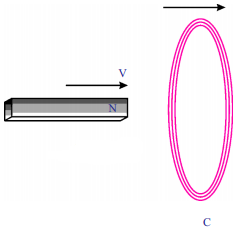
AP SSC 10th Class Physics Solutions Chapter 12 Electromagnetism 8
Answer:

  • What happens if both magnet and coil move in same direction?
  • What happens if both magnet and coil move in opposite direction?
  • What is the direction of the current in the coil?
  • If both move in same direction, is there any linkage of flux with the coil?
  • When ‘N’ pole is moved towards the coil what is the direction of current?
  • If magnet is reversed, what is the direction of current in the coil?

Question 19.
What experiment do you suggest to understand Faraday’s law? What items are required? What suggestions do you give to get good results of the experiment? Give precautions also. (AS3)
Answer:
Aim :
To understand Faraday’s law of induction.

Materials required :
A coil of copper wire, a bar magnet, Galvanometer, etc.

AP SSC 10th Class Physics Solutions Chapter 12 Electromagnetism 12
Procedure :

  1. Connect the terminal of a coil to a sensitive galvanometer as shown in the figure.
  2. Normally, we would not expect any deflections of needle in the galvanometer because there is to be no electromotive force in this circuit.
  3. Now if we push a bar magnet towards the coil, with its north pole facing the coil, we observe the needle in the galvanometer deflects, showing that a current is set up in the coil.
  4. The galvanometer does not deflect if the magnet is at rest.
  5. If the magnet is moved away from the coil, the needle in the galvanometer again deflects, but in the opposite direction, which means that a current is set up in the coil in the opposite direction.
  6. If we use the end of south pole of a magnet instead of north pole in the above activity, the deflections are exactly reversed.
  7. This experiment proves “whenever there is a continuous change of magnetic flux linked with a closed coil, a current is generated in the coil”.

Precautions :

  1. The coil should be kept on an insulating surface.
  2. Bar magnet should be of good magnetic moment.
  3. The centre of the galvanometer scale must be zero.
  4. The deflections in the galvanometer must be observed while introducing the bar magnet into the coil and also while withdrawing it.

AP SSC 10th Class Physics Solutions Chapter 12 Electromagnetism

Question 20.
How can you verify that a current carrying wire produces a magnetic field with the help of an experiment? (AS3)
Answer:
Experiment:

  • Take a thermocole sheet and fix two thin wooden sticks of height 1cm.
  • These sticks are joined with the help of a copper wire.
  • Connect battery and tap key to this copper wire.
  • Place a magnetic compass beneath the wire.
  • Now press the tap key and allow the current through the wire. It is observed that magnetic needle deflects.
  • If you change the direction of the current, the direction of deflection of needle also changes.
  • So we can say current carrying conductor produces magnetic field.

Question 21.
Collect information about generation of current by using Faraday’s law. (AS4)
Answer:
Faraday’s law is useful in generation of current.

  1. According to this law, the change in magnetic flux induces EMF in the coil.
  2. Fie also proposed electromagnetic induction.
  3. Electromagnetic induction is a base for generator, which produces electric current.
  4. Transformer also works on the principle of electromagnetic induction, which is helpful in transmission of electricity.
  5. Hence Faraday’s law is used in the generation and transmission of current.

Question 22.
Collect information about material required and procedure of making a simple electric motor from internet and make a simple ntotor on your own. (AS4)
Answer:
Aim :
Preparation of a simple electric motor.

Material requried :
A wire of nearly 15 cm, 1.5v Battery, Iron nail, strong magnet, paper clip.
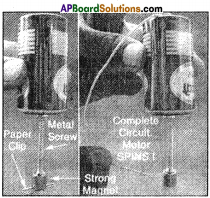
AP SSC 10th Class Physics Solutions Chapter 12 Electromagnetism 19
Procedure:

  1. Attach the magnet to the head of the iron nail.
  2. Attach a paper clip to the open end of the magnet.
  3. Now attach the other end of the nail (Free end) to the cap (positive terminal) of the battery.
  4. Now connect the negative terminal of the battery and the head of the iron nail through a wire.
  5. We observe that the paper clip rotates.

Another model:
Materials required :
1.5 m enamelled copper wire (about 25 gauge), 2 safety pins,
1.5 v battery, magnets, rubber bands or bands cut from cycle tube.
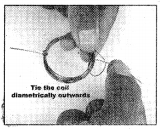
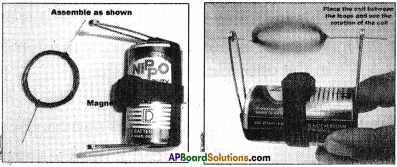
AP SSC 10th Class Physics Solutions Chapter 12 Electromagnetism 20 AP SSC 10th Class Physics Solutions Chapter 12 Electromagnetism 21
Procedure :

  1. Wind copper wire on the battery nearly 10 – 15 turns to make a coil.
  2. Remove the coil and fix the ends as shown in the figure.
  3. Scrape the insulation com¬pletely on one end of the coil.
  4. Scrape the insulation on top, left and right of the other end. The bottom should be insulated.
  5. Now complete the electric mo¬tor as shown in the figure. “5

Question 23.
Collect information of experiments done by Faraday. (AS4)
Answer:
Experiment – 1
AP SSC 10th Class Physics Solutions Chapter 12 Electromagnetism 12

  1. Connect the terminals of a coil to a sensitive galvanometer as shown in the figure.
  2. Normally, we would not expect any deflection of needle in the galvanometer because there is no EMF in the circuit.
  3. Now, if we push a bar magnet towards the coil, with its north pole facing the coil, the needle in the galvanometer deflects, showing that a current has been set up in the coil, the galvanometer does not deflect if the magnet is at rest.
  4. If the magnet is moved away from the coil, the needle in the galvanometer again deflects, but in the opposite direction, which means that a current is set up in the coil in the opposite direction.
  5. If we use the end of south pole of a magnet instead of north pole, the results i.e., the deflections in galvanometer are exactly opposite to the previous one.
  6. This activity proves that the change in magnetic flux linked with a closed coil, produces current.
  7. From this Faraday’s law of induction can be stated as “whenever there is a continuous change of magnetic flux linked with a closed coil, a current is generated in the coil”. This induced EMF is equal to the rate of change of magnetic flux passing through it.

Experiment – 2
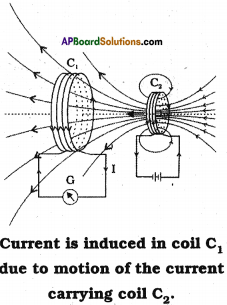
AP SSC 10th Class Physics Solutions Chapter 12 Electromagnetism 22

  1. Prepare a coil of copper wire C1 and connect the two ends of the coil to a galvanometer.
  2. Prepare another coil of copper wire similar to C2 and connect the two ends of the coil to a battery via switch.
  3. Now arrange the two coils C1 and C2 nearby as shown in the figure.
  4. Now switch on the coil C2. We observe a deflection in the galvanometer connected to the coil C1.
  5. The steady current in C2 produces steady magnetic field. As coil C2 is moved towards the coil C1 the galvanometer shows a deflection.
  6. This indicates that electric current is induced in coil C1.
  7. When C2 is moved away, the galvanometer shows a deflection again, but this time in the opposite direction.
  8. The deflection lasts as long as coil C2 is in motion.
  9. When C2 is fixed and C1 is moved, the same effects are observed.
  10. This shows the induced EMF due to relative motion between two coils.

AP SSC 10th Class Physics Solutions Chapter 12 Electromagnetism

Question 24.
Draw a neat diagram of electric motor. Name the parts. (AS5)
Answer:
AP SSC 10th Class Physics Solutions Chapter 12 Electromagnetism 10

Question 25.
Draw a neat diagram of an AC generator. (AS5)
(OR)
Draw the diagram of electric generator and label its parts. A.
Answer:
AP SSC 10th Class Physics Solutions Chapter 12 Electromagnetism 13

Question 26.
How do you appreciate the Faraday’s law, which is the consequence of conservation of energy? (AS6)
Answer:

  • Law of conservation of energy says energy neither be created nor be destroyed, but can be converted from one form to another.
  • Faraday’s law says whenever there is a continuous change of magnetic flux linked with a closed coil, a current is generated in the coil. This induced EMF is equal to the rate of change of magnetic flux passing through it.
  • We have to do some work to move the magnet through a coil. This work produces energy.
  • This energy is converted into electrical energy in the coil.
  • In this way conservation of energy takes place in electromagnetic induction.

AP SSC 10th Class Physics Solutions Chapter 12 Electromagnetism

Question 27.
How do you appreciate the relation between magnetic field and electricity that changed the lifestyle of mankind? (AS6)
Answer:

  • Changing life style of mankind is a result of many inventions, utilising a lot of scientific principles.
  • Scientists all ways going on searching for new principles and new applications to make our life more comfortable.
  • If you consider electricity, right from amber stone to nuclear power, so many changes have been incorporated.
  • The idea of Oersted and Faraday that current carrying wire produces electricity and electromagnetic induction, enable us to use electric motors, generators, fans, mixers, grinders, induction stoves, etc.
  • All these appliances makes our life more comfortable. Hence Faraday and Oersted rendered a lot of servies in this field.
  • Hence, I appreciate the relation between magnetic field and electricity that changed the life style of mankind.
    So if current is more, induction is also more.

Question 28.
Give a few applications of Faraday’s law of induction in daily life. (AS7)
Answer:
Applications:
The daily life applications of Faraday’s law of induction are

  1. Generation of electricity
  2. Transmission of electricity
  3. Metal detectors in security checking
  4. The tape recorder
  5. Use of ATM cards
  6. Induction stoves
  7. Transformers
  8. Induction coils (spark plugs in automobiles)
  9. Break system in railway wheels
  10. AC and DC generators
  11. Windmills, etc.

AP SSC 10th Class Physics Solutions Chapter 12 Electromagnetism

Question 29.
Which of the various methods of current generation protects the nature well? Give examples to support your answer. (AS7)
Answer:
Windmill :

  • Electricity is produced when an armature of a generator rotates between two poles of a strong magnet.
  • Whereas when wind falls on the wheel of a windmill, it rotates. So the armature of the generator rotates between two poles of a magnet along with the rotation of the wheel of the windmill.
  • Thus electric current is produced.
  • This is how, KE of the wind is converted into electric energy.

Advantages :
Wind energy produces no smoke and no harmful gases. So this form of energy is pollution free or environment-friendly.

Fill in The Blanks

1. The SI unit of magnetic field induction is ………………….
2. Magnetic flux is the product of magnetic field induction and …………………
3. The charge is moving along the direction of magnetic field. Then force acting on it is ………………..
4. A current carrying wire of length L is placed perpendicular to a uniform magnetic field B. Then the force acting on the wire with current I is ……………..
5. Faraday’s law of induction is the consequence of …………………
Answer:

  1. weber/m² (or) Tesla
  2. area
  3. zero
  4. ILB
  5. Law of conservation of energy

Multiple Choice Questions

1. Which converts electrical energy into mechanical energy?
A) motor
B) battery
C) generator
D) switch
Answer:
A) motor

2. Waich converts mechanical energy into electrical energy?
(OR)
The device used to convert mechanical energy into electrical energy among the following is
A) motor
B) battery
C) generator
D) switch
Answer:
C) generator

AP SSC 10th Class Physics Solutions Chapter 12 Electromagnetism

3. The magnetic force on a current carrying wire placed in uniform magnetic field if the wire is oriented perpendicular to magnetic field, is
A) 0
B) ILB
C) 2ILB
D) ILB/2
Answer:
B) ILB

10th Class Physics 12th Lesson Electromagnetism InText Questions and Answers

10th Class Physics Textbook Page No. 221

Question 1.
Why does the needle get deflected by the magnet?
Answer:
Because of strength of the magnetic field of the magnet, the needle gets deflected since it is in the field.

10th Class Physics Textbook Page No. 213

Question 2.
How can we find the strength of the field and direction of the field?
Answer:
We can find the strength of the field with magnetic flux and the direction of the field from the tangent drawn to the line of force.

10th Class Physics Textbook Page No. 214

Question 3.
Can we give certain values to magnitude of the field at every point in the magnetic field?
Answer:
In uniform magnetic field it is same whereas in non-uniform magnetic field it is different.

10th Class Physics Textbook Page No. 215

Question 4.
What is the flux through unit area perpendicular to the field?
Answer:
Flux density or magnetic induction.

Question 5.
Can we generalize the formula of flux for any orientation of the plane taken in the field?
Answer:
Yes, Φ = BA cos θ

AP SSC 10th Class Physics Solutions Chapter 12 Electromagnetism

Question 6.
What is the flux through the plane taken parallel to the field?
Answer:
Magnetic flux (or) Magnetic field.

Question 7.
What is the use of introducing the ideas of magnetic flux and magnetic flux density?
Answer:
Magnetic flux and flux density help in understanding the concept of electromagnetic induction and relation between electricity and magnetism.

AP SSC 10th Class Physics Solutions Chapter 12 Electromagnetism

Question 8.
Are there any sources of magnetic field other than magnets?
Answer:
Current carrying straight wires and loops act as sources of magnetic filed.

Question 9.
Do you know how old electric calling bells work?
Answer:
Yes. They work on the principle of magnetic effect of electric currents.

10th Class Physics Textbook Page No. 218

Question 10.
What happens when a current carrying wire is kept in a magnetic field?
Answer:

  • Magnetic field applies force on current carrying wire.
  • So it gets deflected and the direction of deflection is given by right hand rule.
  • Or there will be no force acting on the wire when wire is in the direction of the field.

10th Class Physics Textbook Page No. 219

Question 11.
Do you feel any sensation on your skin?
Answer:
Yes. The hair on my skin rises up when I stand near TV screen.

Question 12.
What could be the reason for that?
Answer:
It is due to the magnetic field produced by electric charges in motion.

AP SSC 10th Class Physics Solutions Chapter 12 Electromagnetism

Question 13.
Why does the picture get distorted?
Answer:
Due to motion of electrons that form the picture is affected by the magnetic field of bar magnet.

Question 14.
Is the motion of electrons reaching the screen affected by the magnetic field of the bar magnet?
Answer:
Yes. The motion of electrons reaching the screen is affected by the magnetic field of the bar magnet.

Question 15.
Can we calculate the force experienced by a charge moving in a magnetic field?
Answer:
Yes, If the force is F, it is given by the expression F = qvB.

Question 16.
Can we generalize the equation for magnetic force on charge when there is an angle ‘0’ between the directions of field “B” and velocity “v”?
Answer:
No, Then force F is given by the formula F = qvB sin θ.

AP SSC 10th Class Physics Solutions Chapter 12 Electromagnetism

Question 17.
What is the magnetic force on the charge moving parallel to a magnetic field?
Answer:
When the charge moves parallel to the magnetic field the value of “θ” becomes zero. In the equation F = qvB sin θ, since θ = θ, the value of force F also becomes zero.

Question 18.
What is the direction of magnetic force acting on a moving charge?
Answer:
By applying right hand rule we can guess the direction of magnetic force acting on a moving charge is the “thumb” direction.

10th Class Physics Textbook Page No. 221

Question 19.
Can you determine the magnetic force on a current carrying wire which is placed along a magnetic field?
Answer:
F = BIl sin θ. If the current carrying wire is placed along direction field θ = 0.
∴ F = 0

Question 20.
What is the force on the wire if its length makes an angle ‘θ’ with the magnetic field?
Answer:
F = Bqv sin θ or F = Bil sin θ, where ‘i’ is current. WorhA
Here B = magnetic induction, q = charge, v = velocity of the charge and ‘θ’ is the angle between direction of field and velocity.

10th Class Physics Textbook Page No. 222

Question 21.
How could you find its (current carrying wire) direction?
Answer:
We can find by using right hand rule.

Question 22.
Is the direction of deflection observed experimentally same as that of the theoretically expected one?
Answer:
Yes. But it depends on polarities of the horse shoe magnet.

AP SSC 10th Class Physics Solutions Chapter 12 Electromagnetism

Question 23.
Does the right hand rule give the explanation for the direction of magnetic force exerted by magnetic field on the wire?
Answer:
The right hand rule does not help us to explain the reason for deflection of wire.

Question 24.
Can you give a reason for it (deflection of wire)?
Answer:
There exists only magnetic field due to external source. When there is a current in the wire, it also produces a magnetic field. These fields overlap and give non-uniform field. This is the reason for it.

10th Class Physics Textbook Page No. 223

Question 25.
Does this deflection fit with the direction of magnetic force found by right hand rule?
Answer:
Yes. This deflection fits with the direction of magnetic force found by right hand rule.

Question 26.
What happens when a current carrying coil is placed in a uniform magnetic field?
Answer:
It gets deflected since magnetic lines of force are perpendicular to the length of the coil.

AP SSC 10th Class Physics Solutions Chapter 12 Electromagnetism

Question 27.
Can we use this knowledge to construct an electric motor?
Answer:
Yes. This is the principle of electric motor.

Question 28.
What is the angle made by AB and CD with magnetic field?
Answer:
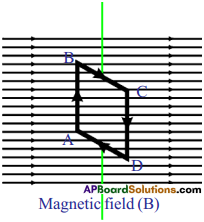
AP SSC 10th Class Physics Solutions Chapter 12 Electromagnetism 30
AB and CD are at right angles to the magnetic field.

10th Class Physics Textbook Page No. 224

Question 29.
Can you draw the direction of magnetic force on sides AB and CD?
Answer:
Yes. The direction of magnetic force on sides AB and CD can be determined by applying right hand rule.

Question 30.
What are the directions of forces on BC and DA?
Answer:
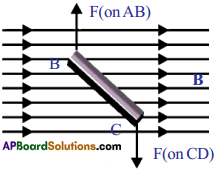
AP SSC 10th Class Physics Solutions Chapter 12 Electromagnetism 31
ADBC, magnetic force pulls the coil up and at DA magnetic force pulls it down.

Question 31.
What is the net force on the rectangular coil?
Answer:
Net force on the rectangular coil is zero.

Question 32.
Why does the coil rotate?
Answer:
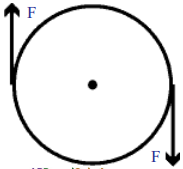
AP SSC 10th Class Physics Solutions Chapter 12 Electromagnetism 32
The rectangular coil rotates in clockwise direction because of equal and opposite pan’ of forces acting on the two sides of the coil.

Question 33.
What happens to the rotation of the coil if the direction of current in the coil remains unchanged?
Answer:
The coil comes to halt and rotates in anti-clockwise direction.

Question 34.
How could you make the coil rotate continuously?
Answer:
If the direction of current in coil, after the first half rotation, is reversed, the coil will continue to rotate in the same direction.

10th Class Physics Textbook Page No. 225

Question 35.
How can we achieve this (convertion of electrical energy to mechanical energy)?
Answer:
Brushes B1 and B2 are used to achieve this.

AP SSC 10th Class Physics Solutions Chapter 12 Electromagnetism

Question 36.
What happens when a coil without current is made to rotate in magnetic field?
Answer:
When the coil rotated due to the change in magnetic flux electricity is generated.

Question 37.
How is current produced?
Answer:
The current is produced from the battery to the coil.

Question 38.
Why is there a difference in behaviour in these two cases?
Answer:
The A.C. supply changes its direction a number of times in a second. But D.C. is unidirectional current. So there is a difference in the behaviour of the metal ring in these two cases.

Question 39.
What force supports the ring against gravity when it is being levitated?
Answer:
The magnetic force developed in the coil of copper wire supports the ring against gravity when it is being levitated.

10th Class Physics Textbook Page No. 226

Question 40.
Could the ring be levitated if DC is used?
Answer:
The metal ring is levitated because the net force on it should be zero according to Newton’s second law.

Question 41.
What is this unknown force acting on the metal ring?
Answer:
The change in polarities at certain intervals at the ends of the solenoid causes the unknown force acting on the metal ring.

AP SSC 10th Class Physics Solutions Chapter 12 Electromagnetism

Question 42.
What is responsible for the current in the metal ring?
Answer:
The field through the metal ring changes so that flux linked with the metal ring changes and this is responsible for the current in metal ring.

Question 43.
If DC is used, the metal ring lifts up and falls down immediately. Why?
Answer:
The flux linked with metal ring is zero. When the switch is on, at that instant there should be a change in the flux linked with ring. So the ring rises up and falls down. If the switch is off, the metal ring again raises up and falls down. There is no change in flux linked with ring when the switch is off.

10th Class Physics Textbook Page No. 227

Question 44.
What could you conclude from the above analysis (metal ring lifts up and falls down)?
Answer:
The relative motion of the magnet and coil sets up a current in the coil.

10th Class Physics Textbook Page No. 228

Question 45.
What is the direction of induced current?
Answer:
The direction of the induced current is such that it opposes the charge that produced it.

AP SSC 10th Class Physics Solutions Chapter 12 Electromagnetism

Question 46.
Can you apply conservation of energy for electromagnetic induction?
Answer:
Yes, we can apply. The mechanical energy is converted into electrical energy.

10th Class Physics Textbook Page No. 229

Question 47.
Can you guess what could be the direction of induced current in the coil in such case?
Answer:
The direction of the induced current in the coil must be in anti-clockwise direction.

Question 48.
Could we get Faraday’s law of induction from conservation of energy?
Answer:
Yes, we can get. Here we have to ignore the friction everywhere.

10th Class Physics Textbook Page No. 230

Question 49.
Can you derive an expression for the force applied on crosswire by the field “B”?
Answer:
Yes. The force applied F = BIl.

10th Class Physics Textbook Page No. 232

Question 50.
How could we use the principle of electromagnetic induction in the case of using ATM card when its magnetic strip is swiped through a scanner? Discuss with your friend or teacher.
Answer:
If the card is moved through a card reader, then a change in magnetic flux is produced in one direction, which induced potential or EMF. The current received by the pickup coil goes through signal amplification and translated into binary code, so that it can be read by computer.

AP SSC 10th Class Physics Solutions Chapter 12 Electromagnetism

Question 51.
What happens when a coil is continuously rotated in a uniform magnetic field?
Answer:
An induced current is generated in the coil.

Question 52.
Does it (continuous rotation of coil) help us to generate electric current?
Answer:
Yes. Continuous rotation of coil helps us to generate electric current.

10th Class Physics Textbook Page No. 233

Question 53.
Is the direction of current induced in the coil constant? Does it change?
Answer:
Yes, it changes. When the coil is at rest in vertical position, with side (A) of coil at top position side (B) at bottom position, no current will be induced in it.

Question 54.
Can you guess the reason for variation of current from zero to maximum and vice-versa during the rotation of coil?
Answer:
The reason for variation of current from zero to maximum and vice-versa during the rotation of coil current generated follows the same pattern so that in first half except that the direction of current is reversed.

AP SSC 10th Class Physics Solutions Chapter 12 Electromagnetism

Question 55.
Can we make use of this current? If so, how?
Answer:
Two carbon brushes are arranged in such a way that they press the slip rings to obtain current from the coil. When these brushes are connected to external devices like TV, Radio we can make them work with current supplied from ends of carbon brushes.

10th Class Physics Textbook Page No. 234

Question 56.
How can we get DC current using a generator?
Answer:
By connecting two half-slip rings instead of a slip ring commutator on either side to the ends of the coil we can get D.C. current.

AP SSC 10th Class Physics Solutions Chapter 12 Electromagnetism

Question 57.
What changes do we need to make in an AC generator to be converted into a DC generator?
Answer:
Instead of two slip rings, we have to use a slip ring commutator to change A.C. generator into a D.C. generator.

10th Class Physics 12th Lesson Electromagnetism Activities

Activity – 2

Question 1.
Show that the magnetic field around a bar magnet is three dimensional and its strength and direction varies from place to place.
Answer:

  • Take a sheet of white paper and place it on the horizontal table.
  • Place a bar magnet in the middle of the sheet.
  • Place a magnetic compass near the magnet it settles to a certain direction.
  • Use a pencil and put dots on the sheet on either side of the needle. Remove the compass. Draw a small line segment connecting the two dots. Draw an arrow on it from south pole of the needle to north pole of the needle.
  • Repeat the same by placing the compass needle at various positions on the paper. The compass needle settles in different directions at different positions.
  • This shows that the direction of magnetic field due to a bar magnet varies from place to place.
  • Now take the compass needle to places far away from magnet, on the sheet and observe the orientation of the compass needle in each case.
  • The compass needle shows almost the same direction along north and soiath at places far from the magnet.
  • This shows that the strength of the field varies with distance from the bar magnet.
  • Now hold the compass a little above the table and at the top of the bar magnet.
  • We observe the deflection in compass needle. Hence we can say that the mag¬netic field is three dimensional i.e., magnetic field surrounds its source.
  • From the above activities we can generalize that a magnetic field exists in the region surrounding a bar magnet and is characterized by strength and direction.

Activity – 3

Question 2.
Explain how you draw magnetic lines of force in the magnetic field.
(OR)
What is the name given to the imaginary lines joining from north pole to south pole of a bar magnet called? Explain how you can draw those lines around a bar magnet.
Answer;
These lines are called magnetic lines of forces.
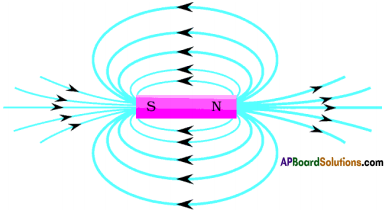
AP SSC 10th Class Physics Solutions Chapter 12 Electromagnetism 24

Procedure:

  1. Take a white drawing sheet.
  2. Place a marine compass at the centre of the sheet.
  3. Draw a line which shows north and south of the earth on the drawing sheet.
  4. Now remove the compass needle and place a bar magnet at the centre of the sheet showing north of the bar magnet pointing north of the earth.
  5. Place the magnetic compass near the bar magnet without contact. The needle comes to rest after oscillations.
  6. Locate the end of the pointer with pencil. Now place the compass needle at this point and once again notice the end of the pointer.
  7. We can repeat the same around the magnet, and draw all the points with the help of the pencil.
  8. We can draw the lines taking the needle too far to the magnet and we can observe the orientation of needle of compass.
  9. So we can conclude that the strength of field varies with distance from the bar magnet.
  10. These lines of force are from north of the bar magnet to south of the bar magnet.

Activity – 4

Question 3.
Explain the direction of magnetic field around the straight conductor carrying current.
(OR)
What field would be formed around straight conductor carrying current? How do you find the direction of that field experimentally?
Answer:
Magnetic field would be formed around current carrying conductor.
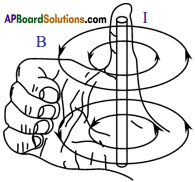
AP SSC 10th Class Physics Solutions Chapter 12 Electromagnetism 18AP SSC 10th Class Physics Solutions Chapter 12 Electromagnetism 25

Procedure:

  1. Take a wooden plank and make a hole and place il on the table.
  2. Place a stand on the plants, and suspend a c opper wire from the stand and see that it passes through the hole made to the plank.
  3. Connect a battery and switch to this wire in series. Place some magnetic needle at the hole.
  4. If the current is passed through the wire, the magnetic needle deflects and it is directed as the tangent to the circle
  5. If the current flows in downward direction, the field lines are in anti-clockwise direction and if the current flows in upward direction, the field lines are in clockwise direction.
  6. The direction ol the current and magnetic fines of force can be easily explained with the help of right hand thu mb rule. If you hold the current carrying conductor with your right hand grip stretching the thumb, the direction of the I humb shows the direction of the current, the direction of the other four fingers shows direction of magnetic lines of force.

Activity 5

Question 4.
Explain the direction of magnetic field due to circular coil.
Answer:
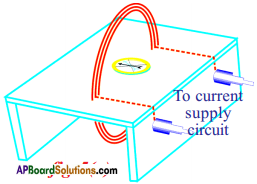
AP SSC 10th Class Physics Solutions Chapter 12 Electromagnetism 26 AP SSC 10th Class Physics Solutions Chapter 12 Electromagnetism 27
Procedure :

  1. Take a thin wooden plank and cover it with whitepaper.
  2. Make two holes to the plank and pass insulated copper wire through the holes and wind the wire 4 to 5 times through the holes such that it looks like a coil.
  3. The ends of the wire are connected to the battery terminals.
  4. Now place a compass needle at the centre of the coil.
  5. Put dots on either side of the compass. Repeat this by keeping at the dots. We can observe that field lines are circular.
  6. Here the direction of the field is perpendicular to the plane of the coil.
  7. The direction of the magnetic field due to coil points towards you when the current in the coil is in anti-clockwise direction.
  8. When you curl your right hand fingers in the direction of current, thumb gives the direction of magnetic field.

Activity – 6

Question 5.
Explain the magnetic field due to solenoid.
(OR)
What is the name given to the device which is a long wire wound in a close pack helix? Find the direction of magnetic field around that device.
Answer:
It is called solenoid.
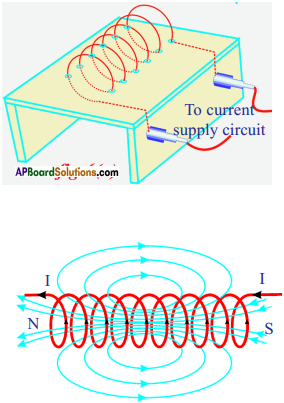
AP SSC 10th Class Physics Solutions Chapter 12 Electromagnetism 28
Procedure :

  1. Take a wooden plank covered with white paper.
  2. Make holes on its surface.
  3. Pass copper wire through the holes.
  4. Join the ends of the coil to a battery through a switch.
  5. Current passes through the coil, when we switch on the circuit.
  6. Now sprinkle iron filings on the surface of the plank, around the coil. Then orderly pattern of iron filings is seen on the paper.
  7. The iron filings arrange themselves in orderly way and look like lines of force.
  8. The long coil is known as solenoid. The direction of the field due to solenoid is determined by using right hand rule.
  9. One end of the solenoid behaves like a north pole and the other behaves like south pole.
  10. Outside the solenoid the direction of the field lines of force is from north to south while inside the direction is from south to north. Thus the magnetic field lines are closed loops.
  11. Hence electric charges in motion produce magnetic field.

Activity – 8

Question 6.
Explain the field lines due to horse-shoe magnet between its poles.
(OR)
Which field is set up between poles of a horse-shoe magnet? Explain the field lines due to horse magnet between its poles.
Answer:
Non-uniform magnet is set up between poles of a horse shoe magnet.
AP SSC 10th Class Physics Solutions Chapter 12 Electromagnetism 11

Procedure :

  1. The field in between north and south pole of horse-shoe magnet are straight and parallel.
  2. If the wire is passing perpendicular to the paper, the magnetic lines of force are concentric circles, when the current is passed.
  3. The direction of field lines due to the wire in upper part coincides with the direction of field lines of horse-shoe magnet.
  4. The direction of field lines by the wire in lower part is opposite to the direction of field lines of horse-shoe magnet.
  5. Hence the net field in upper part is strong and in the lower part is weak.
  6. Hence a non-uniform field is created around the wire.

Activity – 9

Question 7.
Explain electromagnetic induction.
(OR)
Which current will levitate the ring in the following figure? Explain the experimental activity.
Answer:
AC will levitate the ring.
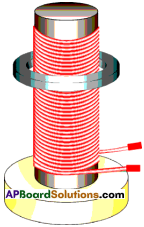
AP SSC 10th Class Physics Solutions Chapter 12 Electromagnetism 29

Procedure :

  1. Fix a soft iron cylinder on the wooden base vertically.
  2. Wind copper wme around the soft iron.
  3. Take a metal ring which is slightly greater in radius than the radius of soft iron cylinder and insert it through the soft iron cylinder.
  4. Connect the ends of the coil to an AC source and switch on the current.
  5. Here metal ring levitates on the coil (appears to rise and floats in the air).
  6. In this experiment we can conclude that if AC current is used, the magnetic induction changes in both magnitude and direction in the solenoid and in the ring. The field through the metal ring changes, so that flux linked with the metal ring changes.
  7. If DC current is used, the metal ring lifts up and falls down immediately.
 

AP Board 9th Class Biology Solutions Chapter 6 Sense Organs

AP State Syllabus AP Board 9th Class Biology Solutions Chapter 6 Sense Organs Textbook Questions and Answers.

AP State Syllabus 9th Class Biology Solutions 6th Lesson Sense Organs

9th Class Biology 6th Lesson Sense Organs Textbook Questions and Answers

Improve Your Learning

I. Give reasons for :

Question 1.
We usually do not see bright colours in dim light.
Answer:

  • Retina contains cells called rods and cones.
  • Nearly 125 million tiny rods are present In our eye which contain pigment ‘rhodopsin’.
  • Rods detect low intensity of light at night.
  • Rods cannot make the fine distinctions of bright colours in dim light.

AP Board 9th Class Biology Solutions Chapter 6 Sense Organs

Question 2.
Removal of wax layer too often will raise incidence of ear infection.
Answer:

  • External ear or pinna has wax producing ceruminous glands and oil producing sebaceous glands.
  • These glands help to keep the ear canal lubricated prevent the dust and other par¬ticles from entering into the ear canal called Auditory Meatus.
  • If we remove wax layer ear diseases like formation of pus, infection of eardrum etc. may be caused by bacterial and fungal infections.

Question 3.
During severe cough and cold we lose taste of food.
Answer:
When we suffering from severe cold and cough our nasal passages are completely blocked, food becomes tasteless as we are unable to smell the foods delicious aromas.

Question 4.
While cutting onions our tears start flowing.
Answer:

  • The cells of onion contains amino acids like mithionine and enzyme cystine. They are kept separate in the onion cell.
  • When we cut the onion, enzymes start mixing and produce propanethiol. Sulpher oxide, which is a volatile compound that starts moving towards our eyes.
  • The gas that is emitted reacts with the water of our eyes and forms sulphuric acid.
  • The sulphuric acid thus produced causes burning sensation in our eyes and this, in turn, leads to the tear glands secreting tears.
  • Thus we end up with watery eyes every time we cut onions at home.

II. Find out the false statements and rewrite them as correct ones.

1. The rationale behind seeing is just the impression of the image in the retina.
Answer:
True

2. Ear functions only to hear.
Answer:
False
Correct statement: Ear helps in hearing and also in maintaining the equilibrium of our body.

AP Board 9th Class Biology Solutions Chapter 6 Sense Organs

3. Iris patterns are like fingerprints used in identifying individuals.
Answer:
True.

4. Saliva helps the taste buds in taste sensation.
Answer:
False
Correct statement: Taste receptors help the taste buds in taste sensation.

5. We are not able to adapt to sensations.
Answer:
False
Correct statement: We are able to adapt to sensations.

III. State the differences between the two.

1. Rods and cones.
Answer:

Rods Cones
1) Rods are responsible for detecting the dim lights only with black and white. 1) Cones are responsible for detecting the bright lights with colour.
2) 125 million rods are present in retina. 2) Seven million cones are present in retina.
3) Rods contain the pigment rhodopsin. 3) Cones contain the pigment idopsin.
4) Defect in rods causes night blindness. 4) Defect in cones causes colour blindness.

2. Iris and pupil.
Answer:

 Iris Pupil
1) This is the coloured part of our eye around pupil. 1) It is the hole located in the centre of the eye.
2) The colour of the iris may be brown, blue, green or grey. 2) The colour of the pupil is black.
3) It does not dialate or contract according to the intensity of light. 3) It dialates or contracts according to the intensity of light.

3. Pinna and tympanum.
Answer:

Pinna Tympanum
1) It is also known as external ear. 1) It is also known as ear drum.
2) Pinna is the visible part of the ear on either side of our head. 2) It is present in between external and middle ear.
3) It is a flap (ring) like structure. 3) It is in the shape of a cone.
4) Pinna is made up of cartilage. 4) It is a thin membranous layer.
5) It collects the sound waves. 5) Sound waves strikes the tympanum and vibrates.
6) It is the first part of external ear. 6) It is the last part of the external ear.

4. Nasal cavity and ear canal.
Answer:

Nasal cavity Ear canal
1) It is the cavity present in external nostrils. 1) It is the canal in the external ear.
2) Nasal cavity opens into internal names. 2) At the end of ear canal ear drum is present.
3) It filters the air that entering into internal names. 3) It carries the sound waves from external ear to ear drum.

IV. How do the following processes occur?

Question 1.
When we see an object, a real inverted image is formed on the retina.
Answer:

  • When we see an object the eye gathers light through a convex lens, focusses it and forms an image in the retina at the back of the eye.
  • The lens turns the image left to right and upside down.

AP Board 9th Class Biology Solutions Chapter 6 Sense Organs

Question 2.
The sound waves, collected by the pinna are changed as vibrations.
Answer:

  • External ear or pinna collects the sound waves.
  • They enter into the auditory meatus or ear canal. Then they strike the tympanum.
  • The vibrations from the tympanum reach the malleus, incus and stapes in the middle ear.
  • They magnify the intensity of the sound vibrations and send them to the membrane of oval window in middle ear.

Question 3.
We move our hand away from a hot object.
Answer:

  • Moving our hand from a hot object is an unconditional reflex.
  • Unconditional reflexes are inherited and shown from birth.
  • Unconditional reflexes are present in all individuals and are basically same.

Question 4.
A pungent odour, makes us close our nose.
Answer:

  • The olfactory receptors sense pungent odour, that information is sent to brain in the form of nerve impulses through sensory nerve.
  • The brain interprets the information and identifies it as pungent odour.
  • It sends message to our hand to close the nose immediately.
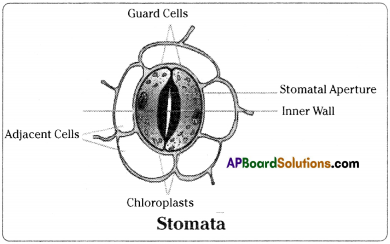
  • The brain also sends information in the form of nerve impulses through motor nerves as we are unable to smell the food’s delicious aromas.

V. Fill in the blanks with suitable words. Then give reasons why the words are suitable.

1. Choroid layer provides ………………… to the eye.
2. The relationship between the tongue and ……………………. is more.
3. Iris pattern is used for individual …………………… .
4. Area where optic nerve leaves the eye is called the ……………………..
5. The ear drum is the …………………….
Answer:

  1. Protection
  2. Nose
  3. Identification
  4. Blind spots
  5. Vibrating membrane

VI. Choose the correct option.

1. This vitamin is essential for the health of eye.
a) Vitamin ‘A’
b) Vitamin ‘B’
c) Vitamin ‘C’
d) Vitamin ‘D’
Answer:
a) Vitamin ‘A’

2. Sensation is a complex pathway involving
a) Sense organs
b) Sense organs and nerve impulses
c) Sense organs, nerve impulses, brain
d)Brain and nerve impulses
Answer:
c) Sense organs, nerve impulses, brain

AP Board 9th Class Biology Solutions Chapter 6 Sense Organs

3. The sound waves if not focused by external pinna and ear cannal will result in
a) Hearing several types of sound loudly
b) Not hearing anything
c) Slight hearing
d) Not being able to make out the type and origin of sound
Answer:
b) Not hearing anything

4. The muscles of the eyeball of a person becomes non functional, the invariable effect would be
a) The person fails to close eyes
b) Fails to move eye and see colours clearly
c) Feels pain in the eye
d) The nerves reaching the muscles become non-functional.
Answer:
b) Fails to move eye and see colours clearly

AP Board 9th Class Biology Solutions Chapter 6 Sense Organs

5. The tongue of a person is exposed to a high salty taste then:
a) The person learns to taste salty things better
b) Loves tasting salty things
c) Hates tasting salty things
d) Fails to taste a less salty thing just after the exposure.
Answer:
d) Fails to taste a less salty thing just after the exposure.

VII. Draw and label the diagrams, showing the structure of the
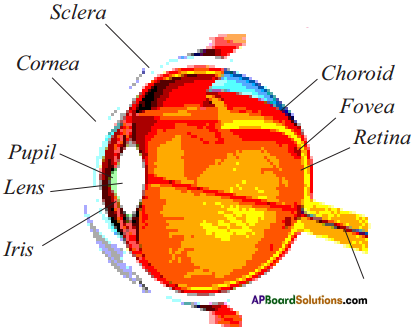
1. Eye
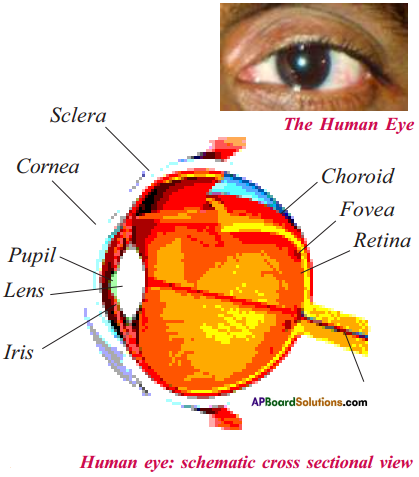
AP Board 9th Class Biology Solutions Chapter 6 Sense Organs 1
2. Ear
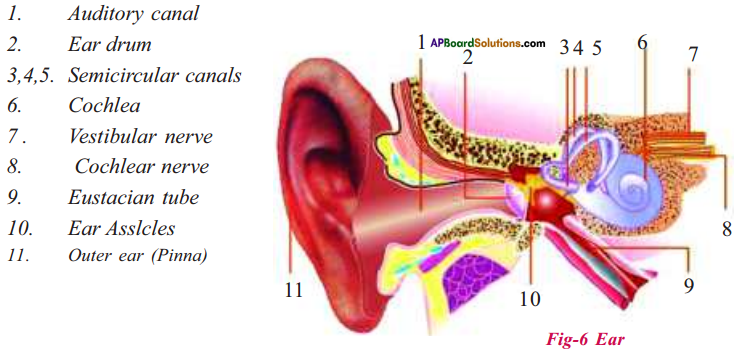
AP Board 9th Class Biology Solutions Chapter 6 Sense Organs 2

3. Tongue
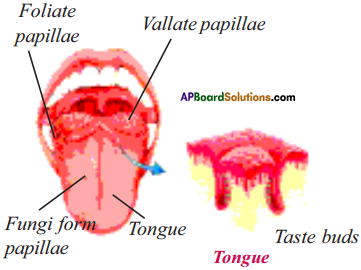
AP Board 9th Class Biology Solutions Chapter 6 Sense Organs 3

VIII. How would you pay concern towards disabled people who is lacking sensory organs?
Answer:

  • 1 will show utmost sympathy forwards disabled people who is lacking sensory organs.
  • I will give my full cooperation in leading normal lives.
  • With my deeds I will bring confidence among the disabled people.
  • If the disabled people are blind everyday I will show the way to school and from school to home.
  • I will see that the disabled people get the government help in a proper way.
  • I will give my support to deaf people by giving symbols and signals to understand things.
  • I will join the disabled people who are in the school age in the school mend for them.

IX. How do you appreciate the functions of sensory organs which helps us to enjoy the beauty of the nature?
Answer:

  • Sense organs help us to enjoy the beauty of the nature.
  • We enjoy the beauty of nature with our eyes, the melodious music with our ears, the taste of food with our tongue and feel the cool breeze on our skin.
  • All these situations show just how our senses pick up information and react to them.
  • Our sense organs are not just parts of us because nothing that we experience in our life, from the most important to the most boring, would be possible without the complicated power of our sense organs.
  • Nothing in the entire universe of scientific exploration can even come close to match-ing the ability of our brain to use information sensed by our eyes, ears, skin, tongue and nose to produce a rich sensory experience in a matter of milli seconds.

AP Board 9th Class Biology Solutions Chapter 6 Sense Organs

X. Form a group with five students in your class and collect eye diseases and its char-acteristics by talking with ophthalmic assistant.
Answer:

Eye disease or defect Characteristics
1. Age related macular degeneration It is an eye condition that leads to the deterioration of the centre of the retina called macula.
2. Astigmatism It is an imperfection in the curvature of retina.
3. Cataract It is the clouding of the eye lens causing vision problems.
4. Central retinal vein occlusion It is a blockage of the main vein in the retina.
5. Colour blindness Occurs when we are unable to see colours in a normal way.
6. Conjunctivitis It is the swelling of the conjunctiva, the eye becomes red, burning sensation in the eye, releases water.
7. Corneal transplant Scars, swelling or an irregular shape can cause the cornea to scatter or distart light resulting in glare or blurring vision.
8. Diabetic retinopathy It is a common diabetic eye disease caused by changes in retinal blood vessels.
9. Dry eye or Xeropthalmia It is a condition where the eyes do not produce enough tears or the right quality of tears to be healthy or comfortable and eye becomes dry.
10. Far sightedness (Hypermetropia) It is a refractive error, which means the eye does not bend or refract light properly. Images are formed behind the retina.
11. Glaucoma It is a disease that damages the eyes optic nerve. This leads to high pressure in the back of the eye.
12. Kerolitis It is a condition where the cornea be­comes swollen or inflamed, making the eye red and painful effecting vision.
13.Macular edema It is a swelling or thickening of the macula, the area of the retina responsible for central vision.
14. Near sightedness (Myopia) It is a refractive error, which means the eye does not bend or refract light properly. Image is formed in front of the retina.
15. Optic neuritis It is an inflammation of the eye’s optic nerve.
16. Retinopathy of prematurity Retinopathy of prematurity is an eye dis­ease that occur in a small percentage of premature babies where abnormal blood vessels grow on the retina.
17. Scleritis It is a painful swelling of the white part of the eye, which is also known as sclera.
18. Detached retina and Torn retina A torn retina is when the retina tears in one or more places. A detached retina is when the retina is lifted off the wall of the eye.
19. Night blindness Person suffering from night blindness cannot see things in dimlight or at nights.
20. Trachoma It is an eye infection affecting both eyes, is the world’s leading cause of prevent­able blindness. It is caused by a bacterium called Chlamydia Trachomatis.

XI. What happens if our skin loses its sensory nature?
Answer:

  • The skin contains numerous sensory receptors which receive information from the outside environment.
  • The sensory receptors of the skin are concerned with at least five different senses: pain, heat, cold, touch and pressure.
  • The five are usually grouped together as the single sense of touch in the classification of the five senses of the whole human body.
  • If the skin loss its sensory nature we cannot experience the pain, heat, cold, touch and pressure.

AP Board 9th Class Biology Solutions Chapter 6 Sense Organs

XII. Sagar is not able to listen things properly. Guess what would happen to him. What suggestions would you like to give him?
Answer:

  • Sagar may be exposed to too much loud noise. This condition is noise induced hearing loss.
  • Some times loud noise can cause a ringing, hissing or roaring sound in the ears called Tinnitus.
  • Hearing problems may also be caused by a virus or bacteria.
  • Hearing impairment happens when there is a problem with one or more partsflof the ear.
  • So, I suggests Sagar to identify the reason for not listening things properly.
  • I also advise him to consult a specialist called audiologist in ear problems.

9th Class Biology 6th Lesson Sense Organs InText Questions and Answers

9th Class Biology Textbook Page No. 76

Question 1.
Do you think our sense organs work together? Why, why not?
Answer:

  • Yes, our sense organs work together.
  • Every single function of the body is managed and controlled by the brain, including our organs and senses.
  • Otherwise, we would have different interpretations of a stimulus, resulting confusion.
  • But to be clear it is not the organs working together it is the brain constantly receiving stimuli from different senses.
  • The brain is responsible for assimilating information and filling the pieces together.

9th Class Biology Textbook Page No. 85

Question 2.
If we do not have our external ear what will happen to us?
Answer:

  • If we have no external ears, sound waves may not be collected by it.
  • So we cannot hear anything and it leads to deafness.

9th Class Biology Textbook Page No. 87

Question 3.
If you are suffering from cold do you smell things in the natural way?
Answer:

  • No, we cannot smell things in the natural way.
  • When we have cold, we will notice foods seem tasteless because your nasal pas¬sages are blocked.

AP Board 9th Class Biology Solutions Chapter 6 Sense Organs

Question 4.
Do you find any relation between smell and taste?
Answer:

  • Like smell, taste is also a sense based on identifying chemicals in food and the texture of it.
  • The sense of taste and smell have a close and cooperative working relationship.

9th Class Biology Textbook Page No. 90

Question 5.
How sensitive is our skin?
Answer:

  • Different parts of our body have different sensitivity and the skin around the neck and finger tips is more sensitive than skin on the palm, knee and arm.
  • This is because sensitivity of our skin depends on
    a) thickness of our skin.
    b) the number of sensory receptors.

9th Class Biology Textbook Page No. 82

Question 6.
What will happen if we have no eyelashes?
Answer:

  • The purpose of eyelashes is to keep moisture like sweat from setting into our eyes.
  • Eyelashes protect the eye from debris and they are sensitive to being touched.
  • If lashes are absent moisture like sweat will not be setting into our eyes.
  • There will not be protection from debris to our eyes.

AP Board 9th Class Biology Solutions Chapter 6 Sense Organs

Question 7.
Are tears good for us?
Answer:

  • Yes, tears are good for us.
  • Whenever unwanted substances come in contact with the conjunctiva the lachry¬mal glands are stimulated to produce tears to wash the substances out of the eye.

9th Class Biology Textbook Page No. 89

Question 8.
Why are we suggested not to take too cool or too hot food material?
Answer:
To cool or too hot food material causes damage the sense of smell. It also damage the taste buds. If we take too cool or too hot food materials we will loose sense of smell and taste.

AP Board 9th Class Biology Solutions Chapter 6 Sense Organs

Question 9.
If you are suffering from fever that time you are not able to enjoy the taste of food why?
Answer:

  • During fever, the temperature of our body increases from the normal body temperature of 98.6°F to high temperature sometimes to 105°F.
  • At this temperature, the function of the enzymes in our tastebuds stop since they can work efficiently only in the temperature range of 77 to 98.6°F.
  • The cells in the tastebuds cannot send messages to the nerve centres in the brain.
  • That is why during fever we are not able to enjoy the taste of food.

9th Class Biology 6th Lesson Sense Organs Activities

Activity – 1

Question 1.
Note down a few lines of any text in your book. Write about the stimuli and re¬sponses and the sensory and motor functions with respect to the sense organs in¬volved.
Answer:
(Stimuli from the environment around are received by our body through some sense organs. As we already know, they are the eyes, ears, nose, tongue and skin. Let’s try to understand the path of receiving a stimulus to expressing a response (sensation))

  1. The sense organs involved in writing the para above are eyes and skin.
  2. Asking to write few lines in textbook is stimulus and writing the lines is response.
  3. The sensory nerve in the eye take the information about writing lines to brain in the form of nerve impulses.
  4. The brain interprets the signals and send the message through motor nerves to write the lines.
  5. The skin in the palm helps to hold the pen in writing the lines.

Activity – 2

Question 2.
Testing tastes with tongue.
Answer:

  • Dissolve a pinch of sugar in a glass of water.
  • Drink a little of this. It doesn’t taste good.
  • Try this for different concentrations of sugar adding by proper quantification that is weighing and preparing solutions to find out taste.
  • You could take l/4th teaspoonful sugar each time which would be nearly 2 grams.
  • After adding three spoons of sugar the taste of water becomes sugary.

Activity – 3

Question 3.
1. Observe the external structure of your friend’s eye, draw the diagram and lable it.
Answer:
AP Board 9th Class Biology Solutions Chapter 6 Sense Organs 4

2. Observe the eye ball of your friend in normal light. Then focus a beam of torch light on youj^friend’s eye.
Answer:

  • Our eye contains eyelids, eyelashes, eyebrows and lachrymal glands.
  • In normal light my friend’s eye ball is normal as usual, but after focusing a beam of torch light he immediately closed his eyes.
  • After closing the eyes for two minutes, the black portion of eye is somewhat big in size.
  • After opening forcibly when we throw the beam of torch light, the size of the small dark portion decrease.
  • The small black portion in the centre of the eye expands in dark whereas in bright light it decreases in size.

Activity – 4

Question 4.
Testing the visual system.
Answer:

  • Hold the text at arm’s length, close your right eye, and fix your left eye straight on the figure.
    AP Board 9th Class Biology Solutions Chapter 6 Sense Organs 5
  • Keep your right eye closed and bring the book slowly closer.
  • When it is about 8 to 10 inches away the gap disappears as it is on the blind spot of your left eye.
  • But you will not see a ‘hole’ in your visual field.
  • Instead, your visual system “fills in” the missing area with information from the blue line on either side.

Activity – 5

Question 5.
Observe the iris and its surrounds of your friend’s eye. Can you find the pupil? Observe the colours and patterns in the iris of your friend’s eyes. Is there any difference from one another?
Answer:

  • I found pupil in my friend’s eye.
  • The colour of iris in my friend’s eyes are different.
  • The colour of iris are blue in some, green in some and grey or brown in some of my friend’s eyes.
  • The colour of iris are different but their shape is round in all my friend’s eyes.

Activity – 6

Question 6.
Enter into a dark room from a very bright place. What happens? Sit in a dark room for sometime. Then go into a bright light room. What happens?
Answer:

  • If we enter into a dark room from a very bright place first we cannot see anything in the room.
  • Because the pupil is very small in size and very less amount of light enters into the eyes.
  • As the time progresses the pupil becomes large in size and we will be able to see things properly.
  • If we go into a bright light room from a dark room, at first we cannot see anything in light from because the pupil does not bear the intensity of light.
  • The pupil gradually lessens its size and we are able to see things properly.

Activity – 7

Question 7.
Eye and illusions.
Answer:
AP Board 9th Class Biology Solutions Chapter 6 Sense Organs 6

  1. Take two pieces of white papers with same size.
  2. Draw the picture of a cage on one pa¬per and the parrot on the other.
  3. Then insert a stick and attach the blank sides of the papers with gum, see the figure.
  4. Let it dry then twist the stick rapidly.
  5. When we twist the stick rapidly, we see the parrot in the cage. What we are experi¬encing is an illusion.

Activity – 8

Question 8.
Testing of sound.
Answer:

  • Take a plastic or iron funnel.
  • Stretch a piece of rubber balloon and cover the wide part of the funnel with it.
  • Tie it with rubber band.
  • Ask your friend to shout ‘Oh’ at the narrow opening of the funnel.
  • Observe the movements of the rubber sheet while he is shouting.
  • Observe the rice grains also.

Observations:

  1. Due to the vibrations in the rubber balloon the rice grains move up and down when we shout ‘Oh’ at the narrow opening of the funnel.
  2. When we put the narrow end at the opening of our eye we hear the sound of heart as lub dub, lub dub …………….

Activity – 9

Question 9.
Touching test.
Answer:

  • Blindfold your friend and ask him/her to identify different things by smell like lemon, tea, coffee, potato, tomato, tamarind, spinach, curd, brinjal etc.
  • Keep as many things but be careful in choosing them.
  • They should not be in powdered form.
  • Don’t allow your friend to touch them.

Observations:

  1. Biologically, the sense of smell or olfaction, begins with chemical events in the nose.
  2. Their odours interact with receptor proteins associated with specialized nerve cells.
  3. These cells incidentally are the body’s only nerve cells that come in direct contact with the outside environment.
  4. Receptors present at the base of the skin lining the inner walls of the nose are highly sensitive to odour chemicals.
  5. These odour chemicals can be complex and varied.

Activity -10

Question 10.
Tongue test
Answer:

  • Close the eyes of your friend with a piece of cloth.
  • Give her/him a piece of ginger, garlic, tamarind, banana and jaggery one by one.
  • Ask her/him to taste by just taking these one at a time on the tongue.
  • Remember that your friend needs to rinse his/her mouth between each test.
  • Could your friend tell the taste by just putting the substances on the tongue? Yes, my friend told the taste.
  • Now repeat the above experiment by asking your friend to take a bite and press the food on the plate.
  • As food enters our mouth, we bite and chew it and press it against the palate with our tongue.
  • This releases chemicals in food that trigger off our taste buds to act and carry stimulus to the brain to be processed for recognition of taste.
  • The same taste bud is capable of producing different signals corresponding to the different chemicals in food.

Activity -11

Question 11.
Observe your tongue by standing in front of the mirror by sticking your tongue out. See how many different kinds of structures you can see on your tongue. Compare with the given diagram.
Answer:
AP Board 9th Class Biology Solutions Chapter 6 Sense Organs 3

  • We can clearly see flake like structures that are filiform papillae.
  • The roundish structures are fungi¬form papillae.
  • There are large roundish ones at the back of the tongue which are circumvallate papillae.
  • On the sides of the tongue, the bump like structures are foliate papillae.
  • Taste buds are present on all of these except the filiform papillae that are not the sites of taste sensation.

Activity -12

Question 12.
Smell test
Answer:

  • Blindfold your friend and ask him/her to close his or her nose as well.
  • Give a few cumin seeds to your friend and ask him/her to chew.
  • Ask your friend to identify what you have gave.
  • You could try this with a small piece of potato as well.
  • My friend has identified the cumin seeds and piece of potato.

Activity – 13

Question 13.
1) Make bundles of three toothpicks.
2) See to it that their pointed ends are at the same level.
3) Now ask your friend to make an outline of one of her/his palm.
4) Ask your friend to close her/his eyes. Now starting from the tip of the thumb keep pricking lightly with your toothpick bundle all over the plam.
5) Ask your friend how many points she/he could identify each time.
6) Repeat this with some of your friends.
Answer the following questions.
a) Where do you find maximum sensation on the palm?
Answer:
In the centre of the palm we find maximum sensation.

b) Where do you find minimum sensation?
Answer:
We find minimum sensation on the beginning of the palm.

c) Are palm sense patterns same for all your friends?
Answer:
Yes, palm sense patterns are same.

Activity – 14

Question 14.
Press your thumb gently on the tip of a sharpened pencil. Later press it on the blunt end of the pencil. How do you feel? Why?
Answer:

  • When we press our thumb gently on the tip of a sharpened pencil it makes us feel pain.
  • The sensory receptors sense the sharpened pencil’s press and the message is sent to brain through sensory nerve.
  • Then the brain interprets the message and sends signals to feel pain through motor nerves.
  • When we press our thumb with the blunt end of the pencil we do not feel pain because the sensory receptors (touch receptors) sends the message to brain through sensory nerve.
  • Brain interprets the message and sends signals to our thumb to feel soft through motor nerves.


AP Board 9th Class Biology Solutions Chapter 10 Soil Pollution

AP State Syllabus AP Board 9th Class Biology Solutions Chapter 10 Soil Pollution Textbook Questions and Answers.

AP State Syllabus 9th Class Biology Solutions 10th Lesson Soil Pollution

9th Class Biology 10th Lesson Soil Pollution Textbook Questions and Answers

Improve Your Learning

Question 1.
Define soil pollution. (AS 1)
Answer:
Soil or land pollution can be defined as the buildup in soils of persistent toxic compounds, chemicals, salts, radioactive materials, or disease causing agents, which have adverse effects on plant growth and animal health.

Question 2.
Why are plastic bags a big environmental nuisance? (AS 6)
Answer:

  • Plastics are so versatile in use that their impact on environment are extremely wide ranging.
  • Careless disposal of plastic bags chokes drains, blocks the porosity of the soil, and causes problems for ground water recharge.
  • Plastic disturbs the soil microbe activity, and once ingested can kill animals.
  • Plastic bags can also contaminate food stuffs due to leaching of toxic dyes and transfer of pathogens.
  • Plastic bags remains strewn on the ground, or in unmanaged garbage dumps.
  • Though small percentage lies strewn, it is this portion that is of concern as it causes extensive damage to the environment.

Question 3.
Describe an environmental friendly method to profitably dispose of human waste and cattle waste. (AS 1)
Answer:

  • In recent years, an alternate and better method is used to obtain energy from not only from cattle waste but also from human waste.
  • This is by anaerobic fermentation of the wastes to produce a gas which can be used as fuel.
  • As this gas is produced from biological waste, this is called biogas.
  • Biogas is a mixture of several gases : methane, carbondioxide, and small amounts of hydrogen, nitrogen, and hydrogen sulphide.

AP Board 9th Class Biology Solutions Chapter 10 Soil Pollution

Question 4.
Chemical fertilizers are useful to crops. In which way they cause environmental pollution? (AS 1)
(OR)
We often read in newspapers that environmentalists often show deep concern of threats posed by chemical fertilisers and pesticides, etc. What are those threats to environment?
Answer:

  • Fertilisers contaminate the soil with impurities, which come from the raw materials used for their manufacture.
  • Due to excessive use of phosphate fertilizers soil becomes an indestructible poison for crops.
  • Excessive use of fertilizers can endup polluting lakes, rivers and streams.
  • This leads to promote the growth of algae in water bodies and is called eutropication.
  • This abundant uncontrolled growth of plants blocks the flow of water and reduces oxygen content in the water.
  • Other organisms living in the water do not get sufficient water, oxygen and ultimately die.
  • Nitrogen fertilizer contribute to air pollution when it enters the atmosphere as ammonia and nitrogen oxide.
  • This inturn cause acid rain and city smog associated health and environmental problems such as respiratory illness.

Question 5.
What steps can be taken to reduce pollution due to particulate matter from industries?
Answer:

  • Industrial wastes can be treated physically, chemically and biologically until they are less hazardous.
  • Acidic and alkaline wastes should be first neutralized; the insoluble material if biodegradable should be allowed to degrade under controlled conditions before being disposed.
  • Electrostatic precipitators are used to reduce the particulate matter in the factory smoke.

Question 6.
What is a medical waste? Why it is called hazardous waste? What is the safe way to dispose medical waste? (AS 1)
Answer:

  • Waste that is produced from hospitals is known as medical waste.
  • Medical waste include needles, syringes, saline bottles, instruments used in surgeries, bandages soaked with blood and pus, used medicines, human excreta etc.
  • Medical waste is called as hazardous waste because it containing toxic substances.
  • Burying the medical waste in locations situated away from residential areas is the simplest method to dispose medical waste.

Question 7.
Prepare a flow chart to describe soil pollution, causes and methods of control. (AS 5)
(OR)
Prepare a pamphlet of your own to create awareness on soil pollution among the people in your area.
Answer:
AP Board 9th Class Biology Solutions Chapter 10 Soil Pollution 2

Question 8.
What soil problems do you find in your area? Prepare a list of those problems and suggest a method for each of them to control those problems. (AS 7)
Answer:
The soil problems identified by me in our area :
AP Board 9th Class Biology Solutions Chapter 10 Soil Pollution 5

Question 9.
What farm practices impact soil? Do they impact soil in a positive or a negative way?
Answer:

  • Indiscriminate use of fertilizers, pesticides, insecticides, herbicides, no-till farming and growing same crop in all seasons are the farm practices impact soil.
  • These farm practices may show positive or negative impact on the soil.
  • By using chemical fertilizers we can get high yielding for only 20 to 30 years.
  • After that soil becomes reluctant to plant growth. These chemicals damage fertility.
  • Due to the extensive use of pesticides, insecticides, herbicides the salinity of the soil increases and it is not suitable for growing crops.
  • Notill farming is a way of growing crops without disturbing the soil through tillage.
  • Tillage activity can lead to compaction of soil, loss of organic matter in soil, loss of native vegetation, and death of the organisms in the soil.
  • Growing the same crop in all seasons decreases the fertility.

AP Board 9th Class Biology Solutions Chapter 10 Soil Pollution

Question 10.
Rank the negative impact practices in your area in the order in which you think they should be eliminated. (AS 1)
Answer:
Negative impact practices in our area :

  1. Using chemical fertilizers
  2. Using pesticides
  3. Using insecticides
  4. Using herbicides
  5. Till farming
  6. Deforestation
  7. Using weedicides
  8. Growing same crop in all seasons
  9. Using locally prepared seeds

Question 11.
Rank the positive impact practices in order in which you think they should be used for the most benefit on your farm. (AS 1)
Answer:

  1. Hybridised seeds
  2. Organic manures
  3. Organic weedicides
  4. Predatory insects
  5. No-till farming
  6. Maintaining suitable pH value
  7. Crop rotation
  8. Salinity management
  9. Soil organisms

Question 12.
Ravi said soil health is important. How can you support him? (AS 7)
Answer:

  1. I support Ravi’s statement.
  2. Healthy soil is fundamental to the quality of food it produces and to the health of those who eat the food produced from it.
  3. When the soil components are present in appropriate percentage, the productivity is high.

Question 13.
How would soil texture affect the nutrients in soil? What would be its impact on crop production? (AS 2)
Answer:

  • Soil with loose pores will allow water to collect and roots to expand. Loose soil is better than hard compact soil.
  • Finer particles like clay increase surface area of the soil which allow nutrients to stay in the soil.
  • Very porous soil, such as sand will allow nutrients to be leached more easily which can make less nutrients available to plants.
  • Generally, a loose, airy soil structure is best for most plants.
  • This can be accomplished by digging the bed and mixing together coarse and finer textures such as tilling compost into clay soil.

AP Board 9th Class Biology Solutions Chapter 10 Soil Pollution

Question 14.
What are the three main physical properties of soil? What effects do this have on the plants? (AS 1)
Answer:

  1. Colour texture, structure and porosity are the three main physical properties of soil.
  2. These properties regulate and affect air and water movement in the soil and thus, soil ability to function.

Question 15.
What is pH? What is its range? What are the negative impacts if the pH of soil is too low or too high? (AS 1)
Answer:

  1. The term pH is used to indicate the level of acidity or alkalinity of a soil.
  2. The range of pH values of a good soil live from 5.5 to 7.5.
  3. Below pH 7 the soils are termed as acidic and above pH 7 alkaline.

Negative impacts of low pH value :

  1. The concentration of soluble metals especially aluminium and manganese may be toxic.
  2. Calcium may be deficient.
  3. Soil organisms responsible to transform N, S and P to plant available forms may be reduced.
  4. Symbiotic nitrogen fixation in legume crops is greatly impaired.
  5. Soils will be having low organic matter.
  6. The availability of mineral elements to plants may be effected.

Negative impacts of high pH value :

  1. If the pH is beyond 7, nutrient absorption and microbial activity will be affected which can be poisonous to plants.
  2. pH extremes are unhealthy for most plants because they close or open membranes of plant cells too much.
  3. This affects plant structure and their ability to uptake nutrients.
  4. pH extremes make minerals and nutrients either too available or not available enough.

Question 16.
What is soil fertility? What are the sources of soil fertility? (AS 1)
Answer:

  • Fertility of soil is closely associated with the properties of soil and is defined by its capacity to hold water and nutrients and supply them to plants when they need them, independent of direct application of nutrients.
  • Soil organisms contribute to buildup soil organic matter, including humus, the soils most important nutrient reservoir.
  • A major part of the soil microbial biomass is composed of fungi.
  • Soil fertility is a complex process that involves the constant cycling of nutrients between organic and inorganic forms.
  • As plant material and animal wastes decompose they release nutrients to the soil solution.
  • Soil pH, its acidity or alkalinity is highly relevant to how readily nutrients become available in the soil.

AP Board 9th Class Biology Solutions Chapter 10 Soil Pollution

Question 17.
Name 5 living things that live in soil. What do these things do to affect the soil?
Answer:

  1. Viruses, earthworms, rats, ground squirrels, bacteria, fungi, algae, protozoa, dung beetle and different types of worms live in the soil.
  2. These organisms feed on plant residues burrow the soil and help in aeration and percolation of water.
  3. Soild microbes convert organic forms of elements to their inorganic forms.
  4. Soil bacteria also control the forms of ions in which these nutrients occurs.

Question 18.
What is organic matter? Why it is important to plants? (AS 1)
Answer:

  • Organic matter is the organic component of soil which includes the residues of dead plants and animals.
  • Organic matter consists of nutrients necessary for plant growth such as nitrogen, phosphorus, and potassium.
  • Soils which contain 30% or more organic matter are considered organic soil, all other soils are identified as mineral soils.
  • Organic matter in soil improves water in filteration, decreases evaporation, and increases the water holding capacity.
  • And also where there is organic matter, there will be numerous organisms present helping to convert it back to nutrients and these organisms help to create small pieces of nutrients, ideal for cultivation.

Question 19.
What are the factors affecting organic matter levels in soil? How this level of organic matter can be increased? (AS 1)
Answer:
1. Temperature, rainfall, natural vegetation, texture, drainage, cropping and tillage and crop rotation are the factors affecting organic matter levels in soil.

2. Temperature :
The decomposition of organic matter is accelerated in warm climates as compared to cooler climates.

3. For each 10°C decline in mean annual temperature the total organic matter and nutrients increases by two to three times.

4. Rainfall:
There is an increase in organic matter with an increase in rainfall.

5. Natural vegetation :
The total organic matter is higher in soils developed under grasslands than those under forests.

6. Texture :
Fine textured soils are generally higher in organic matter than coarse textured soils.

7. Drainage:
Poorly drained soils because of their high moisture content and relatively poor aeration are much higher in organic matter and nutrients than well drained soils.

8. Cropping and Tillage :
The cropped lands have much low nutrients and organic matter than comparable virgin soils.

9. Crop rotation :
Crop rotation of cereals with legumes results in higher soil organic matter.

AP Board 9th Class Biology Solutions Chapter 10 Soil Pollution

Question 20.
What is solid waste? Explain best practices for solid waste management. (AS 1)
Answer:
Solid waste:
Solid waste may be defined as the organic and inorganic waste produced by various activities of the society which have lost their value to the first user.

Best practices for solid waste management:

  1. By practicising four R’s : Reduce, Reuse, Recycle and Recover we would get less solid waste.
  2. Materials such as glass containers, plastic bags, paper, cloth, etc., can be reused at domestic levels rather than being disposed, reducing solid waste pollution.
  3. Solid waste management involves activities including collection, transfer, and transport to suitable sites and safe disposal of wastes by methods which are environmentally friendly methods.
  4. Burying the waste in locations situated away from residential areas is the simplest and most widely used technique of solid waste management.
  5. Solid waste management can also be done by methods such as sanitary landfill, composting and incineration, etc.

Question 21.
What is bioremediation? How it helps in controlling soil pollution? (AS 1)
Answer:
AP Board 9th Class Biology Solutions Chapter 10 Soil Pollution 1

  1. Bioremediation means to use a biological remedy to reduce or clean up contamination.
  2. Microbes are often used to remedy environ¬mental problems found in soil, water and sediments.
  3. Plants have also been used to assist bio¬remediation processes. This is called phytoremediation.
  4. Biological processes have been used for some inorganic materials, like metals to lower radioactivity and to remediate organic contaminants.

AP Board 9th Class Biology Solutions Chapter 10 Soil Pollution

Question 22.
Why soil conservation is important to us? What will happen if no preventive measures would be taken? (AS 2)
Answer:

  • Soil conservation is important to us because it forms the basis for habitats and plants, which act as source of food to both humans and animals.
  • Soil conservation is also important because with the erosion of the top soil layer, valuable nutrients are lost and crop yield diminish, which means very less food is produced per acre.
  • We have to conserve soil because it has organic material that is good for plant growth.
  • If no preventive measures are taken for soil conservation, soil erosion takes place.
  • And also soil will be over used and it has more chemicals leading to unproductive soil.
  • Amount of nutrients present in the soil decreases.

Question 23.
Look at the following symbol, what does it mean?
AP Board 9th Class Biology Solutions Chapter 10 Soil Pollution 6
Answer:
1. It is the symbol of bioremediation.
2. Plants have been used to assist bioremediation.

9th Class Biology 10th Lesson Soil Pollution InText Questions and Answers

9th Class Biology Textbook Page No. 155

Question 1.
Today what are the pollutants produced from your school. How many of these are non-degradables?
Answer:
Wastes produced from our school :
Peels of fruits, vegetables, rice, glass materials, pens, polythene bags, biscuit and chocolate covers, icecream sticks, rubber, plastic tea glasses, paper leaves twigs etc.

Non-degradable pollutants :
Glass materials, pens, polythene bags, biscuit and chocolate wrappers, rubber, plastic glasses.

9th Class Biology 10th Lesson Soil Pollution Activities

Activity – 1

Question 1.
Answer:
1. During interval time Venu was eating a fruit.
2. He was about to throw the peel in corner of verandah.
3. His friend Ramu stopped him.
4. Ramu said you should not throw waste in the verandah. Drop it in the bin/basket given.
5. Prepare a list of waste materials we throw out in a day from morning to evening.
6. Classifying them as wet wastes and dry wastes with the help of the example given in the table.

Wet waste Dry waste
Vegetable peels Biscuit wrapper
Banana peels Polythene covers
Food materials Used papers
Fruit peels Plastic materials
Dung Glass materials
Hay Card board

7. Weigh the wet wastes, which you have listed in the table for one day.
8. Divide the weight by number of people in your home.
9. The result will be the per capita wet waste we are producing in one day.
10. Suppose if a family containing four members throws 400 gms of wet wastes per day,

AP Board 9th Class Biology Solutions Chapter 10 Soil Pollution 3
Multiply it by 30 = 100 × 30 = 3000 gms per month
Multiply it by 365 = 3000 × 365 = 10,95,000 gms = 1095 kgs per year.

Activity – 2

Question 2.
Dumping and decomposing,
Answer:
1. Take a polythene bag / plastic bucket / or any container.
2. Fill half of it with soil.
3. Keep wet wastes and other wastes in it.
4. Wastes should include vegetable peels, rubber, plastic etc.
5. Add some more soil and sprinkle water regularly on it.
6. Dig it and observe in 15 days intervals.
7. Note your observations in the table.
AP Board 9th Class Biology Solutions Chapter 10 Soil Pollution 4

AP Board 9th Class Biology Important Questions Chapter 1 Cell its Structure and Functions

AP State Syllabus AP Board 9th Class Biology Important Questions Chapter 1 Cell its Structure and Functions.

AP State Syllabus 9th Class Biology Important Questions 1st Lesson Cell its Structure and Functions

9th Class Biology 1st Lesson Cell its Structure and Functions 1 Mark Important Questions and Answers

Question 1.
What are the cell organelles present in a cell?
Answer:
The cell organelles present in a cell are endoplasmic reticulum, golgi apparatus, lysosomes, mitochondria, ribosomes, plastids and vacuoles.

Question 2.
What is the role played by cell wall in plant cells?
Answer:

  • Cell wall excretes and inward wall pressure to resists the outward directed pres¬sure exerted by cell sap.
  • So, the plant cells can withstand much greater changes in surrounding medium than animal cells.

Question 3.
What is cell theory?
Answer:

  • Cell theory was proposed by Schleiden and Schwann.
  • All living organisms are composed of cells and product of cell.
  • All cells arise from pre-existing cells.

AP Board 9th Class Biology Important Questions Chapter 1 Cell its Structure and Functions Important Questions

Question 4.
Write one precaution while observing nucleus in cheek cells.
Answer:

  • Do not scrap the cheek too hard as it may injure the buccal mucosa.
  • Excess stain should be drained off.

Question 5.
Name the colourless plastids in plants.
Answer:
Leucoplasts

Question 6.
Write the name of the plastids that are responsible for different colours in flowers and fruits.
Answer:
Chromoplasts

AP Board 9th Class Biology Important Questions Chapter 1 Cell its Structure and Functions Important Questions

Question 7.
Mention the cell organell that is called “Protein factories”.
Answer:
Ribosomes

Question 8.
Name the cell organell that is known as “suicidal bags of the cell”.
Answer:
Lysosomes.

Question 9.
Write the main function of Smooth Endoplasmic Reticulum.
Answer:
The SER helps in the manufacture of fat molecules or lipids important for cell function.

Question 10.
What happens if Endoplasmic reticulum is destroyed in the cell?
Answer:
The transportation of substances from one part to another part of the cell will not occur.

Question 11.
What is the site of protein synthesis in the cell?
Answer:
Ribosomes

Question 12.
Write some examples for prokaryotic cells.
Answer:
Bacterium, Cyanobacteria and Blue green algae are examples for prokaryotic cells.

Question 13.
Write the unique feature seen in plant cells.
Answer:
Presence of cell wall is the unique feature seen in plant cells.

AP Board 9th Class Biology Important Questions Chapter 1 Cell its Structure and Functions Important Questions

Question 14.
Name the selectively permeable membrane that covers the cell.
Answer:
Plasma membrane

Question 15.
What is an enzyme?
Answer:
An organic catalyst which catalyses a reaction within a cell.

Question 16.
Who coined the term ’Cytoblast’ and why?
Answer:
Schleiden called the nucleus as cytoblast, because he thought that new cells were created from the nucleus.

Question 17.
What is the site of cellular respiration?
Answer:
Mitochondria

Question 18.
What are vacuoles and write their function.
Answer:
Vacuoles are the fluid filled sac like structures present in the cytoplasm. They store solid or liquid contents.

9th Class Biology 1st Lesson Cell its Structure and Functions 2 Marks Important Questions and Answers

Question 1.
What is the difference between protoplasm and cytoplasm?
Answer:

  • There is a fluid present inside the cell.
  • For a long time it was believed that the essence of life was stored in the fluid.
  • Hence the fluid was named as protoplasm, which means life fluid.
  • When it became clear that the fluid is basically a medium in which various particles and membranes float, protoplasm was renamed as cytoplasm.

Question 2.
Take one grape fruit and place it in salt solution, Note the observations.
Answer:

  • I take one grape fruit and placed it in salt solution.
  • After sometime I observed that the fruit shrunk.
  • This is because of loss of water inside the fruit, it comes out into salt solution.
  • During this, the process of osmosis takes place.

Question 3.
Collect some parts of plants like, orange, beetroot, raddish, drumsticks, lady’s fin-ger, Jasmine, etc. and put a tick mark if you find the listed plastids present in them.
Answer:
AP Board 9th Class Biology Important Questions Chapter 1 Cell its Structure and Functions Important Questions 1

Question 4.
Why animals depend upon plants for food?
Answer:

  • Animal cells do not have chloroplasts.
  • Chloroplast trap the energy from sunlight.
  • It converts solar energy to chemical energy which takes place during photosynthesis.
  • During the process of photosynthesis food materials are formed.
  • Due to lack of chloroplasts animals are unable to prepare their own food.
  • So, animals depend on plants for food.

Question 5.

Cell organelle Function
Nucleus Nucleus regulates and controls all the functions of a cell and determines the characteristics of the organism.
Endoplasmic reticulum 1. It serve as channels for the transport of materials within the cell.
2. It also functions as a cytoplasmic framework for various biochemical activities.
Golgi Apparatus It package various substances. Proteins are altered slightly by golgi apparatus.
Lysosomes It participates in intracellular digestion. It destroys the cell contents.
Mitochondria It produces energy through cellular respiration.
Plastids These are responsible for the colour of the plant cell.
A. Chloroplasts These trap solar energy and convert this to chemical energy during photosynthesis.
B. Chromoplasts These are responsible for the coloured fruits, flowers.
C. Leucoplasts These are colourless, stores carbohydrates, oils and proteins.

Study the table and answer the questions.
1) Name the cell structure that helps in photosynthesis.
2) Name the cell organell that participates in intercellular digestion.
Answer:

  1. Chloroplasts
  2. Lysosomes

Question 6.
What happens if stomata are closed with paraffin wax?
Answer:

  • Stomata helps in exchange of gases in leaf.
  • If the stomata are closed with paraffin wax gaseous exchange will not takes place.

AP Board 9th Class Biology Important Questions Chapter 1 Cell its Structure and Functions Important Questions

Question 7.
What questions do you pose to know more details about plasma membrane?
Answer:

  1. How can you say that plasma membrane is also known as selectively permeable membrane?
  2. Name the substances that can pass through the plasma membrane.
  3. Give examples for selectively permeable membrane.

Question 8.
Write the main function of the cell wall.
Answer:

  • The cell wall is tough but flexible porous layer that gives a definite shape to the cell.
  • It provides protection to the cell from the external shocks.

Question 9.
Venu is asking his teacher about different functions of cell organells of Eukaryotic cell. What questions he would ask to his teacher ?
Answer:

  1. Prokaryotic cells devoid of nucleus . Why?
  2. Are the cell organells of same size in all the higher animals?
  3. Why lysosomes are called suicidal bags of the cell?
  4. What happens if cell wall is not present in plant cell?

Question 10.
Write about plastids.
Answer:

  • Plastids are present only in plant cells.
  • Plastids mainly of two types. 1. Chromoplasts (coloured) and leucoplasts (colourless).
  • Chloroplasts are the type of chromoplasts present only in plants.
  • The primary function of a chloroplast is to trap the energy of sunlight and transform it to chemical energy thus helping to carryout photosynthesis.
  • Chromoplasts are responsible for having various colours of fruits, flowers and leaves.
  • Leucoplasts are used to store starch, oil and proteins.

AP Board 9th Class Biology Important Questions Chapter 1 Cell its Structure and Functions Important Questions

Question 11.
Write differences between plasma membrane and cell wall.
Answer:

Plasma membrane Cell wall
1. Made up of lipid and proteins. 1. Made up of cellulose.
2. It is Living. 2. It is Dead.
3. Present in both plant and animal cell. 3. Found exclusively in plant cells.

Question 12.
What is the reason for colour change in tomatoes? (green – white – yellow – red)
Answer:
1) Plastids are responsible for colour change in tomatoes.

2) Plastids are of three types :
1. Chromoplasts (coloured)
2. Leucoplasts (colourless)
3. Chloroplasts (green)

3) All the three plastids have the capacity to change from one to another.

4) As the young tomatoes mature we see green, white, yellow and red coloured tomatoes.

Question 13.
Draw a neat and labelled diagram of nucleus.
Answer:
AP Board 9th Class Biology Important Questions Chapter 1 Cell its Structure and Functions Important Questions 2

Question 14.
Draw a neat and labelled diagram showing L.S of mitochondria.
Answer:
AP Board 9th Class Biology Important Questions Chapter 1 Cell its Structure and Functions Important Questions 3

Question 15.
Draw a neat and labelled diagram showing the structure of chloroplast.
Answer:
AP Board 9th Class Biology Important Questions Chapter 1 Cell its Structure and Functions Important Questions 4

Question 16.
Draw a neat and labelled diagram of Endoplasmic Reticulum find in electron microscope.
Answer:
AP Board 9th Class Biology Important Questions Chapter 1 Cell its Structure and Functions Important Questions 5

Question 17.
What is the function of a nucleus in a cell?
Answer:

  • The nucleus plays a vital role in the cell.
  • It controls all functions of the cell. It controls cell division.
  • Nucleus contains chromosomes. These chromosomes contain DNA and proteins.

Question 18.
“Cell is the structural and functional unit of life” – How?
Answer:
a) A cell is capable of independently carrying out all necessary activities of life,
b) Hence, it is called the structural and functional unit of life.

Question 19.
What is Protoplasm? Who coined this term and when?
Answer:
a) The living fluid substance of the cell is called “Protoplasm”
b) Purkinje in 1839 coined the term protoplasm.

AP Board 9th Class Biology Important Questions Chapter 1 Cell its Structure and Functions Important Questions

Question 20.
Name the smallest and largest known cells in this world?
Answer:
a) The smallest known cells is pneumonea cell. It is about 0.1 m in diameter.
b) An Ostrich egg cell is the largest known cell. It is 170 x 135 mm approximately.
Question 21.
What will happen to the size of the cell if it is placed in such solutions which vary in their concentrations.
a) When placed in Hypotonic solution?
b) When placed in Isotonic solution?
Answer:

  • When a cell is placed in Hypotonic solution (dilute solution), water enters into the cell. Hence the cell swells up.
  • When a cell is placed in Isotonic solution (same concentration), there is no movement of water. Hence the cell will stay the same size.

Question 22.
“A cell is a building unit of an organism”. Do you agree with this statement? If yes, explain why.
Answer:

  • I agree with the above statement.
  • A cell is a building unit of an organism because it is responsible for building the entire body of an organism.

Question 23.
What is Osmosis?
Answer:
Osmosis is the passage of water or any solvent from a region of its lower concentration to a higher concentration through a semi permeable membrane.

Question 24.
What are genes? What is their function?
Answer:
Genes are the segments of DNA present on the chromosomes. These are the hereditary units which are transmitted from one generation to another by chromosomes.

9th Class Biology 1st Lesson Cell its Structure and Functions 4 Marks Important Questions and Answers

Question 1.
Write a short note on the Golgi apparatus.
Answer:
AP Board 9th Class Biology Important Questions Chapter 1 Cell its Structure and Functions Important Questions 6

  • Camillo Golgi first observed the golgi bodies in 1898.
  • This is made up of several membranes.
  • These membranes create sac-like structure around which many fluid-filled vesicles abound.
  • The proteins and other substances produced in the ribosomes reaches the golgi body through these vesicles.
  • This organelle package various substances before Ciste they are transported to other parts of the cell. _
  • The number of golgi bodies varies from cell to cell. Golgi apparatus
  • They are large in number in those cells that secrete hormones and enzymes.

Question 2.
Write about mitochondria.
Answer:
AP Board 9th Class Biology Important Questions Chapter 1 Cell its Structure and Functions Important Questions 3

  • Mitochondria are small, spherical or cylindrical in shape.
  • They are 2-8 micron long and about 0.5 micron wide.
  • It is about 150 times smaller than the nucleus.
  • 100 – 150 are present in each cell.
  • They are made of a double-membrane
  • The inner membrane of the wall protrudes into the interior in folds and forms cristae.
  • The space between cristae is known as the matrix.
  • They are responsible for cellular respiration.
  • Energy generated and stored in mitochondria.
  • Hence they are also called as cell’s power house.

Question 3.
Write a note on Cytoskeleton.
Answer:
AP Board 9th Class Biology Important Questions Chapter 1 Cell its Structure and Functions Important Questions 5

  • Endoplasmic Reticulum (ER) is one of the important cell organelle.
  • It extends all over the cell, so it is also called as cytoskeleton.
  • It is responsible for the transport of substances from one part of the cell to another.

AP Board 9th Class Biology Important Questions Chapter 1 Cell its Structure and Functions Important Questions 11

  • RER has ribosomes on its surface which are caused for protein manufacture.
  • The SER helps in the manufacture of fat molecules.
  • Invertebrate liver cells SER plays a crucial role in detoxifying many poisons and drugs.

Question 4.
How could you appreaciate the function of nucleus in a cell?
Answer:

  • Nucleus is the most prominent one of all cell organelles.
  • This is also known as cell’s control room.
  • It was named by Robert Brown in 1831.
  • All cells have nucleus except a few cells.
  • In mammal red blood cells and phloem sieve tube in plants nucleus is absent.
  • It regulates and controls all the functions of the cell.
  • It determines the characteristics of the organism.
  • It is the barrier of all genetic information.
  • It involved in the process of cell division.
  • If there is no nucleus in the cell, growth of organism not takes place.

AP Board 9th Class Biology Important Questions Chapter 1 Cell its Structure and Functions Important Questions

Question 5.
Draw the diagram of nucleus and label it.
Answer:
AP Board 9th Class Biology Important Questions Chapter 1 Cell its Structure and Functions Important Questions 2

Question 6.
Why the colouring fruits or vegetables changes? Support your answer.
Answer:

  • In plants plastids are responsible for the colouring of fruits and vegetables.
  • There are 3 types of plastids present in plants.
  • Chloroplasts are responsible for green colour.
  • Chromoplasts are responsible for different colours, i.e., orange, yellow, red etc.
  • Leucoplasts are responsible for white colour.
  • These plastids have the capacity to change from one form to another.
  • E.g. : Young tomatoes are white in colour as they mature they turn to green and then to red in colour.

Question 7.
In what way different colours in flowers helpful to bio-diversity?
Answer:

  • We can easily identify their species at a glance.
  • By having different colours plants attracts insects for pollination, for their propagation.
  • By having different colours plants appeal to the aesthetic sense of man, immense pleasure and happiness.
  • This is useful in the propagation of plants by the human beings.
  • Generally butterflies are known as the pollinators, but in fact they are the indicators of the health of an ecosystem.

Question 8.
Describe endoplasmic reticulum.
Answer:
AP Board 9th Class Biology Important Questions Chapter 1 Cell its Structure and Functions Important Questions 5

  • The network or membranes present in the cytoplasm for the transport of substances
    from the one part of the cell to another is known as endoplasmic reticulum.
  • Endoplasmic reticulum is of two types.
    i) Rough endoplasmic reticulum and
    ii) Smooth endoplasmic reticulum.
  • Endoplasmic reticulum having ribosomes on their surface is known as rough endoplasmic reticulum.
  • The rough endoplasmic reticulum is the sites of protein synthesis.
  • Ribosomes are absent in smooth endoplasmic reticulum and is involved in lipid synthesis.
  • One function of the endoplasmic reticulum is to serve as channels for the transport of materials within the cytoplasm.
  • It also function as a cytoplasmic framework providing a surface for some of the biochemical activities of the cell.

Question 9.
Observe the following slides under the microscope and draw their pictures. Write the cell organelles in them.
Answer:
AP Board 9th Class Biology Important Questions Chapter 1 Cell its Structure and Functions Important Questions 7
Organelles present in Amoeba :
Nucleus, contractile vacuole, food vacuole etc.

Organelles present in Euglena :
Nucleus, chloroplasts, contractile vacuole, reservoir, paraflagellar body, endosome etc.

Cell organelles present in Paramoecium :
Anterior and posterior contractile vacuoles, micronucleus, macronucleus, cytostome, cytopyge, food vacuole etc.

Question 10.
Collect the names and photographs of scientists helped for the development of cell biology. Give brief note on them.
Answer:
AP Board 9th Class Biology Important Questions Chapter 1 Cell its Structure and Functions Important Questions 8 AP Board 9th Class Biology Important Questions Chapter 1 Cell its Structure and Functions Important Questions 9

  • 1632 – 1723 Antonie Van Leeuwenhoek constructed simple microscope and draws protozoa, verticella from rain water and bacterium from his mouth.
  • 1665 Robert Hooke discover cells in Cork, then in living plant tissues using an early compound microscope.
  • In 1831 Robert Brown discovered nucleus. In 1839 Purkinje coined the term protoplasm.
  • In 1839 Theodar Schwann and M.J. Schleiden proposed cell theory.
  • 1855 – Rudolf Carl Virchow observed cell division.
  • 1931 – Earnest Ruska built first transmission electron microscope.
  • 1953 – Watson & Crick made their first announcement on the double helix structure of DNA.
  • Albert Claude, father of cell biology awarded Nobel prize for Physiology (Medicine) in 1974.
  • 1981 – Lynn Margulis published symbiosis in cell evolution detailing the endosymbiotic theory.

9th Class Biology 1st Lesson Cell its Structure and Functions Important Questions and Answers

Question 1.
What happens if there are no mitochondria in eukaryotic cell?
Answer:
If Mitochondria are absent in Eukaryotes, the energy required to perform all cellular activities will not be released. Hence, all the biological activities occurring in the cell will be stopped ultimately. This leads to the death of the eukaryotic cell.
Question 2.
What are the differences between protoplasm and cytoplasm?
Answer:

  • Protoplasm is the content of the cell including the cell membrane, cytoplasm and the cell nucleus.
  • Cytoplasm is the jelly like substance surrounding the nucleus within the cell membrane. The cytoplasm contains the cell organelles like mitochondria, ribosomes, etc.

AP Board 9th Class Biology Important Questions Chapter 1 Cell its Structure and Functions Important Questions

Question 3.
a) Identify the figure and write the parts.
b) Write a short note on the above figure.
AP Board 9th Class Biology Important Questions Chapter 1 Cell its Structure and Functions Important Questions 3
Answer:
a)

  1. Matrix
  2. Cristae
  3. Inner membrane
  4. Outer membrane

b)

  1. The above shown cell organelle is mitochondria.
  2. It performs cellular respiration and releases energy required for all cellular activities.
  3. Mitochondria is also known as “Power house of the cell”.
  4. Mitochondria are made up of a double membrane wall. The inner membrane of the wall protrudes into the interior in folds and forms structures called cristae.
  5. The space between cristae is filled with a fluid known as the matrix.

Question 4.
Write the functions of the following cell organelles.
AP Board 9th Class Biology Important Questions Chapter 1 Cell its Structure and Functions Important Questions 12
Answer:

  • Mitochondria performs cellular respiration. They release energy for all biological activities of the cell.
  • Chloroplasts trap the solar energy and helpful in photosynthesis through which plants derive their food.

Question 5.
a) Draw a neat labelled diagram of a plant cell.
b) Write the functions of endoplasmic reticulum.
Answer:
a)
AP Board 9th Class Biology Important Questions Chapter 1 Cell its Structure and Functions Important Questions 10
b) Functions of Endoplasmic Reticulum :

  1. The ER is to serve as channels for the transport of materials between various regions of the cytoplasm or between the cytoplasm and the nucleus.
  2. It is the site of many bio – chemical activities in the cell.
  3. It helps in the synthesis of proteins and lipids.
  4. In vertebrate liver cells, SER plays a crucial role in detoxifying many poisons and drugs.

Question 6.
What does the modern cell theory propose?
Answer:
i) All living organisms are composed of cells and products of the cells.
ii) All cells arise from the pre existing cells.

AP Board 9th Class Biology Important Questions Chapter 1 Cell its Structure and Functions Important Questions

Question 7.
What happens if lysosomes are absent in the cell?
Answer:
The materials that need to be destroyed are sent to lysosomes. They release the enzymes and digest them. If lysosomes are not present, the harmful substances which are dangerous to the cell would not be destroyed. The cell may die.

Question 8.
Name the chemical substance used in cheek cell lab activity.
Answer:
Methylene blue

Question 9.
Describe the nucleus of cell with the help of a well labelled diagram.
AP Board 9th Class Biology Important Questions Chapter 1 Cell its Structure and Functions Important Questions 2
Answer:

  • The membrane that encloses the nucleus and separates it from contents of cytoplasm is known as nuclear membrane.
  • The entire genetic material of the cell is found in the nucleus.
  • The nucleus has fluid like substance called nucleoplasm.
  • In the centro of the nucleus, we can see a round shaped structure called nucleolus.
  • Nucleus controls and regulates all the activities of the cell.
  • Nucleus is closely involved in the process of cell division.

WorkBook Part

  1. Write an activity to observe the nucleus in cheek cells.
  2. Write a brief notes about mitochondria with help of the diagram.
  3. Draw the diagram of Nucleus and label its parts.
  4. Write name of the following figure and write its parts.
  5. Write the name of the following figure and write its parts.

AP Board 9th Class Biology Important Questions Chapter 1 Cell its Structure and Functions Important Questions 10
AP Board 9th Class Biology Solutions Chapter 1 Cell its Structure and Functions 3

AP Board 9th Class Biology Solutions Chapter 1 Cell its Structure and Functions

AP State Syllabus AP Board 9th Class Biology Solutions Chapter 1 Cell its Structure and Functions Textbook Questions and Answers.

AP State Syllabus 9th Class Biology Solutions 1st Lesson Cell its Structure and Functions

9th Class Biology 1st Lesson Cell its Structure and Functions Textbook Questions and Answers

Improve Your Learning

Question 1.
Differentiate between a) Plant cell and animal cell b) Prokaryotic and Eucaryotic cells. (AS 1)
Answer:
a)

Plant Cell Animal Cell
1. Cell wall present. 1. Cell wall absent.
2. Chloroplasts present. 2. Chloroplasts absent.
3. Plant cell can perform photosynthesis. 3. Animal cell cannot perform photosynthesis,
4. Vacuoles are large in size. 4. Vacuoles are small in size.
5. Centrioles are absent. They appears only at the time of cell division. 5. Centrioles present.

b)

Prokaryotic cell Eucaryotic cell
1. Nuclear membrane is absent. 1. Nuclear membrane is present.
2. The membrane bound cell organelles absent. 2. Cell organelles are enclosed by membranes.
3. Except ribosomes other organelles are absent. 3. All cell organelles are present.
4. They has a tough cell wall. 4. Flexible, porus cell wall present in plants, plasma membrane present in animals.
5. E.g. : Cynobacteria, blue green algae. 5. E.g. : All higher plants and animals.

Question 2.
What happens if plasma membrane ruptures or breaks? (AS 2)
Answer:

  • Cell membrane or plasma membrane is covering of the animal cell.
  • It separate cytoplasm from the external environment.
  • It defined the shape and size of the cell.
  • It plays a crucial role in maintaining a balance of various substances inside the cell.
  • It controls the exchange of substances between the cell and its external environment.
  • If it ruptured or broke, then the above activities will stop, the cell will die.

Question 3.
Prepare a model of plant cell or animal cell with locally available materials. (AS 5)
Answer:
AP Board 9th Class Biology Solutions Chapter 1 Cell its Structure and Functions 1

Question 4.
What would happen to the life of cell if there was no golgi complex? (AS 2)
Answer:

  • The golgi apparatus packed various substances before they are transported to other parts of the cell.
  • If there was no golgi complex in the cell the proteins and other substances are not altered and packed.
  • Substances transport will not occur.
  • Regeneration or repair of the membrane will not takes place.

AP Board 9th Class Biology Solutions Chapter 1 Cell its Structure and Functions

Question 5.
What happen to the cell if nucleus is removed? Give two reasons to support your answer. (AS 1)
Answer:

  • If nucleus is removed from a cell, there would be no control on the functions of a cell.
  • Cells are not involved in the process of cell division.
  • The cell will not live for more time.
  • E.g.: Red blood cells, not having nucleus live less time than the other cells, which are having nucleus.

Question 6.
Lysosomes are known as suicidal bags of the cell. Why? (AS 1)
Answer:

  • Lysosomes contained the destructive enzymes.
  • Thus the enzymes normally do not come in contact with the rest of the cell.
  • The materials that need to be destroyed are transported to the lysosomes.
  • At times, the lysosomes burst and the enzymes are released to digest the cell.
  • Hence, lysosomes are known as suicidal bags of the cell.

Question 7.
Why do plant cell possess large sized vacuole? (AS 1)
Answer:

  • Vacuoles are fluid filled sac-like structures.
  • In a newly formed plant cell, the vacuoles are small.
  • As the cell becomes old, these vacuoles, fuse to form a single large vacuole.
  • In mature plant cells, they might occupy almost the entire cell space.

AP Board 9th Class Biology Solutions Chapter 1 Cell its Structure and Functions

Question 8.
Prepare a temporary mount of any leaf peel observe the stomata draw their picture. Write a short note on the same. (AS 5)
Answer:
AP Board 9th Class Biology Solutions Chapter 1 Cell its Structure and Functions 2

  • A fresh leaf of Rheo is taken.
  • Making a slit in the pith material and keep the leaf inside the slit.
  • To get the T.S a leaf, section cutting with a blade should be done.
  • The thin section with brush and keep the section on the slide.
  • Putting a drop of water, glycer¬ine on it.
  • Staining the section with saffronin.
  • Cover the section with a cover slip.
  • By observing under the microscope of the leaf. We can see stomata in the lower epidermis.
  • They are enclosed by two kidney shaped cells, called guard cells.
  • In between two guard cells a pore formed stomata.

Question 9.
“Cell is the basic unit of life” – explain the statement. (AS1)
Answer:

  • The fundamental organizational unit of life is the cell.
  • All living organisms are composed of cells.
  • In unicellular organisms, a single cell performs all the the functions.
  • In multicellular organisms, a no. of cells together performs different functions.
  • So, we can say that “Cell is the basic unit of life”.

Question 10.
How do you appreciate about the organisation of cell in the living body? (AS 6)
Answer:

  • Cell is the basic unit in the structural organisation of all living organisms.
  • Cell carry physiological functions like oxidise food materials to derive energy.
  • Excrete the waste materials.
  • Increase in number by dividing into two identical cells.
  • Defend itself against the attack of foreign organisms.
  • Try to adjust to the conditions in its surroundings.
  • Function of an organism depends on the functions carried out by the cell.

Question 11.
If the organisation of cell is destroyed due to physical and chemical influence, what will happen? (AS 6)
Answer:

  • If the organisation of cell is destroyed due to physical and chemical influence, the cell will die.
  • Sometimes it also effects the functions of other cells nearby.

AP Board 9th Class Biology Solutions Chapter 1 Cell its Structure and Functions

Question 12.
Read the chapter carefully collect the information about the functions of different cell organelles and make a table which contains serial number. Cell organelle, function. Don’t forget to write your specific findings below the table. (AS 4)
Answer:

Cell organelle Functions
1. Nucleus 1. Regulates and controls all the functions of the cell.
2. Barrier of genetic information.
3. Determines the characteristics of the organism.
4. Cell division.
2. E.R 1. Transport of substances.
2. RER are the sites of protein manufactures.
3. SER helps in the manufactures of lipids.
3. Golgi Apparatus 1. Packing of various substances in the cell.
2. Secretion of proteins from the cell.
4. Lysosomes 1. Digestion of food materials
2. At the time of disease condition it digest the cell also.
5. Mitochondria 1. Generates and stores the energy.
6. Plastids 1. Chloroplasts trap the energy of sunlight during photosynthesis.
2. Chromoplasts are responsible for the colouring of fruits and flowers.
7. Vacuole 1. Storing of carbohydrates, amino acids, proteins, pigments and waste materials.

Question 13.
How could you appreciate the function of tiny cell in a large body of an organism? (AS 6)
Answer:

  • Cell is the basic unit in the structural organisation of ail living organisms.
  • It is the functional and structural unit of the organism.
  • Functions essential for survival of the organism are carried out at the level of a cell only.
  • Each cell acts as an individual unit.
  • In each cell excretion, generation of energy, defending itself, adjust to the conditions, production of new cells etc. functions are carried out.
  • So we must appreciate the function of a tiny cell in a large body of an organism.

Question 14.
Look at the following cartoon of a cell. Find out the functions of cell organelles. (AS 5)
AP Board 9th Class Biology Solutions Chapter 1 Cell its Structure and Functions 4
Answer:

Cell organelle Function
Nucleus Nucleus regulates and controls all the functions of a cell and determines the characteristics of the organism.
Endoplasmic reticulum 1. It serve as channels for the transport of materials within the cell.
2. It also functions as a cytoplasmic framework for various biochemical activities.
Golgi Apparatus It package various substances. Proteins are altered slightly by golgi apparatus.
Lysosomes It participates in intracellular digestion. It destroys the cell contents.
Mitochondria It produces energy through cellular respiration.
Plastids These are responsible for the colour of the plant cell.
A. Chloroplasts These trap solar energy and convert this to chemical energy during photosynthesis.
B. Chromoplasts These are responsible for the coloured fruits, flowers.
C. Leucoplasts These are colourless, stores carbohydrates, oils and proteins.

Question 15.
Who and when was “The cell theory” proposed? When did they prepare it? What are its salient features? (AS 1)
Answer:
M.J. Schleiden and Theodar Schwann proposed “The cell theory”. They prepared it in 1838 – 39.

Statements of modern form of cell theory :

  1. All the living organisms are made up of cells and their products.
  2. All the cells are formed from pre-existing cells.
  3. All the cells are made up of similar chemicals and show similar metabolic activities.
  4. Functioning of an organism depends on the functions carried out and the interac-tion of different cells present in the organism.

AP Board 9th Class Biology Solutions Chapter 1 Cell its Structure and Functions

Question 16.
When you observing the nucleus of cheek cell in laboratory, what precautions do you take?
Answer:
While observing the nucleus of cheek cell in laboratory the following precautions are to be taken.

Precautions:

  1. Do not scrap the cheek too hard as it may injure the buccal mucosa.
  2. Scrapped material should be spread uniformly on the slide.
  3. Excess stains should be drained off.
  4. There should be no air bubbles under the coverslip.

Question 17.
Draw the typical animal cell and lable its parts.
Answer:
AP Board 9th Class Biology Solutions Chapter 1 Cell its Structure and Functions 3

9th Class Biology 1st Lesson Cell its Structure and Functions InText Questions and Answers

9th Class Biology Textbook Page No. 1& 2

Question 1.
Observe the following figures.
AP Board 9th Class Biology Solutions Chapter 1 Cell its Structure and Functions 1
a) What common features do you see in both the cells?
Answer:
We can observe some common features in plant and animal cells. They both are having plasma membrane, mitochondria, golgi apparatus, endoplasmic reticulum, nucleus etc.

b) Which cell organelles are found exclusively in plant cell?
Answer:
Chloroplasts and big vacuoles are the cell organelles exclusively found in plant cell.

9th Class Biology Textbook Page No. 3

Question 2.
What is the role of the cell wall in plant cells?
Answer:
It exerts an inward wall pressure to resist the outward pressure exerted by the cell sap.

9th Class Biology 1st Lesson Cell its Structure and Functions Activities

Activity – 1

Question 1.
How do you observe cell membrane in a peel of Rheo leaf under microscope? Draw the diagram of it. Write your observations.
Answer:
Take Rheo leaf, tear the leaf in single stroke take a small piece of leaf peel with light coloured (transparent) portion. Put it on slide and put a drop of water on it. Cover it with cover slip and observe the light portion of leaf under the microscope.
AP Board 9th Class Biology Solutions Chapter 1 Cell its Structure and Functions 5
Observations:

  1. Cells are arranged in rows.
  2. Cell membrane is clearly seen.
  3. Nucleus is present in the cell.

Lab Activity

Question 2.
To observe the nucleus in cheek cells.
Answer:
Aim :
To observe the nucleus in cheek cells.

Material:
A tooth pick or ice-cream spoon or spatula, glass slide, coverslip, watch glass, needle, blotting paper, 1% methylene blue, normal saline, glycerine, microscope etc.

Procedure:

  1. Wash your mouth and scrap a little of the internal living of your cheek inside your mouth with a clean tooth pick or spatula or ice-cream spoon.
  2. Place the scrap in a watch glass containing a very small quantity of normal saline.
  3. Then place the material on a glass slide.
  4. Put a drop of methylene blue and wait for a couple of minutes.
  5. Wipe off the extra stain with a fine cloth of blotting paper.
  6. Put a drop of glycerine over it.
  7. Place a coverslip. Tap the coverslip with the blunt end of needle so as to spread the cells.

AP Board 9th Class Biology Solutions Chapter 1 Cell its Structure and Functions 6
Precautions :

  1. Do not scrap the cheek too hard as it may injure the buccal mucosa.
  2. Scrapped material should be spread uni¬formly on the slide.
  3. Excess stains should be drained off.
  4. There should be no air bubbles under the coverslip.

Observations :

  1. The shape of the cells are circular in shape.
  2. These cells are not similar to the structure in onion peel cell.
  3. Near the centre of the cell there is a darkly coloured oval dot like structure present.

Activity – 2

Question 3.
How do you observe mitochondria in onion peel ? Observe and make a sketch of mitochondria.
Answer:
Observing mitochondria :

  1. Make a fresh solution of Janus Green-B in a beaker.
  2. Mix 200 mg Janus Green-B in 100 ml of water.
  3. Take a watch glass pour some solution. Put the onion peel in this solution and keep it about half an hour.
  4. Keep a piece of onion peel on the slide and wash thoroughly with water. Mitochondria in onion peel ceil
  5. Cover the slide with a cover slip and observe it under microscope at high magnification.

AP Board 9th Class Biology Solutions Chapter 1 Cell its Structure and Functions 7
Observations :
Green oval or cylindrical grains scattered in the cytoplasm. They are mitochondria.

Activity – 3

Question 4.
Observe a chSoroplast in Rheo leaf under microscope ? Draw the diagram of it and write your observation.
Answer:
Observing chloroplast:

  1. Take the peel of Rheo leaf and mount it in water on a slide.
  2. Observe it under high power microscope.

AP Board 9th Class Biology Solutions Chapter 1 Cell its Structure and Functions 8
Observations :

  1. Small green granules called chloroplasts are present in the cells of Rheo leaf.
  2. Chloroplasts mainly contain green substance called chlorophyll.

Activity – 4

Question 5.
How do you observe chloroplast in Algae under microscope? Draw the diagram and write your findings.
Answer:
Observing chloroplast:

  1. Collect some algae from pond and separate out thin filaments of them.
  2. Place a few filaments on slide. Observe it under microscope.

AP Board 9th Class Biology Solutions Chapter 1 Cell its Structure and Functions 9
Observations:

  1. In algae the chloroplasts are found as ladders, stars, spirals or reticulate.
  2. The primary function of chloroplasts is to trap the energy of sunlight and transform it to chemical energy in photosynthesis.

Activity – 5

Question 6.
How do you observe under microscope the vacuoles of succulent plant like cactus?
Write small note on them.
Answer:
Observing vacuoles :

  1. Take the leaf or stem of any succulent plant like cactus.
  2. Take thin cross section of stem of cactus in a watch glass containing water.
  3. Stain it with dilute safranine solution.
  4. Observe it under low and high power microscope.

Observations :

  1. The large empty spaces visible in the cell are vacuoles.
  2. These are fluid filled sac like structures.


AP SSC 10th Class Physics Solutions Chapter 6 Refraction of Light at Curved Surfaces

AP State Board Syllabus AP SSC 10th Class Physics Solutions Chapter 6 Refraction of Light at Curved Surfaces Textbook Questions and Answers.

AP State Syllabus SSC 10th Class Physics Solutions 6th Lesson Refraction of Light at Curved Surfaces

10th Class Physics 6th Lesson Refraction of Light at Curved Surfaces Textbook Questions and Answers

Review of Your Previous Knowledge

Question 1.
Have you ever touched a magnifying glass with your hand?
Answer:
Yes.

Question 2.
Have you touched the glass in the spectacles used for reading with your hand?
A. Yes.

AP SSC 10th Class Physics Solutions Chapter 6 Refraction of Light at Curved Surfaces

Question 3.
Is it a plane or curved surface?
Answer:
Curved surface.

Question 4.
Is it thicker in the middle or at the edge?
Answeer:
Magnifying glass and some spectacle are thicker in middle whereas some spectacles are thicker at edge.

Improve Your Learning

Question 1.
A man wants to get a picture of a zebra. He photographed a white donkey after fitting a glass, with black stripes, on to the lens of his camera. What photo will he get? Explain. (AS1)
(OR)
A person wants to get a picture of zebra and he photographed a white donkey fitting a glass with black stripes. Does he get photo of zebra? Explain.
Answer:
The person was unable to gel the picture <>l zebra because only two rays are enough to form complete image after convergence. So he will get the image of white donkey but the intensity may be less.
(OR)
He will get a picture of while donkey because e\ery part of lens forms an image so if you cover lens with stripes still it forms a complete image. However, the intensity of the image will be reduced.

AP SSC 10th Class Physics Solutions Chapter 6 Refraction of Light at Curved Surfaces

Question 2.
Two converging lenses are to be placed in the path of parallel rays so that the rays remain parallel after passing through both lenses. How should the lenses be arranged? Explain with a neat ray diagram. (AS1)
Answer:
AP SSC 10th Class Physics Solutions Chapter 6 Refraction of Light at Curved Surfaces 17

  • Two lenses are placed in the path of parallel rays as shown in figure.
  • The first lens is placed in the direction of parallel lines, which converges at focus.
  • The second lens is arranged so that it is the focus of 2nd then emerging rays will be parallel.

Question 3.
The focal length of a converging lens is 20 cm. An object is 60 cm from the lens. Where will the image be formed and what kind of image is it? (AS1)
Answer:
f = 20 cm (by sign conversion f = + 20 cm)
u = 60 cm (by sign conversion u = – 60 cm)
AP SSC 10th Class Physics Solutions Chapter 6 Refraction of Light at Curved Surfaces 1
Image will be formed at 30cm in between F1, and 2F1. Image is real, inverted and diminished.

Question 4.
A double convex lens has two surfaces of equal radii ‘R’ and refractive index n = 1.5. Find the focal length ‘f’. (AS1)
(OR)
What is the focal length ‘f, when its double convex lens has two surfaces of equal radii ‘R’ and refractive index n = 1.5?
Answer:
R1 = R2 = R (suppose)
Focal length (f) = ?; Refractive index (n) = 1.5
AP SSC 10th Class Physics Solutions Chapter 6 Refraction of Light at Curved Surfaces 2
∴ Focal length of lens = Radius of curvature of surface.

Question 5.
Write the lens maker’s formula and explain the terms in it. (AS1)
(OR)
Ravi wants to make a lens. Which formula he has to follow ? Write the formula and explain the terms in it.
(OR)
Write lens formula.
Answer:
Lens maker’s formula:
[latex]\frac{1}{\mathrm{f}}=(\mathrm{n}-1)\left(\frac{1}{\mathrm{R}_{1}}-\frac{1}{\mathrm{R}_{2}}\right)[/latex]
n = Refractive index of the medium
R1 = Radius of curvature of 1 st surface
R2 = Radius of curvature of 2nd surface
f = Focal length

Question 6.
How do you verify experimentally that the focal length of a convex lens is increased when it is kept in water? (AS1)
(OR)
Write an activity to show that the focal length of a lens depends on its surrounding medium.
Answer:
Aim :
To prove focal length of convex lens is increased when it is kept in water.

Apparatus :
Convex lens, water, cylindrical vessel, circular lens holder, stone.
AP SSC 10th Class Physics Solutions Chapter 6 Refraction of Light at Curved Surfaces 18

Procedure :

  1. Take a cylindrical vessel like glass tumbler.
  2. Its height must be greater than the focal length of lens, (the around four times focal length of lens).
  3. Keep a black stone inside the vessel at its bottom.
  4. Pour the water into the vessel such that the height of the water level from the top of the stone is greater than the focal length of lens.
  5. Now dip the lens horizontally using a circular lens holder.
  6. Set the distance between stone and lens that is equal to or less than focal length of lens.
  7. Now see the stone through the lens.
  8. We can see the image of the stone.
  9. If we dip the lens to a certain height which is greater than the focal length of lens in air, still we can see the image.
  10. This shows that the focal length of convex lens has increased in water.
  11. Thus we conclude that the focal length of lens depends upon the surrounding medium.

Note : For convenience, use 5 or 10 cm focal length convex lens.

AP SSC 10th Class Physics Solutions Chapter 6 Refraction of Light at Curved Surfaces

Question 7.
How do you find the focal length of a lens experimentally? (AS1)
Answer:

  • Take the lens (Ex : Convex), which focused towards the distant object.
  • A white coated screen (Ex : White paper) is placed on the other side of the lens.
  • Adjust the screen till you get a clear image of the object.
  • At this position measure the distance between the lens and screen which is equal to the focal length of the lens.

Question 8.
Harsha tells Siddhu that the double convex lens always behaves like a convergent lens. But Siddhu knows that Harsha’s assertion is wrong and corrected Harsha by asking some questions. What are the questions asked by Siddhu? (As2)
Answer:
The questions asked by Siddhu :

  1. Is the object placed beyond 2f point?
  2. Is the object located at 2f point?
  3. Is the object located in between the 2f and the focal point?
  4. Is the object located at the focal point?
  5. Is the object located in front of the focal point?
  6. Is the lens kept in a medium with refractive index less than lens or more than lens?

Question 9.
Assertion (A): A person standing on the land appears taller than his actual height to a fish inside a pond. (AS2)
Reason (R) : Light bends away from the normal as it enters air from water.
Which of the following is correct? Explain.
a) Both A and R are true and R is the correct explanation of A.
b) Both A and R are true and R is not the correct explanation of A.
c) A is true but R is false.
d) Both A and R are false.
e) A is false but R is true.
Answer:
Answer a is correct.
Explanation :
Because the light travelling from water to air it bends away from the normal so the fish observes the apparent image of the person, appears taller than his original.

Question 10.
A convex lens is made up of three different materials as shown in the figure Q-10. How many of images does it form? (AS2)
AP SSC 10th Class Physics Solutions Chapter 6 Refraction of Light at Curved Surfaces 3
Answer:
AP SSC 10th Class Physics Solutions Chapter 6 Refraction of Light at Curved Surfaces 4

  • A lens made of three different materials of refractive indices say n1, n2 and n3.
  • These three materials will have three different refractive indices. Thus for a given object it forms three images.

Question 11.
Can a virtual image be photographed by a camera? (AS2)
Answer:
Yes, we can.
Ex : – A plane mirror forms a virtual image, we can able to take photograph of that image in plane mirror.

AP SSC 10th Class Physics Solutions Chapter 6 Refraction of Light at Curved Surfaces

Question 12.
You have a lens. Suggest an experiment to find out the focal length of the lens. (AS3)
(OR)
Through an experiment, find out the focal length of the lens.
Answer:
Aim :
To find focal length of given lens.

Apparatus :
Object (candle), convex lens, v – stand, screen.
AP SSC 10th Class Physics Solutions Chapter 6 Refraction of Light at Curved Surfaces 19

Procedure :

  • Take a v-stand and place it on a long table at the middle.
    Place a convex lens on the v-stand. Imagine the principal axis of the lens.
  • Light a candle and ask your friend to take the candle far away from the lens along the principal axis.
  • Adjust a screen (a sheet of white paper placed perpendicular to the axis) which is on other side of the lens until you get an image on it.
  • Measure the distance of the image from the v-stand of lens (image distance V) and also measure the distance between the candle and stand of lens (object distance ‘u’). Record the values in the table.

AP SSC 10th Class Physics Solutions Chapter 6 Refraction of Light at Curved Surfaces 20

  • Now place the candle at a distance of 60 cm from the lens, try to get an image of the candle flame on the other side on a screen. Adjust the screen till you get a clear image.
  • Measure the image distance V and object distance ‘u’ and record the values in table.
  • Repeat the experiment lor various object distances like 50 cm, 40 cm, 30 cm, etc. Measure the image distances in all cases and note them in table.
  • Using the formula [latex]\frac{1}{f}=\frac{1}{v}-\frac{1}{u}[/latex], find f in all the cases. We will observe the value ‘f is equal in all cases. This value off is the focal length of the given lens.

Question 13.
Let us assume a system that consists of two lenses with focal length f1, and f2 respectively. How do you find the focal length of the system experimentally, when

i) two lenses are touching each other
ii) they are separated by a distance ‘d’ with common principal axis? (AS3)
Answer:
Experimental Proof:
i) Two lenses are touching each other :
Aim :
To find focal length of combination of two convex lenses, touching each other. Material required : Convex lenses – 2 (with known focal lengths say f, and f2); V-stands – 2, candle, screen scale.

Procedure:

  • Place two V-stands with two convex lenses as they touch each other on a table.
  • Place a candle (object) far away from the lenses.
  • Adjust a screen, which is placed other side of the lenses until we get a clear image on it.
  • At that position, measure the image distance (v) and object distance (u).
  • Do this experiment for several object distances and record in the given table.

AP SSC 10th Class Physics Solutions Chapter 6 Refraction of Light at Curved Surfaces 21

ii) They are separated by a distance of ‘d’ :
Procedure :

  • Now place v-stands along with lenses with distance’d’.
  • Do the same procedure again.
  • Record the observations in the given table.
  • Find the average of the ‘f’comb.

AP SSC 10th Class Physics Solutions Chapter 6 Refraction of Light at Curved Surfaces 22

Question 14.
Collect the information about the lenses available in an optical shop. Find out how the focal length of a lens may be determined by the given power’ of the lens. (AS4)
Answer:
I had collected the information regarding different lenses available at optical shops.
The relationship between power and focal length is power (D) = [latex]\frac{1}{f}[/latex]. f is in meters.

Power of lens in diopters Type of lens Focal length
0.25 Convex 400 cm
0.5 Convex 200 cm
1 Convex 100 cm
-2 Concave 50 cm
– 1 Concave – 100 cm
-0.5 Concave – 200 cm
-0.25 Concave – 400 cm

Question 15.
Collect the information about lenses used by Galileo in his telescope. (AS4)
(OR)
What lenses are used by Galileo in his telescope?
Answer:
AP SSC 10th Class Physics Solutions Chapter 6 Refraction of Light at Curved Surfaces 5
A Galilean telescope is defined as having one convex lens and one concave lens. The concave lens serves as the ocular lens or the eye piece, while the convex lens serves as the objective. The lens are situated on either side of a tube such that the focal point of the ocular lens is the same as the focal point for the objective lens.

AP SSC 10th Class Physics Solutions Chapter 6 Refraction of Light at Curved Surfaces

Question 16.
Use the data obtained by activity – 2 in table-1 of this lesson and draw the graphs of u vs v and [latex]\frac{1}{u}[/latex] vs [latex]\frac{1}{v}[/latex] (AS5)
(OR)
By obtaining data from activity – 2 in table – 1 of this lesson, draw the graphs of u vs v and [latex]\frac{1}{u}[/latex] vs [latex]\frac{1}{v}[/latex]
Answer:
Graph of u – v using data obtained by activity – 2. Take lens with focal length 30 cm.

Object distance (u) Image distance (v) Focal length (f)
60 cm 60 cm 30 cm
50 cm 75 cm 30 cm
40 cm 120 cm 30 cm

The graph looks like this
AP SSC 10th Class Physics Solutions Chapter 6 Refraction of Light at Curved Surfaces 23

The shape of the graph is rectangular hyperbola.

Graph of [latex]\frac{1}{u}[/latex] – [latex]\frac{1}{v}[/latex]
AP SSC 10th Class Physics Solutions Chapter 6 Refraction of Light at Curved Surfaces 24
For these values the graph is straight line which touches the axis as shown in figure.
AP SSC 10th Class Physics Solutions Chapter 6 Refraction of Light at Curved Surfaces 25

Question 17.
Figure shows ray AB that has passed through a divergent lens. Construct the path of the ray up to the lens if the F position of its foci is known. (AS5)
AP SSC 10th Class Physics Solutions Chapter 6 Refraction of Light at Curved Surfaces 6
Answer:
AP SSC 10th Class Physics Solutions Chapter 6 Refraction of Light at Curved Surfaces 7
The path of the ray up to the lens if the position of foci is known for ray AB is diverging lens or concave lens path.

Question 18.
Figure shows a point light source and its image produced by a lens with an optical axis N1, N2. Find the position of the lens and its foci using a ray diagram. (AS5)
AP SSC 10th Class Physics Solutions Chapter 6 Refraction of Light at Curved Surfaces 8
Answer:
AP SSC 10th Class Physics Solutions Chapter 6 Refraction of Light at Curved Surfaces 9

  1. The object is in between focus and optic centre.
  2. The image is virtual, erect and magnified. Nv
  3. l is the lens, ‘O’ is the object and T is the image.

Question 19.
Find the focus by drawing a ray diagram using the position of source S and the image S’ given in the figure. (AS5)
AP SSC 10th Class Physics Solutions Chapter 6 Refraction of Light at Curved Surfaces 10
Answer:
AP SSC 10th Class Physics Solutions Chapter 6 Refraction of Light at Curved Surfaces 11

  1.  Image is real.
  2. l’ is lens, ‘O’ is object and T is image.
  3.  Lens is convex.

(Or)
AP SSC 10th Class Physics Solutions Chapter 6 Refraction of Light at Curved Surfaces 12

  1. Image is real.
  2. l’ is lens, ‘O’ is object and ‘I’ is image.
  3. Lens is convex.

Question 20.
A parallel beam of rays is incident on a convergent lens with a focal length of 40 cm. Where should a divergent lens with a focal length of 15 cm be placed for the beam of rays to remain parallel after passing through the two lenses? Draw a ray diagram. (AS5)
Answer:
AP SSC 10th Class Physics Solutions Chapter 6 Refraction of Light at Curved Surfaces 26
1. A parallel beam of rays when incident on a convergent lens, after refraction they meet at the focus of the lens.

2. A beam of rays which is incident on a divergent lens, after refraction, pass parallel to the principal axis. If we extend these incident rays, they seems to meet at focus of the lens.

3. Hence the divergent lens should be kept at 25 cm distance from convergent lens (40 – 15 = 25 cm) as shown in the figure.
AP SSC 10th Class Physics Solutions Chapter 6 Refraction of Light at Curved Surfaces 27
PF = 40 cm (Focal length of convergent lens)
P’F = 15 cm (Focal length of divergent lens)
PP’ = 40 – 15 = 25 cm (Position of divergent lens)

AP SSC 10th Class Physics Solutions Chapter 6 Refraction of Light at Curved Surfaces

Question 21.
Draw ray diagrams for the following positions and explain the nature and position of image.
i) Object is placed at 2F2
ii) Object is placed between F2 and optic centre P. (AS5)
Answer:
i) Object is placed at 2F2:
AP SSC 10th Class Physics Solutions Chapter 6 Refraction of Light at Curved Surfaces 13
Nature : Real, inverted and diminished.
Position : Image is formed on the principal axis between the points F1, and 2F1.

ii) Object is placed between F2 and optic centre P :
AP SSC 10th Class Physics Solutions Chapter 6 Refraction of Light at Curved Surfaces 14
Nature : Virtual, erect and magnified.
Position : Same side of the lens where object is placed.

Question 22.
How do you appreciate the coincidence of the experimental facts with the results obtained by a ray diagram in terms of behaviour of images formed by lenses? (AS6)
Answer:

  • Ray diagrams are very useful in optics.
  • By the ray diagrams, we can easily find the values of image distance, object distance, focal length, radius of curvature, magnification, etc.
  • These results are exactly equal to the result gotten by an experiment.
  • For example : In the experiment, with a convex lens, we get clear image of an object, on a screen by adjusting the screen.

Then, we measure the image distane (v) practically. This takes more time and requires equipped lab also.
But, by simply draw a ray diagram on a paper, we can get exact image distance (v) very easily, without lab.

  • So, ray diagrams are very useful in the construction of microscopes, telescopes, etc.
  • Hence, one can trust and depend on the result of ray diagrams instead of several lab experiments.
  • So, I appreciate the ray diagrams.

Question 23.
Find the refractive index of the glass which is a symmetrical convergent lens if its focal length is equal to the radius of curvature of its surface. (AS7)
Answer:
Given that lens is convergent symmetrical
AP SSC 10th Class Physics Solutions Chapter 6 Refraction of Light at Curved Surfaces 15

Question 24.
Find the radii of curvature of a convexo – concave convergent lens made of glass with refractive index n = 1.5 having focal length of 24 cm. One of the radii of curvature is double the other. (AS7)
Answer:
AP SSC 10th Class Physics Solutions Chapter 6 Refraction of Light at Curved Surfaces 28

Question 25.
The distance between two point sources of light is 24 cm. Where should a convergent lens with a focal length of f = 9 cm be placed between them to obtain the images of both sources at the same point? (AS7)
Answer:
For Source S1 :
AP SSC 10th Class Physics Solutions Chapter 6 Refraction of Light at Curved Surfaces 16
∴ The convex lens may be placed between the two sources, such that a distance of 18 cm from one source, and 6 cm from other source.

Question 26.
Suppose you are inside the water in a swimming pool near an edge. A friend is standing on the edge. Do you find your friend taller or shorter than his usual height? Why? (AS7)
(OR)
If your friend is standing near an edge of the swimming pool and you are in the water, do you find he is taller or shorter than his usual height?
Answer:
AP SSC 10th Class Physics Solutions Chapter 6 Refraction of Light at Curved Surfaces 29

  1. My friend appears to be taller because the light is travelling from rarer to denser.
  2. The rays bend in such away that they seems to be coming from long distance.
  3. So it is actually apparent image of my friend which appears to be taller due to refraction.

Fill in the Blanks

1. The rays from the distant object, falling on the convex lens pass through ……………….. .
2. The ray passing through the ……………….. of the lens is not deviated.
3. Lens formula is given by ……………….. .
4. The focal length of the plano-convex lens is 2R where R is the radius of curvature of the surface. Then the refractive index of the material of the lens is ……………….. .
5. The lens which can form real and virtual images is ……………….. .
Answer:

  1. Tocus
  2. optical centre
  3. [latex]\frac{1}{f}=\frac{1}{v}-\frac{1}{u}[/latex]
  4. 1.5
  5. convex lens

Multiple Choice Questions

1. Which one of the following materials cannot be used to make a lens?
A) water
B) glass
C) plastic
D) clay
Answer:
D) clay

AP SSC 10th Class Physics Solutions Chapter 6 Refraction of Light at Curved Surfaces

2. Which of the following is true?
A) The distance of virtual image is always greater than the object distance for convex lens.
B) The distance of virtual image is not greater than the object distance for convex lens.
C) Convex lens always forms a real image.
D) Convex lens always forms a virtual image.
Answer:
B) The distance of virtual image is not greater than the object distance for convex lens.

3. Focal length of the plano-convex lens is when its radius of curvature of the surface is R and n is the refractive index of the lens.

4. The value of the focal length of the lens is equal to the value of the image distance when the rays are
A) passing through the optic centre
B) parallel to the principal axis
C) passing through the focus
D) in all the cases
Answer:
D) in all the cases

5. Which of the following is the lens maker’s formula?
AP SSC 10th Class Physics Solutions Chapter 6 Refraction of Light at Curved Surfaces 44
Answer:
C

10th Class Physics 6th Lesson Refraction of Light at Curved Surfaces Additional Questions and Answers

Question 1.
Derive a relation between refractive indices of two media (n1, n2), object distance (u), image distance (v) and radius of curvature (R) for a curved surface.
(OR)
Derive [latex]\frac{\mathbf{n}_{2}}{\mathbf{v}}-\frac{\mathbf{n}_{1}}{\mathbf{u}}=\frac{\mathbf{n}_{2}-\mathbf{n}_{1}}{\mathbf{R}}[/latex]
(OR)
Derive curved surface formula.
Answer:
AP SSC 10th Class Physics Solutions Chapter 6 Refraction of Light at Curved Surfaces 30

  • Consider a curved surface separating two media of refractive indices n1, and n2.
  • A point object is placed on the principal axis at point ‘O’.
  • The ray which travels along the principal axis passes through the pole undeviated.
  • The second ray, which forms an angle with a princi¬pal axis, meets the interface at A. The angle of incidence is Q1. The ray bends and passes through the second medium along the line AI. The angle of refraction is Q2.
  • The two refracted rays meet at I and the image is formed there.
  • 6) Let the angle made by the second refracted ray with principal axis be γ and the angle between the normal and principal axis be β.
  • From figure,

PO = u (object distance), PI = v (Image distance),
PC = R (radius of curvature) and n1, n2 are refractive indices of the media.
From ∆ACO, θ1 = α + β
∆ACI, β = θ2 + γ
⇒ θ2 = β – γ
According to Snell’s law, n1sin θ1 = n2 sin θ2.
∴ n1 sin (α + β) = n2 sin (β – γ) …………….. (1)
As per paraxial approximation,
sin (α + β) = α + β and sin (β – γ) = β – γ.
∴ (1) ⇒ n1(α + β) = n2 (β – γ)
⇒ n1 α + n1β = n2 β – n2 γ — (2)
Since all angles are small, we can write
AP SSC 10th Class Physics Solutions Chapter 6 Refraction of Light at Curved Surfaces 31
∴ This is the required relation for curved surfaces.

Question 2.
Derive expression for lens maker’s formula.
(OR)
Prove [latex]\frac{1}{\mathbf{f}}=(\mathbf{n}-\mathbf{1})\left(\frac{1}{\mathbf{R}_{1}}-\frac{1}{\mathbf{R}_{2}}\right)[/latex].
Answer:
AP SSC 10th Class Physics Solutions Chapter 6 Refraction of Light at Curved Surfaces 32
Procedure :

  • Imagine a point object ‘O’ placed on the principal axis of the thin lens
  • Let this lens be placed in a medium of refractive index na and let refractive index of lens be nb.
  • Consider a ray, from ‘O’ which is incident on the convex surface of the lens with radius of curvature R1 at A.
  • The incident ray refracts at A.
  • It forms image at Q, if there were no concave surface.
  • From figure Object distance PO = – u;

Image distance PQ = v = x
Radius of curvature R = R1
n1 = na and n2 = nb.
AP SSC 10th Class Physics Solutions Chapter 6 Refraction of Light at Curved Surfaces 33

  • But the ray that has refracted at A suffers another refraction at B on the concave surface with radius of curvature (R2).
  • At B the ray is refracted and reaches I.
  • The image Q of the object due to the convex surface. So I is the image of Q for concave surface.
  • Object distance u = PQ = + x
    Image distance PI = v
    Radius of curvature R = – R2
  • The refraction of the concave surface of lens is medium -1 and surrounding is medium – 2.
    ∴ n1 = nb and n2 = na

AP SSC 10th Class Physics Solutions Chapter 6 Refraction of Light at Curved Surfaces 34

Question 3.
Derive the lens formula.
Answer:
1. Consider an object 00′ placed on the principal axis in front of a convex lens as shown in the figure. Let II’ be the real image formed by the lens, i.e. the other side of it.
AP SSC 10th Class Physics Solutions Chapter 6 Refraction of Light at Curved Surfaces 35
2. From the figure : PO, PI, PFt are the object distance, image distance and focal length respectively.

AP SSC 10th Class Physics Solutions Chapter 6 Refraction of Light at Curved Surfaces 36
AP SSC 10th Class Physics Solutions Chapter 6 Refraction of Light at Curved Surfaces 37

10th Class Physics 6th Lesson Refraction of Light at Curved Surfaces InText Questions and Answers

10th Class Physics Textbook Page No. 64
Question 1.
What happens to a ray that is incident on a curved interface separating the two media? Are the laws of refraction still valid?
Answer:
It undergoes deviation from its path. Yes, the laws of reflection are still valid.

AP SSC 10th Class Physics Solutions Chapter 6 Refraction of Light at Curved Surfaces

Question 2.
How do rays betid when they are incident on a curved surface?
Answer:
A ray will bend towards the normal when it travels from rarer to denser medium and bends away from the normal when it travels from denser to a rarer medium.

10th Class Physics Textbook Page No. 65

Question 3.
What happens to ray that travels along the principal axis? Similarly, a ray that travels through the centre of curvature?
AP SSC 10th Class Physics Solutions Chapter 6 Refraction of Light at Curved Surfaces 40
Answer:
According to Snell’s law the ray which travels along the normal drawn to the surface does not deviate from its path. Hence both rays in the given condition travel along normal, so they do not deviate.

Question 4.
What difference do you notice in the refracted rays in 4 (a) and 4 (b)? What could be the reason for that difference?
AP SSC 10th Class Physics Solutions Chapter 6 Refraction of Light at Curved Surfaces 41
Answer:

  • In figure 4 (a) ray travelling parallel to the principal axis strikes a convex surface and passes from a rarer medium to a denser medium.
  • In figure 4 (b) a ray travelling parallel to the principal axis strikes a convex surface passes from a denser medium to a rarer medium.
  • Figure 4 (a) : The refracted ray moves towards the normal.
  • Figure 4 (b) : The refracted ray moves away from the normal.
    Reason : The main reason is that light passes through different media.

10th Class Physics Textbook Page No. 66

Question 5.
What difference do you notice in refracted rays in 4 (c) and 4 (d)? What could be the reasons for that difference?
(OR)
Draw the ray diagrams when the incident ray passes through the curved surfaces.
a) Rarer medium to denser medium.
b) Denser medium to rarer medium.
AP SSC 10th Class Physics Solutions Chapter 6 Refraction of Light at Curved Surfaces 42
Answer:

  • In figure 4 (c) a ray travelling parallel to the principal axis strikes a concave surface and passes from a denser medium to a rarer medium.
  • In figure 4 (d) a ray travelling parallel to the principal axis strikes a concave surface and passes from a rarer medium to a denser medium.

Reasons :

  • Figure 4 (c) :The refracted ray reaches a particular point on the principal axis.
  • Figure 4 (d) : The refracted ray moves away from the principal axis.
  • The main reason is that light passes through different media.

AP SSC 10th Class Physics Solutions Chapter 6 Refraction of Light at Curved Surfaces

Question 6.
You might have observed that a lemon in the water of a glass tumbler appears bigger than its actual size, when viewed from the sides of tumbler.
1) How can you explain this (appeared) change in size of lemon?
Answer:
It can be explained by using refraction. When light travels from one medium to another medium it undergoes refraction.

2) Is the lemon that appears bigger in size an image of lemon or is it the real lemon?
Answer:
That is image of lemon.

3) Can you draw a ray diagram to explain this phenomenon?
Answer:
AP SSC 10th Class Physics Solutions Chapter 6 Refraction of Light at Curved Surfaces 43

10th Class Physics Textbook Page No. 70

Question 7.
What happens to the light ray when a transparent material with two curved surfaces is placed in its path?
Answer:
The light ray undergoes refraction.

Question 8.
Have you heard about lenses?
Answer:
Yes, we have heard about lenses. A transparent material bounded by two spherical v surfaces is called lens.

Question 9.
How does a light ray behave when it is passed through a lens?
Answer:
A light ray will deviate from its path in some cases and does not deviate in some other cases.

10th Class Physics Textbook Page No. 72

Question 10.
How does the lens form an image?
Answer:
Lens forms an image through converging light rays or diverging light rays.

Question 11.
If we allow a light ray to pass through the focus, which path does it take?
Answer:
The ray passing through the focus takes a parallel path to principal axis after refraction.

10th Class Physics Textbook Page No. 73

Question 12.
What happens when parallel rays of light fall on a lens making some angle with the principal axis?
Answer:’
The rays converge at a point (or) appear to diverge from a point lying on the focal plane.

AP SSC 10th Class Physics Solutions Chapter 6 Refraction of Light at Curved Surfaces

Question 13.
What do you mean by an object at infinity? What type of rays fall on the lens?
Answer:
The distance between the lens and the object is very much greater than when compared to object size is known as object at infinity. Parallel rays fall on the lens.
The object at infinity means distant object. The rays falling on the lens from an object at infinity are parallel to principal axis.

10th Class Physics Textbook Page No. 77

Question 14.
Could you get an image on the screen for every object distance with a convex lens?
Answer:
No, when the object is placed between pole and focus we will get virtual, erect and enlarged image on the other side of the- object.

Question 15.
Why don’t you get an image for certain object distances?
Answer:
Because at those distances the light rays diverge each other.

AP SSC 10th Class Physics Solutions Chapter 6 Refraction of Light at Curved Surfaces

Question 16.
Can you find the minimum limiting object distance for obtaining a real image? What do you call this minimum limiting object distance?
Answer:
Yes, this minimum limiting object distance is called focal length.

Question 17.
When you do not get an image on the screen, try to see the image with your eye directly from the place of the screen. Could you see the image? What type of image do you see?
Answer:
Yes, we can see the image. This is a virtual image which we cannot capture on screen.

Question 18.
Can you find the image distance of a virtual image? How could you do it?
Answer:
We can find the image distance of virtual image by using lens formula [latex]\frac{1}{\mathrm{f}}=\frac{1}{\mathrm{v}}-\frac{1}{\mathrm{u}}[/latex] (if we know the focal length of lens and object distance.)

10th Class Physics 6th Lesson Refraction of Light at Curved Surfaces Activities

Activity – 1

Question 1.
Write an activity to observe the light refraction at curved surface.
Answer:
Procedure and observation :
AP SSC 10th Class Physics Solutions Chapter 6 Refraction of Light at Curved Surfaces 38

  • Draw an arrow of length 4 cm usfng a black sketch pen on a thick sheet of paper.
  • Take an empty cylindrical-shaped transparent vessel.
  • Keep it on the table.
  • Ask your friend to bring the sheet of paper on which arrow was drawn behind the vessel while you look at it from the other side.
  • We will see a diminished image of the arrow.
  • Ask your friend to fill vessel with water.
  • Look at the arrow from the same position as before.
  • We can observe an inverted image.

Explanation :

  • In the first case, when the vessel is empty, light from the arrow refracts at the curved interface, moves through the glass, enters in to air then it again undergoes refraction on the opposite curved surface of vessel and comes out into the air.
  • In this way light travels through two media, comes out of the vessel and forms a diminished image.
  • In the second case, light enters the curved surface, moves through water, comes out of the glass and forms an inverted image.

Lab Activity

Question 2.
Write an activity to know the characteristics of image due to convex lens at various distances.
Answer:
Aim:
Determination of focal length of bi-convex lens using UV method.

Material Required :
V Stand, convex lens, light source, screen, meter scale. Take a V-stand and place it on a long (nearly 2m) table at the middle. Place a convex lens on the v-stand. Imagine the principal axis of the lens. Light a candle and ask your friend to take the candle far away from the lens along the principal axis. Adjust a screen (a sheet of white paper placed perpendicular to the axis) which is on other side of the lens until you get an image on it.

Procedure :

  1. Take a V-stand and place a convex lens on this stand.
  2. Imagine the principal axis of the lens.
  3. Light a candle and ask your friend to take the candle far away from the lens along the principal axis.
  4. We use a screen because it forms a real image generally which will form on a screen. Real images cannot be seen with an eye.
  5. Adjust the screen, on other side of lens until clear image forms on it.
  6. Measure the distance of the image from the stand and also measure the distance between the candle and stand of lens.
  7. Now place the candle at a distance of 60 cm from the lens such as the flame of the candle lies on the principal axis of the lens.
  8. Try to get an image of candle flame on the other side on a screen.
  9. Adjust the screen till you get a clear image.
  10. Measure the distance of image (v) from lens and record the value of’u’ and V in the table.
  11. Repeat this for various distances of images; in all cases note them in the table.

Observation :
AP SSC 10th Class Physics Solutions Chapter 6 Refraction of Light at Curved Surfaces 39
Conclusion : From this we conclude that a convex lens forms both real and virtual images when object is placed at various positions.

AP SSC 10th Class Chemistry Solutions Chapter 8 Structure of Atom

AP State Board Syllabus AP SSC 10th Class Chemistry Solutions Chapter 8 Structure of Atom Textbook Questions and Answers.

AP State Syllabus SSC 10th Class Chemistry Solutions 8th Lesson Structure of Atom

10th Class Chemistry 8th Lesson Structure of Atom Textbook Questions and Answers

Improve Your Learning

Question 1.
What information does the electronic configuration of an atom provide? (AS1)
Answer:

  • The distribution of electrons in shells, sub-shells and orbital in an atom is known as electronic configuration.
  • It provides the information of position of an electron in the space of atom.
  • The distribution of electrons in various atomic orbitals provides an understanding of the electronic behaviour of the atom and in turn its reactivity.
  • The short hand notation is as shown below.

AP SSC 10th Class Chemistry Solutions Chapter 8 Structure of Atom 1

Question 2.
a) How many maximum number of electrons that can be accommodated in a principal energy shell?
Answer:
The maximum number of electrons that can be accommodated in a principal energy shell is 2n². Here n is principal quantum number.

b) How many maximum number of electrons that can be accommodated in a sub-shell?
Answer:
The maximum number of electrons that can be accommodated in a sub-shell is 2(2l +1) (where l is orbital quantum number).

c) How many maximum number of electrons can that be accommodated in an orbital?
Answer:
The maximum number of electrons that can be accommodated in an orbital is 2.

d) How many sub-shells are present in a principal energy shell?
Answer:
The number of sub-shells in a principal energy shell is n (n is principal quantum number).

e) How many spin orientations are possible for an electron in an orbital?
Answeer:
The spin orientations possible for an electron in an orbital are 2.

AP SSC 10th Class Chemistry Solutions Chapter 8 Structure of Atom

Question 3.
In an atom the number of electrons in M-shell is equal to the number of electrons in the K and L-shell. Answer the following questions. (AS1)
a) Which is the outermost shell?
Answer:
The outermost shell is N shell.

b) How many electrons are there in its outermost shell?
Answer:
Two electrons are there in outermost shell.

c) What is the atomic number of element?
Answer:
The atomic number of element is 22.

d) Write the electronic configuration of the element.
Answer:
The element is Ti (Titanium). Its electronic configuration is 1s²2s²2p63s²3p64s²3d².

Reason :

  • Electrons enter M shell after completion of K and L.
  • So the number of electrons in M shell is 10.
  • But after completion of 3p orbital electron enters 4s before entering to 3d.
  • So outermost orbit or shell is N shell.
  • So the atomic number of element is 22.
  • Its electron configuration is 1s² 2s² 2p6 3s² 3p6 4s² 3d².

Question 4.
Rainbow is an example for continuous spectrum – explain. (AS1)
(OR)
Which is naturally occurring continuous spectrum ? Explain.
Answer:

  • Rainbow is a spectrum of different colours (VIBGYOR) with different wavelengths.
  • These colours are continuously distributed.
  • There is no fixed boundary for each colour.
  • Hence, rainbow is a continuous spectrum.

AP SSC 10th Class Chemistry Solutions Chapter 8 Structure of Atom

Question 5.
How many elliptical orbits are added by Sommerfeld in third Bohr’s orbit ? What was the purpose of adding these elliptical orbits? (AS1)
Answer:
Sommerfeld added two elliptical orbits to Bohr’s third orbit.

Purpose of adding elliptical orbits :

  • Bohr’s model failed to account for splitting of line spectra and line spectrum.
  • In an attempt to account for the structure of line spectrum, Sommerfeld modified Bohr’s atomic model by adding elliptical orbits.

Question 6.
What is absorption spectrum?
Answer:
Absorption spectrum: The spectrum formed by the absorption of energy when electron jumps from lower energy level to higher energy level is called absorption spectrum. It contains dark lines on bright background.

Question 7.
What is an orbital? How it is different from Bohr’s orbit? (AS1)
(OR)
Comparison between orbit and orbital.
Answer:
The region of space around the nucleus where the probability of finding electron is maximum is called orbital. Whereas orbit is the path of the electron around the nucleus.

These two are differentiated like this.

Orbit Orbital
1. Path of electron around nucleus. 1) Probability of finding electron around nucleus.
2. Orbits are represented by letters K, L, M, N, 0, …….etc. 2. Orbitals are represented by letters s, p, d, f, g, …….etc.
3) Its information is given by principal 3) Its information is given by orbital quantum number.
4) It is two dimensional. 4) It is three dimensional.
5) It does not satisfy Heisenberg’s uncertainty principle. 5) It satisfies the Heisenberg’s principle of uncertainty.

Question 8.
Explain the significance of three quantum numbers in predicting the positions of an electron in an orbit. (AS1)
(OR)
How are quantum numbers helpful to understand the atomic structure?
Answer:
Significance of three quantum numbers in predicting the positions of an electron in an orbit.

1) Principal quantum number (n) :
The principal quantum number explains about the size and energy of shells (or) orbitals. It is denoted by n.

As ‘n’ increases, the orbitals become larger and the electrons in those orbitals are farther from the nucleus.

It takes values 1, 2, 3, 4, ……………. for that the shells are represented by letters K, L, M, N, ……….

The number of electrons in a shell is limited to 2n².

2) The Angular – momentum quantum number (l) :
The angular momentum quantum number defines the shape of the orbital occupied by the electron and the orbital angular momentum of the electron, is in motion.

l takes values from 0 to n – 1 for these values the orbitals are designated by letters s, p, d, f, ………….. etc.

l also governs the degree with which the electron is attached to nucleus. The larger the value of l, the smaller is the bond with which it is maintained with the nucleus.

3) Magnetic orbital quantum number (ml) :
The orientation of orbital with external magnetic field determines magnetic orbital quantum number.

ml has integer values between – l and l including zero.

The number of values for m, are 2l + l, which give the number of orbitals per sub-shell. The maximum number of electrons in orbitals in the sub-shell is 2 (2l + l).

AP SSC 10th Class Chemistry Solutions Chapter 8 Structure of Atom

Question 9.
What is nlx method? How is it useful? (AS1)
(OR)
What is nlx method? How is it useful in electronic configuration?
Answer:
The shorthand notation consists of the principal energy level (n value) the letter representing sub – level (l value), and the number of electrons (x) in the sub-shell is written as superscript nlx.

It is useful in writing electron configuration of elements. For example, in Hydrogen (H), the set of quantum numbers is n = 1, l = 0, ml = 0, ms = ½ or – ½. The electronic configuration is
AP SSC 10th Class Chemistry Solutions Chapter 8 Structure of Atom 2

Question 10.
Following orbital diagram shows the electronic configuration of nitrogen atom. Which rule does not support this? (AS1)
AP SSC 10th Class Chemistry Solutions Chapter 8 Structure of Atom 3
(OR)
Write the correct electronic configuration of the given nitrogen atom with the help of Hund’s rule.
Answer:
AP SSC 10th Class Chemistry Solutions Chapter 8 Structure of Atom 3

  • This electron configuration does not support Hund’s rule.
  • According to Hund’s rule, the orbitals of equal energy are occupied with one elec-tron each before pairing of electrons starts.
  • Here, pairing of electrons in 2px orbital was taken place without filling of an elec-tron in 2pz orbital.
  • Hence the correct electron configuration is as follows.

AP SSC 10th Class Chemistry Solutions Chapter 8 Structure of Atom 4

Question 11.
Which rule is violated in the electronic configuration 1s0 2s² 2p4?
Answer:

  • Aufbau principle is violated in this electronic configuration because according to Aufbau principle, electron enters orbital of lowest energy.
  • Among 1s, 2s and 2p, Is has least energy.
  • So Is orbital must be filled before the electron should enter 2s.

AP SSC 10th Class Chemistry Solutions Chapter 8 Structure of Atom

Question 12.
Write the four quantum numbers for the differentiating electron of sodium (Na) atom. (AS1)
Answer:
The electronic configuration of sodium (Na) is 1s² 2s² 2p6 3s¹. So the differentiating electron enters 3s. Therefore the four quantum numbers are
AP SSC 10th Class Chemistry Solutions Chapter 8 Structure of Atom 5

Question 13.
What is emission spectrum?
(OR)
When radiation is emitted what is the name given to such spectrum? Explain such spectrum.
Answer:

  • The spectrum produced by the emitted radiation is known as emission spectrum.
  • This spectrum corresponds to liberation of energy when an excited electron returns back to ground state.

Emission spectrum is of two types :

1) Continuous spectrum :
When white light passes through a prism it dissociates into seven colours. This spectrum is called continuous spectrum.

2) Discontinuous spectrum :
Discontinuous spectrum is of two types.

a) Line spectrum :
The spectrum with sharp and distinct lines. It is given by gaseous atoms.

b) Band spectrum :
The spectrum very closely spaced lines is known as band spectrum. It is given by molecule.

Question 14.
i) An electron in an atom has the following set of four quantum numbers to which orbital it belong to : (AS2)
Answer:
AP SSC 10th Class Chemistry Solutions Chapter 8 Structure of Atom 7
This electron belongs to 2s orbital.
Spin is in clockwise direction. ⇒ 2s¹

ii) Write the fojur quantum numbers for Is1 electron. (AS1)
Answer:
The four quantum numbers for Is1 electron are
AP SSC 10th Class Chemistry Solutions Chapter 8 Structure of Atom 8

Question 15.
Which electronic shell is at a higher energy level K or L? (AS2)
Answer:
L – shell is at higher energy level, because it is far from nucleus than K shell.

Question 16.
Collect the information regarding wavelengths and corresponding frequencies of three primary colours red, blue and green. (AS4)
Answer:
The wavelengths and corresponding frequencies of three primary colours red, blue and green are given below.

Primary colours Wavelength in nm
(1 nm = 10-9m)
Frequency in Hz
(Hertz)
Red 700 4.29 × 10¹⁴
Green 530 5.66 × 10¹⁴
Blue 470 6.38 × 10¹⁴

Question 17.
The wavelength of a radio wave is 1.0 m. Find its frequency. (AS7)
Answer:
c = 3 × 10⁸ m/s ; λ = 1m ; c = vλ ⇒ v = [latex]\frac{\mathrm{c}}{\lambda}=\frac{3 \times 10^{8}}{1}[/latex] = 3 × 10⁸ Hz.

AP SSC 10th Class Chemistry Solutions Chapter 8 Structure of Atom

Question 18.
Why are there exemptions in writing the electronic configurations of Chromium and Copper?
Answer:
1. Elements which have half-filled or completely filled orbitals have greater stability.

2. So in chromium and copper the electrons in 4s and 3d redistributes their energies to attain stability by acquiring half-filled and completely filled d-orbitals.

3. Hence the actual electronic configuration of chromium and copper are as follows.
AP SSC 10th Class Chemistry Solutions Chapter 8 Structure of Atom 6

Fill In The Blanks

1. If n = 1, then angular momention quantum number (l) = …………………
2. If a sub-shell is denoted as 2p, then its magnetic quantum number values are …………………, …………………, …………………
3. Maximum number of electrons that an M-shell contain is / are …………………
4. For ‘n’, the minimum value is ………………… and the maximum value is …………………
5. For?, the minimum value is ………………… and the maximum value is …………………
6. For’m/ the minimum value is ………………… and the maximum value is …………………
7. The value of ‘ms’ for an electron spinning in clockwise direction is ………………… and for anti-clockwise direction is …………………
Answer:

  1. 0
  2. – 1, 0, + 1
  3. 18
  4. 1, – ∞
  5. 0, (n – 1)
  6. – l, + l
  7. + ½, – ½

Multiple Choice Questions

1. An emission spectrum consists of bright spectral lines on a dark back ground. Which one of the following does not correspond to the bright spectral lines?
A) Frequency of emitted radiation
B) Wavelength of emitted radiation
C) Energy of emitted radiations
D) Velocity of light
Answer:
D) Velocity of light

2. The maximum number of electrons that can be accommodated in the L-shell of an atom is
A) 2
B) 4
C) 8
D) 16
Answer:
C) 8

AP SSC 10th Class Chemistry Solutions Chapter 8 Structure of Atom

3. If l = 1 for an atom, then the number of orbitals in its sub-shell is
A) 1
B) 2
C) 3
D) 0
Answer:
C) 3

4. The quantum number which explains about size and energy of the orbit or shell is
A) n
B) l
C) ml
D) ms
Answer:
A) n

10th Class Chemistry 8th Lesson Structure of Atom InText Questions and Answers

10th Class Chemistry Textbook Page No. 112

Question 1.
How many colours are there in a rainbow? What are they?
Answer:
There are seven colours in a rainbow. They are Violet, Indigo, Blue, Green, Yellow,Orange and Red.

Question 2.
What are the characteristics of electromagnetic waves?
A.nswer:
Electromagnetic energy is characterised by wavelength (l) and frequency (u).

10th Class Chemistry Textbook Page No. 113

Question 3.
Can we apply this equation c = uA, to a sound wave?
Answer:
Yes. It is a universal relationship and applies to all waves.

10th Class Chemistry Textbook Page No. 114

Question 4.
What happens when you heat an iron rod on a flame? Do you find any change in colour while heating an iron rod?
Answer:

  • When we heat an iron rod, some amount of heat energy that was absorbed by iron rod is emitted as light.
  • First iron turns into red (lower energy corresponding to higher wavelength) and as the temperature rises it glows and turns into orange, yellow, blue or even white respectively (higher energy and lower wavelength).
  • If we go on heating the rod, it turns into white light which includes all visible wavelengths.
  • So we find some changes in colour while heating an iron rod.

Question 5.
Do you observe any other colour at the same time when one colour is emitted?
Answer:
While heating the rod if the temperature is high enough, other colours will also be emitted, but due to higher intensity of one particular emitted colour (eg.: red), others cannot be observed.

AP SSC 10th Class Chemistry Solutions Chapter 8 Structure of Atom

Question 6.
How do various colours come from fire works?
(OR)
Do you enjoy Deepavali fire works? Variety of colours is seen from fire works. How do these colours come from fire works?
Answer:
Yes. The electrons present in atoms of elements absorb energy and move to excited states and they return to ground state with emission of energy in visible spectrum. So the colours observed during fire works are the emitted energy by various elements in different fire works.

10th Class Chemistry Textbook Page No. 115

Question 7.
Do you observe yellow light in street lamps? Which will produce yellow light?
Answer:
Yes, sodium vapours produce yellow light in street lamps.

Question 8.
Why do different elements emit different flame colours when heated by the same non-luminous flame?
Answer:

  • All the materials are made up of atoms and molecules. These atoms and molecules possess certain fixed energy.
  • An atom or molecule having lowest possible energy is said to be in ground state.
  • When we heat the materials the electrons of these atoms gain energy and move to excited states (higher energy state).
  • An atom of molecule in excited state can emit light to lower its energy in order to get stability and come back to ground state.
  • Light emitted in such process has certain fixed wavelength for one kind of atoms.
  • The light emitted by different kinds of atoms is different because the excited states electrons will go are different. So different elements produce different flame colours.

Question 9.
What happens when an electron gains energy?
Answer:
The electron moves to higher energy level called the excited state.

10th Class Chemistry Textbook Page No. 116

Question 10.
Does the electron retain the energy forever?
Answer:
The electron loses the energy and comes back to its ground state. The energy emitted by the electron is seen in the form of electromagnetic energy.

AP SSC 10th Class Chemistry Solutions Chapter 8 Structure of Atom

Question 11.
Did Bohr’s model account for the splitting of line spectra of a hydrogen atom into finer lines?
Answer:
No, Bohr’s model failed to account for splitting of line spectra.

Question 12.
Why is the electron in an atom restricted to revolve around the nucleus at certain fixed distances?
Answer:
In order to explain the atomic spectra, Bohr-Sommerfeld model proposed that the electrons are restricted to revolve around the nucleus at certain fixed distances.

10th Class Chemistry Textbook Page No. 117

Question 13.
Do the electrons follow defined paths around the nucleus?
Answer:
No, they revolve around the nucleus in a region called orbital.

Question 14.
What is the velocity of the electron?
Answer:
It is very close to light.

AP SSC 10th Class Chemistry Solutions Chapter 8 Structure of Atom

Question 15.
Is it possible to find exact position of electron? How do you find the position and velocity of an electron?
Answer:
No, as the electrons are very small, light of very short wavelength is required for this task.

This short wavelength light interacts with the electron and disturbs the motion of electron. So it is not possible to find exact position and velocity of electron simultaneously. Whereas we can find the region where the probability of finding electron is more.

Question 16.
Do atoms have a definite boundary, as suggested by Bohr’s model?
Answer:
Yes, atoms have definite boundary.

Question 17.
What do we call the region of space where the electron might be, at a given time?
Answer:
The region of space around the nucleus where the probability of finding an electron is maximum, called an orbital.

10th Class Chemistry Textbook Page No. 118

Question 18.
What information do the quantum numbers provide?
Answer:
The quantum numbers describe the space around the nucleus where the electrons are found and also their energies.

Question 19.
What does each quantum number signify?
Answer:
The quantum numbers signify the probability of finding electron in the space around nucleus.

10th Class Chemistry Textbook Page No. 119

Question 20.
What is the maximum value of/for n = 4?
Answer:
The maximum value of / for n = 4 is 3.

AP SSC 10th Class Chemistry Solutions Chapter 8 Structure of Atom

Question 21.
How many values can l have for n = 4?
Answer:
l takes values from 0 to n – 1. So l has 4 values for n = 4. Those values are 0, 1,2, 3.

Question 22.
Do all the p-orbitals have the same energy? A. Orbitals in the sub-shell belonging to same shell possess same energy but they differ in their orientations.

10th Class Chemistry Textbook Page No. 121

Question 23.
How are two electrons in the Helium atom arranged?
Answer:
They are arranged in pair in Is orbital and the electronic configuration is 1s².

10th Class Chemistry Textbook Page No. 122

Question 24.
What are the spins of two electrons in an orbital?
Answer:
The two electrons in an orbital have opposite spins. If one is clockwise spin, then other electron has anti-clockwise spin.

AP SSC 10th Class Chemistry Solutions Chapter 8 Structure of Atom

Question 25.
How many electrons can occupy an orbital?
Answer:
An orbital can hold only two electrons.

10th Class Chemistry 8th Lesson Structure of Atom Activities

Activity – 1

Question 1.
Explain the wave nature of light.
(OR)
How does light behave? Explain.
Answer:

  • Light is an electromagnetic wave.
  • Electromagnetic waves are produced when an electric charge vibrates.
  • This vibrating electric charge creates a change in the electric field. The changing electric field creates a changing magnetic field.
  • This process continues with both the created fields being perpendicular to each other and at right angles to the direction of propagation of the wave.
  • This electromagnetic wave is produced.

Activity – 2

Question 2.
Write an activity which shows metal produces colour in flame.
(OR)
‘Metal produces colour in a flame.’ Prove the statement by giving examples.
Answer:
A)

  • Take a pinch of cupric chloride in a watch glass and make a paste with concentrated hydrochloric acid.
  • Take this paste on a platinum loop and introduce it into a non-luminous flame.
  • Cupric chloride produces a green colour flame.

B)

  • Take a pinch of strontium chloride in a watch glass and make a paste with concentrated hydrochloric acid.
  • Take this paste on a platinum loop and introduce it into a non-luminous flame.
  • Strontium chloride produces a crimson red flame.

Activity – 3

Question 3.
Complete the electronic configuration of the following elements.
AP SSC 10th Class Chemistry Solutions Chapter 8 Structure of Atom 9
Answer:
AP SSC 10th Class Chemistry Solutions Chapter 8 Structure of Atom 10

AP SSC 10th Class Physics Solutions Chapter 1 Heat

AP State Board Syllabus AP SSC 10th Class Physics Solutions Chapter 1 Heat Textbook Questions and Answers.

AP State Syllabus SSC 10th Class Physics Solutions 1st Lesson Heat

10th Class Physics 1st Lesson Heat Textbook Questions and Answers

Improve your learning

Question 1.
What would be the final temperature of a mixture of 50 g of water at 20° C temperature and 50 g of water at 40° C temperature? (AS1)
Answer:
In CGS system :
Mass m1 = 50 g
Higher temperature = T1 = 40° C
Mass m2 = 50 g
Lower temperature = T2 = 20° C
AP SSC 10th Class Physics Solutions Chapter 1 Heat 1

Question 2.
Explain, why dogs pant during hot summer days using the concept of evaporation. (AS1)
(OR)
How do dogs cool their body? Explain by using the process of evaporation.
Answer:

  • Dogs pant during hot summer days and get their body cooled. This cooling effect is due to evaporation.
  • Evaporation is a surface phenomenon. Temperature of a system falls during evaporation.
  • During summer the temperature in the human body increases.
  • The temperature of the skin becomes higher and the water in the sweat glands starts evaporating. Since evaporation is a cooling process human body becomes cool.
  • Dogs don’t have sweat glands. Their body is covered with hair. They have sweat glands only in their feet.
  • So by panting the water on the tongue undergoes evaporation resulting in the cooling of the dog’s body.

Question 3.
Why do we get dew on the surface of a cold soft drink bottle kept in open air? (AS1)
(OR)
Raju observed small droplets of water outside a cold soft drink bottle kept in open air. What is the reason for the formation of droplets?
Answer:

  • When cold soft drink bottle is kept in open air, the temperature of surrounding air is higher than the temperature of cold drink bottle.
  • Air contains molecules in the form of vapour.
  • During the motion of water molecules in air strike the surface of cold drink bottle.
  • Then the molecules of air lose their kinetic energy which leads to lower the temperature and they convert into droplets.
  • So dew is formed on the surface of cold soft drink bottle.

AP SSC 10th Class Physics Solutions Chapter 1 Heat

Question 4.
Write the differences between evaporation and boiling. (AS1)
(OR)
Sita observed decrease in quantity of spirit kept in a vessel placed in open air. Whereas Ramu observed formation of bubbles on a water surface when it is heated. What are those two processes? Distinguish between those two processes.
Answer:

Evaporation Boiling
1. The process of escaping of molecules from the surface of a liquid at any temperature is called evaporation. 1. The process in which the liquid phase changes to gaseous phase at constant temperature. This temperature is called boiling point of liquid.
2. Evaporation takes place at any temperature. 2. Boiling takes place at a definite temperature.
3. The temperature of liquid gets down. 3. The temperature of liquids increases up to a constant temperature.
4. The kinetic energy does not change. 4. The kinetic energy of the molecules increases with the increase of temperature.
5. The evaporation depends on surface area, wind, speed, humidity. 5. The boiling depends on atmospheric pressure.
6. It is surface phenomenon. 6. It is bulk phenomenon.
7. Eg : 1) Wet clothes dries.
2) Sea water evaporates to form clouds.
7. Eg : 1) Water boils at 100° C.

Question 5.
Does the surrounding air become warm or cool when vapour phase of H2O condenses? Explain. (AS1)
Answer:

  • Gases have more higher energy than liquids and solids.
  • When vapour condenses, it changes from gas to liquid.
  • Therefore there is a drop in energy.
  • This energy has to go (somewhere) to the surroundings.
  • So surrounding air becomes warm when vapour phase of H20 condenses.

Question 6.
Answer these. (AS1)
a) How much energy is transferred when 1 gm of boiling water at 100°C condenses to water at 100°C?
Answer:
CGS system :
Mass of water = m = 1 gm
Latent heat of vapourisation = 540 cal/gm.
The amount of heat energy released when 1 gm of boiling water at 100°C condenses to water at 100°C
Q = mLvapour = 1 × 540 = 540 cal.

(OR)

In SI system :
Mass of water = m = 1 gm = 1 × 10⁻³ kg
Latent heat of vapourisation = 540 cal/gm.
The amount of heat energy released when 1 gm of boiling water at 100°C condenses to water at 100°C
Q = mLvapour – 1 × 540 = 540 cal.
In SI, Q = 540 × 4.18 = 2257 J.

b) How much energy is transferred when 1 gm of boiling water at 100° C cools to water 0° C?
Answer:
CGS system :
Latent heat of vapourisation = 540 cal/gm
The amount of heat energy released when 1 gm of boiling water at 100°C condenses to water at 100 °C. m = 1 gm.
Q1 = mLvapour = 1 × 540 = 540 cal.
The specific heat of water = 1 cal/gm-°C
Difference in temperature = 100-0 = 100°C.
The heat released to cool water to 0°C is
Q2 = mS∆T = 1 × 1 × 100 = 100 cal.
∴ Total energy released = 540 + 100 = 640 cal.

c) How much energy is released or absorbed when 1 gm of water at 0° C freezes to ice at 0° C?
Answer:
In CGS system :
Mass of water = m = 1 gm
Latent heat of fusion of ice (L) = 80 cal/gm
The energy transferred or released when 1 gm of water at 0° C freezes to ice at 0° C.
Q = mLfreeze = 1 × 80 = 80 Cal.

(OR)

In SI system :
Mass of water = m = 1 gm = [latex]\frac{1}{1000} \mathrm{~kg}[/latex]
Latent heat of fusion = L = 3.36 × 10⁵ J/kg.
Amount of heat released or transferred when lgm of water at 0°C freezes to ice at 0°C.
Q = mLfusion = [latex]\frac{1}{1000} \mathrm{~kg}[/latex] × 3.36 × 105 = 3.36 × 102 = 336J.

(OR)

In CGS system :
Mass of water = m = 1 gm
Latent heat of fusion of ice (L) = 80 cal/gm
The energy transferred or released when 1 gm of water at 0° C freezes to ice at 0°C.
Q = mLfreeze = 1 × 80 – 80 cal.
(Or)
In SI system : In SI, Q = 80 × 4.2 [1 cal = 4.2 J]
Q = 1 x 10-3 × 3.36 × 105 = 3 36 J.

d) How much energy is released or absorbed when 1 gm of steam at 100°C turns to ice at 0°C?
Answer:
In CGS system :
Mass of water = m = 1 gm
Latent heat of vapourisation = Lvapour = 540 cal/gm
Latent heat of fusion of ice = Lfusion = 80 cal
Specific heat of water = S = 1 cal/gm-0°C
Difference in temperature
∆T = 100 – 0 = 100°C.
The energy transferred when 1 gram of steam at 100°C turns to ice at 0°C
Q = mLvapour + mS∆T + mLfusion
= 1 × 540 + 1 × 1 × 100 + 1 × 80 = 540 + 100 + 80 = 720 cal.

(OR)

Mass of water = m = 1 gm = [latex]\frac{1}{1000} \mathrm{~kg}[/latex]
Latent heat of vapourisation = Lvapour = 2.25 × 10⁶ J/kg
Latent heat of fusion = Lfusion = 3.36 × 10⁵ J/kg
Difference in temperature
∆T = 373 – 273 – 100 K.
Specific heat of water = 4180 J/kg-K
The energy transferred when 1 gram of steam at 100° C turns to ice at 0°C =
AP SSC 10th Class Physics Solutions Chapter 1 Heat 2

(OR)

In CGS system :
Conversion : Steam at 100°C → Water at 100°C → Water at 0°C → Ice at 0°C.
Mass of water = m = 1 gm
Latent heat of vapourisation = Lvapour = 540 cal/gm
Latent heat of fusion of ice = Lfusion = 80 cal
Specific heat of water = S = 1 cal/gm-0°C
Difference in temperature
∆T= 100-0 = 100°C.
The energy transferred when 1 gram of steam at 100°C turns to ice at 0°C
Q = mLvapour + mS∆T + mLfusion
= 1 × 540 + 1 × 1 × 100 + 1 × 80
= 540 + 100 + 80 = 720 cal. = 720 × 4.18 = 3009.6 J.

AP SSC 10th Class Physics Solutions Chapter 1 Heat

Question 7.
Explain the procedure of finding specific heat of solid experimentally. (AS1)
(OR)
Determination of specific heat of solid experimentally.
(OR)
Ravi wanted to prepare solid with high specific heat to use on cooking utensil. What fool does he need to find the specific heat of aluminium and copper? How should he conduct the experiment?
Answer:
Aim : To find the specific heat of given solid.
Apparatus : Calorimeter, thermometer, stirrer, water, steam heater, wooden box and lead shots.

Procedure:

  • Measure the mass of the calorimeter with stirrer = m1 gm
  • Fill water one third volume of calorimeter and measure the mass = m2 gm.
  • At this time initial temperature = T1.
  • Mass of the water = m2 – m1 gm.
  • Take a few lead shots and place them in steam heater and heat up to 100° C. Let this temperature be T2.
  • Transfer the lead shots into calorimeter and measure the final (or) resultant temperature T3.
  • Mass of calorimeter with contents = m3 gm and mass of lead shots = m3 – m2 gm.
  • If the specific heats of the calorimeter, lead shots and water are Sc, Sl and Sw respectively, by using method of mixtures we have
    Heat lost by the solid = Heat gained by the calorimeter + water
    AP SSC 10th Class Physics Solutions Chapter 1 Heat 3
  • Knowing the specific heats of calorimeter and water we can calculate specific heat of solid (lead shots).

Question 8.
Convert 20° C into Kelvin scale. (or) Change 20°C into absolute scale. (AS1)
Answer:
T = t°C + 273 = 20 + 273 = 293
⇒ T = 293 K.

Question 9.
Your friend is asked to differentiate between evaporation and boiling. What questions could you ask to make him to know the differences between evaporation and boiling? (AS2)
(OR)
Veena found that the water kept in a pot is cool and Siva observed when water is heated the temperature remains constant for some time until water turns into vapour. What are the processes involved in these two aspects? Ask some questions to understand these aspects.
Answer:
The questions asked by me are :

  • How do wet clothes get dried without heating?
  • Are boiling and evaporation one and same or different?
  • Is there any difference in kinetic energy if it boils?
  • Is the temperature the main cause for boiling and evaporation?
  • What are the factors which influence evaporation?
  • Is boiling temperature for water always 100° C?

AP SSC 10th Class Physics Solutions Chapter 1 Heat

Question 10.
What happens to the water when wet clothes dry? (AS3)
Answer:

  1. When wet clothes dry, the water present in the clothes is evaporated.
  2. So that the process of evaporation causes the wet clothes dry.

Question 11.
Equal amounts of water are kept in a cap and in a dish. Which will evaporate faster? Why? (AS3)
(OR)
Srinu kept. equal amounts of water in a cap and in a dish in open air. What is his observation? Explain the experiment.
Answer:
Aim : To show the evaporation of equal amounts of water in cap and dish.
Apparatus : Cap, dish, water.

Procedure :

  • Take equal amounts of water in cap and dish. Keep them in open air for two hours. Now weigh the water in the cap and the dish.
  • We can observe that the weight of water in dish is less than that of water in cap.
  • This shows that the water in dish has more evaporation than the water in cap.
  • It is due to more surface area of dish.
  • As the surface area increases rate of evaporation also increases.

Question 12.
Suggest an experiment to prove that rate of evaporation of a liquid depends on its surface area and vapour already present in surrounding air. (AS3)
Answer:
Aim: The rate of evaporation of liquid depends on its surface area and vapour already present in surrounding air.
Apparatus : Two dishes of different surface areas and water.

Procedure :

  • Take two dishes of different surface area.
  • Pour equal amounts of water in the both dishes.
  • Keep aside for two to three hours.
  • Observe them after some time.
    Dish with more surface area has less quantity of water than the dish having less surface area. ,
  • This shows evaporation increases with increasing of surface area.
  • Take two dishes of equal surface area containing water.
  • This experiment should be conducted on more humid day and less humid day.
  • We will find that evaporation is less on more humid day due to more vapour in the air.
  • So evaporation decreases with vapour in the air.

Question 13.
Place a Pyrex funnel with its mouth-down in a sauce pan full of water, in such a way that the stem tube of the funnel is above the water or pointing upward into air. Rest the edge of the bottom portion of the funnel on a nail or on a coin so that water can get under it. Place the pan on a stove and heat it till it begins to boil. Where do the bubbles form first? Why? Can you explain how a natural geyser works using this experience? (AS4)
Answer:

  • When Pyrex funnel with its mouth down in a sauce pan then the bubbles formed by the heat energy come from the top of the funnel.
  • That is from stem tube.
  • This is because of pressure inside mouth of funnel increases rapidly due to increasing of heat energy.
  • Pressure inside the funnel rs more than outside the funnel and very high at stem.
  • Hence, bubbles come from stem of the funnel and escapes through stem tube with force, like a geyser.

AP SSC 10th Class Physics Solutions Chapter 1 Heat 5
Working of natural geyser by using this experience :

  • Geysers are the fountains of hot water coming under the layers of the earth.
  • It is a hole with narrow and deep from the bottom of the earth layers.
  • It contains water.
  • Water heats up due to high temperatures of the inner layers of the earth.
  • As by the pressure of water at top layers of the hole, temperature rises, water boils.
  • This hot water comes with narrow vent with high pressure, like Lava from the Volcano.

Question 14.
Collect the information about working of natural geyser and prepare a report. (AS4)
Answer:
Natural Geysers :

  • Geysers are the fountains of hot water coming under the layers of the earth.
  • It is a hole with narrow and deep from the bottom of the earth layers.
    AP SSC 10th Class Physics Solutions Chapter 1 Heat 6
  • It contains water.
  • Water heats up due to high temperatures of the inner layers of the earth.
  • As by the pressure of water at top layers of the hole, temperature rises, water boils.
  • This hot water comes with narrow vent with high pressure, like Lava from the Volcano.
  • This looks like a water fountain at the surface of the earth.
    AP SSC 10th Class Physics Solutions Chapter 1 Heat 7

Question 15.
Assume that heat is being supplied continuously to 2 kg of ice at – 5°C. You know that ice melts at 0°C and boils at 100°C. Continue the heating till it starts boiling. Note the temperature for every minute. Draw a graph between temperature and time using the values you get. What do you understand from the graph ? Write the conclusions. (AS5)
Answer:
Graph between time and temperature from ice melting at 5° C to boils at 100° C.
AP SSC 10th Class Physics Solutions Chapter 1 Heat 8

Understanding from the graph :

  • [latex]\overline{\mathrm{AB}}[/latex] = Ice warms up from – 5°C to 0°C
  • [latex]\overline{\mathrm{BC}}[/latex] = Ice melts at 0°C for a certain time period. So [latex]\overline{\mathrm{BC}}[/latex] indicates no rising in temperature.
  • [latex]\overline{\mathrm{CD}}[/latex] = Water warms up from 0°C to 100° C, [latex]\overline{\mathrm{CD}}[/latex] indicates rising in temperature.
  • [latex]\overline{\mathrm{DE}}[/latex] = Water boils at 100° C for a certain time period. So [latex]\overline{\mathrm{DE}}[/latex] indicates no rising in temperature.

Conclusion :

  • The temperature remains same at 0° C until all the ice converted into water. So, 0° C is the melting point of water.
  • The temperature remains constant at 100° C until all the water converted into water vapour. So, 100° C is the boiling point of the water.

Question 16.
How do you appreciate the role of the higher specific heat of water in stabilising atmospheric temperature during winter and summer seasons? (AS6)
Answer:

  • Due to higher specific heat of water oceans absorb the solar energy for maintaining a relatively constant temperature.
  • Oceans absorb large amounts of heat at the equator.
  • The oceans moderate the surrounding temperature near the equator.
  • Ocean water transports the heat away from the equator to areas closer to the north and south pole.
  • This transported heat helps moderate the climate in parts of the Earth that are far from the equator.
  • So higher specific heat of water is stabilising atmospheric temperature.
  • So we have to extremely appreciate the role of higher specific heat of water to stabilise the atmospheric temperature.

Question 17.
Suppose that 1 / of water is heated for a certain time to rise and its temperature by 2°C. If 2 l of water is heated for the same time, by how much will its temperature. (AS7)
Answer:
Mass of 1 litre of water (m1) = 1 kg ; ∆T1 = 2°C
Mass of 2 litres of water (m2) = 2 kg ; ∆ T2 = ?
Time duration is same. So same heat is absorbed by water in both the cases
⇒ Q1 = Q2
m1S(∆T1) = m2S (∆T2)
AP SSC 10th Class Physics Solutions Chapter 1 Heat 9
So the rise in temperature for 2 kg of water = 1°C.

AP SSC 10th Class Physics Solutions Chapter 1 Heat

Question 18.
What role does specific heat play in keeping a watermelon cool for a long time after removing it from a fridge on a hot day? (AS7)
Answer:

  • Generally, watermelon contains large percentage of water.
  • Water has high specific heat value than other substances.
  • High specific heat substances oppose the increase of temperature. Hence they continuous of the coolingness.
  • So watermelon retains coolness after removing from fridge on a hot day due to the high specific cheat of water.

Question 19.
If you are chilly outside the shower stall, why do you feel warm after the bath if you stay in bathroom? (AS7)
Answer:

  • In the bathroom, the number of vapour molecules per unit volume is greater than the number of vapour molecules per unit volume outside the room.
  • When we try to dry ourselves with a towel, the vapour molecules surrounding you condense on your skin.
  • Condensation is a warming process.
  • Because of the condensation, you feel warm outside the shower stall when it is chilly.

Question 20.
Three objects A at 30°C, B at 303K and C at 420 K are in thermal contact. Then answer the follwing questions.
(i) Which are in “Thermal equibrium” among A, B and C?
(ii) From which object to another heat transferred? (2 Marks)
Answer:
i) 303K – 273K + 30K = 0°C + 30°C = 30°C.
∴ A and B objects are in ‘Thermal equibrium”.
ii) From object ‘C’ to objects ‘A’ and ‘B’ heat transferred.

Fill in the Blanks

1. The SI unit of specific heat is …………………. .
2. …………………. flows from a body at higher temperature to a body at lower temperature.
3. …………………. is a cooling process.
4. An object A at 10° C and another object B at 10 K are kept in contact, then heat will flow from …………………. to …………………. .
5. The latent heat of fusion of ice is …………………. .
6. Temperature of a body is directly proportional to …………………. .
7. According to the principle of method of mixtures, the net heat lost by the hot bodies is equal to …………………. by the cold bodies.
8. The sultryness in summer days is due to
9. …………………. is used as a coolant.
10. Ice floats on water because …………………. .
Answer:

  1. J/kg – K
  2. Heat
  3. Evaporation
  4. A, B
  5. 80 cal/gm
  6. Average kinetic energy of the molecules of the body.
  7. net heat gained
  8. high humidity
  9. Water
  10. the density of ice is less than that of water

Multiple Choice Questions

1. Which of the following is a warming process?
A) evaporation
B) condensation
C) boiling
D) all the above
Answer:
B) condensation

AP SSC 10th Class Physics Solutions Chapter 1 Heat

2. Melting is a process in which solid phase changes to ………………. .
A) liquid phase
B) liquid phase at constant temperature
C) gaseous phase
D) any phase
Answer:
B) liquid phase at constant temperature

3. Three bodies A, B and C are in thermal equilibrium. The temperature of B is 45° C. Then the temperature of C is ……………… .
A) 45° C
B) 50° C
C) 40° C
D) any temperature
Answer:
A) 45° C

4. The temperature of a steel rod is 330 K. Its temperature in ° C is ……………… .
A) 55° C
B) 57° C
C) 59° C
D) 53° C
Answer:
B) 57° C

5. Specific heat S =
AP SSC 10th Class Physics Solutions Chapter 1 Heat 4
Answer: C

6. Boiling point of water at normal atmospheric pressure is ……………… .
A) 0° C
B) 100° C
C) 110° C
D) -5° C
Answer:
B) 100° C

AP SSC 10th Class Physics Solutions Chapter 1 Heat

7. When ice melts, its temperature ……………… .
A) remains constant
B) increases
C) decreases
D) cannot say
Answer:
A) remains constant

10th Class Physics 1st Lesson Heat InText Questions and Answers

10th Class Physics Textbook Page No. 1

Question 1.
Take a piece of wood and a piece of metal and keep them in a fridge or ice box. After 15 minutes, take them out and ask your friend to touch them. Which is colder? Why?
Answer:
1) The metal piece is colder than the wooden piece.
2) Because more heat energy flows out of our body so metal piece gives coldness to our body, than wooden piece.

Question 2.
What could be the reason for difference in coldness of metal and wood?
Answer:

  • Due to more heat energy loss by our body when touches the metal piece compared to the wooden piece.
  • In other way we say degree of coldness of the metal piece is greater than that of. the wooden piece.

AP SSC 10th Class Physics Solutions Chapter 1 Heat

Question 3.
Does it have any relation to the transfer of heat energy from our body to the object?
Answer:

  • Yes, the principle of calorimetry, means heat loss by hot body is equal to heat gained by cold body.
  • This means that when heat energy flows out of our body we feel the coldness and when heat energy enters our body we feel hotness.

10th Class Physics Textbook Page No. 2

Question 4.
Why does transfer of heat energy take place between objects?
Answer:

  • Due to the temperature difference between the two bodies which are in thermal contact.
  • Now heat energy transfers from hot body to cold body until they attain same temperature.

Question 5.
Does transfer of heat take place in all situations?
Answer:
No, when the bodies are in thermal equilibrium there is no transfer of heat energy.

Question 6.
What are the conditions for transfer of heat energy?
Answer:

  • Two bodies should have difference in temperature.
  • They (two bodies) are in thermal contact with each other.
  • When the bodies have equal temperature there is no transfer of heat energy.

AP SSC 10th Class Physics Solutions Chapter 1 Heat

Question 7.
What is temperature?
(OR)
Define temperature.
Answer:
Temperature : The measure of hotness or coldness of a body is called temperature.

Question 8.
How can you differentiate temperature from heat?
Answer:

  • Heat is a thermal energy that flows from hot body to cold body. Temperature is measure of the hotness or coldness of a body.
  • Temperature decides direction of heat (energy) flow, whereas heat is energy itself that flows.

10th Class Physics Textbook Page No. 2 & 3

Question 9.
Place a laboratory thermometer in a glass tumbler containing hot water. Observe the change in mercury level. Wffet change did you notice in mercury level? Did mercury level increase or decrease?
Answer:
The mercury level rises up that means temperature of the mercury level increases.

10th Class Physics Textbook Page No. 3

Question 10.
Place a laboratory thermometer in a glass tumbler containing cold water. Observe the change in mercury level. Did mercury level decrease or increase?
Answer:
The mercury level falls down that shows temperature of the mercury level decreases.

AP SSC 10th Class Physics Solutions Chapter 1 Heat

Question 11.
If two different systems A and B in thermal contact, are in thermal equilibrium individually with another system C (thermal contact with A and B), will the systems A and B be in thermal equilibrium with each other?
Answer:
Yes, A and B will be in thermal equilibrium with each other that means A and B will have equal temperatures.

Question 12.
How would you convert degree Celsius to Kelvin?
Answer:
Temperature in Kelvin = 273 + Temperature in degree Celsius. [K = t°C + 273]

10th Class Physics Textbook Page No. 4

Question 13.
Take two bowls one with hot water and second with cold water. Gently sprinkle food colour on the surface of the water in both bowls. How do food grains move? Why do they move randomly?
Answer:
We will notice that the grains of food colour move randomly (jiggle). This happens because of the molecules of water on both bowls are in random motion.

AP SSC 10th Class Physics Solutions Chapter 1 Heat

Question 14.
Why do the grains in hot water move more rapidly than the grains in cold water?
Answer:

  • Temperature kinetic energy. So molecules in hot water have more KE than molecules in cold water.
  • As water molecules in hot water move rapidly, grains in hot water move more rapidly than the grains in cold water.

10th Class Physics Textbook Page No. 4 & 5

Question 15.
a) Take a cylindrical jar and pour hot water and then coconut oil in the vessel (do not mix them). Keep thermometers in hot water and coconut oil as shown in figure. The reading of thermometer in hot water decreases, at the same time reading of the thermometer, kept in oil increases. Why does this happen?
Answer:
AP SSC 10th Class Physics Solutions Chapter 1 Heat 10

  • Heat transfers from hot water to oil.
  • So, water loses heat and shows downfall in temperature.
  • Oil takes the heat and shows increasing in the temperature.

b) Can you say that water loses energy’?
Answer:

  • Yes. Due to the temperature difference between the water and oil, water loses energy and oil gains energy.
  • Thus some heat energy flows from water to oil.
  • This means, the kinetic energy of the molecules of water decreases while the kinetic energy of molecules of oil increases.

c) Can you differentiate between heat and temperature based on the heat transmit activity?
Answer:
Heat is the energy that flows from a hotter body to a colder body. Temperature denotes which body is hotter and which is colder. So, temperature determines direction of heat (energy) flow, whereas heat is the energy that flows.

10th Class Physics Textbook Page No. 5 & 6

Question 16.
Place two test tubes containing 50 gm of water, 50 gm of oil in boiling water for same time.
a) In which material does the temperature rise quickly? Are the amounts of heat given to the water and oil same? How can you assume this?
Answer:

  • Rise in temperature of oil is faster than the water.
  • Yes, same amount of heat energy given to both the oil and water through boiling water.

AP SSC 10th Class Physics Solutions Chapter 1 Heat

b) Why does this happen in specific heat?
Answer:
This happens because rise in temperature depends on the nature of substance.

10th Class Physics Textbook Page No. 7

Question 17.
How much heat energy is required to rise the temperature of unit mass of substance (material) by 1°C?
Answer:
Energy equal to its specific heat.

AP SSC 10th Class Physics Solutions Chapter 1 Heat

Question 18.
Why is the specific heat different for different substances?
(OR)
Explain why specific heat values are different for different materials.
Answer:

  • We know that the temperature of the body is directly proportional to the average kinetic energy of particle of the body.
  • The molecules of the system have different forms of energies such as linear, rotational kinetic energy, vibrational energy and potential energy.
  • When we supply heat energy, it will be shared in different forms and increase the energy in the system.
  • This sharing will vary from material to material.
  • If the maximum share of heat energy is spent to rise linear kinetic energy, then the system gets increasing in temperature.
  • Due to differences in sharing different materials have different specific heats.

10th Class Physics Textbook Page No. 8

Question 19.
Take 200 ml of water in two beakers and heat them to same temperature and pour the water of two beakers into a larger beaker.
What do you observe? What could be the reason for the fact you observed?
Answer:

  • The temperature of mixture remains the same.
  • The reason is that the masses rise in temperature and the materials are same.

Question 20.
Heat the water in one beaker to 90°C and the other to 60°C. Mix the water from these beakers in large beaker. What will be the temperature of the mixture? What did you notice? Can you give reason for the change in temperature?
Answer:

  • The temperature of mixture is 75°C.
  • The reason is for a given material the temperature of mixture,
    AP SSC 10th Class Physics Solutions Chapter 1 Heat 12
  • Hot water gives heat to the cold water until thermal equilibrium takes place.
  • So, the thermal equilibrium attains at 75°C.

Question 21.
ake 100 ml of water at 90°C and 200 ml of water at 60°C and mix the two. What is the temperature of the mixture? What difference do you notice in change of temperature?
Answer:

  • The temperature of mixture is 70°C.
  • The reason is here m1 = 100 gm ; m2 = 200 gm
    AP SSC 10th Class Physics Solutions Chapter 1 Heat 13
  • Final temperature of the mixture is less than the above case.
  • If the quantity increases, the quantity of heat to transfer is also rises to attain thermal equilibrium.
    Here hotter body quantity is less and colder body quantity is high. So, the temperature at thermal equilibrium decreases and stands at 70° C.

10th Class Physics Textbook Page No. 10

Question 22.
When floor of room is washed with water, the water on the floor disappears within minutes. Why does water on the floor disappear after some time?
Answer:
Due to evaporation water disappears from the floor.

Question 23.
Pour a few drops of spirit on your palm. Why does your skin become colder? (1 Mark)
Answer:
Spirit absorbs heat energy from our palm and evaporates. So our palm becomes colder.

10th Class Physics Textbook Page No. 10 & 11

Question 24.
Take a few drops of spirit in two petri dishes separately. Keep one of the dishes under a ceiling fan and switch on the fan. Keep another dish with its lid closed. What do you notice? What could be the reason for this change?
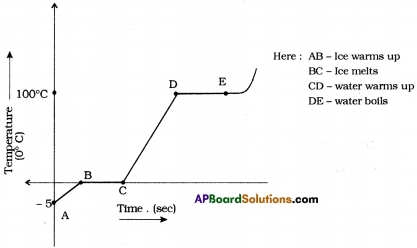
Answer:
1) The spirit in the dish which is kept under the ceiling fan disappears.
2) Whereas we will find some spirit left in the dish that is kept in the lidded dish.
3) The molecules which are escaping from the surface is high and they can’t reach back to liquid due to wind blow. So, evaporation is high under fan.
4) At the same time evaporation is less in the dish which is closed by lid.

10th Class Physics Textbook Page No. 12

Question 25.
Does the reverse process of evaporation take place? When and how does it take place?
Answer:
1) Yes, the reverse process of evaporation takes place.
2) When the vapour molecules lose their kinetic energy which leads to lower the temperature, they convert into droplets.
3) This process is called condensation.

10th Class Physics Textbook Page No. 13

Question 26.
In early morning, during winter, you might have noticed that water droplets form on window panes, flowers, grass, etc. How are these water droplets formed?
(OR)
Why do water drops (dew) form on flowers and grass during morning hours of winter season?
Answer:

  • During winter season, in the night times, atmospheric temperature goes down.
  • The surfaces of window panes, flowers, grass, etc. become colder.
  • The water vapour molecules touch the surfaces, gets cooled and lost its energy.
  • Then water vapour condenses on the surface and water drops formed.
  • The water droplets condensed on such surfaces are known as dew.

10th Class Physics Textbook Page No. 14

Question 27.
Are the process of evaporation and boiling the same? Explain.
Answer:

  • No, they are different.
  • Evaporation takes place at any temperature.
  • But boiling occurs at particular temperature called the boiling point.

10th Class Physics Textbook Page No. 16

Question 28.
You might have observed coconut oil and ghee getting converted from liquid state to solid state during winter season. What could be the reason for this change? What happens to water kept in a refrigerator? How does it get converted from liquid phase to solid phase?
Answer:
1) If temperature of a substance decreases kinetic energy also decreases.
2) Kinetic energy decreases from water to ice. That means solid state to liquid state.
3) In winter season coconut oil in the form of liquid get down its temperature, hence its kinetic energy also decreases. So, it-freezes.
4) Water, which is kept in refrigerator loses the kinetic energy along with decreasing temperature and freezes.
5) In this way water converted liquid phase to solid phase.

AP SSC 10th Class Physics Solutions Chapter 1 Heat

Question 29.
Are the volumes of water and ice formed with same amount of water equal? Why?
Answer:
1) No, the volume of ice is greater than volume of water.
2) Water expands on freezing.
3) That means density of ice is less than density of water.

10th Class Physics 1st Lesson Heat Activities

Activity – 1

1. Explain the term temperature with example.
(OR)
What is the name given to degree of hotness or coldness? Explain the quantity with an example.
Answer:
Procedure: Take a piece of wood and a piece of metal and keep them in fridge or ice box.
Observation : When we touch both of them we feel that metal piece is colder than the wooden piece.

Explanation :

  • This is due to more energy flow out of our body when we touch the metal piece as compared with wooden piece.
  • The degree of coldness of metal is greater than that of the wooden piece.
  • The degree of hotness or coldness is called temperature.
  • From this example, we say metal piece is at a lower temperature compared to wooden piece.

Activity – 2

2. What is the measure of thermal equilibrium? How do you prove?
(OR)
How do you prove temperature is the measure of thermal equilibrium?
(OR)
Explain thermal equilibrium with an activity.
Answer:
Procedure :
Take two glass tumblers and fill one of them with hot water and another with cold water.
Explanation & Observation :
1) When we place a thermometer inside the hot water the mercury level of thermometer rises from initial position due to heat transferred from hotter body (hot water) to colder body (mercury in thermometer).
2) When we place the thermometer inside the cold water the mercury level comes down from its initial position due to transfer of heat from mercury (hotter body) to water (colder body).

Conclusion :

  • Heat is a form of energy that flows from a body at higher temperature to a body at lower temperature until the temperature remains same for two bodies that is called thermal equilibrium.
  • In the above case, the steadiness of mercury column shows that thermal equilibrium is achieved. That reading of mercury column gives temperature.
  • Thus temperature is a measure of thermal equilibrium.

Activity – 3

3. Establish the relationship between temperature and average kinetic energy.
(OR)
Suggest an activity to prove that the average kinetic energy of the molecules is directly proportional to the absolute temperature of the substances.
(OR)
How do you prove that temperature of a body is an indicator of average kinetic energy?
Answer:
Procedure :

  • Take two bowls one with hot water and second with cold water.
  • Gently sprinkle food colour on the surface of the water in both bowls.

Observation :
We will observe the jiggling of grains of food colour in hot water is more when compared to jiggling in cold water.

Explanation :

  • We know kinetic energy depends on speed motion of particles.
  • So the kinetic energy of hotter body is greater than that of colder body.
  • Thus the temperature of a body is an indicator of average kinetic energy of molecules of that body.

Conclusion :
Therefore average kinetic energy of molecules is directly proportional to absolute temperature.

Activity – 4

4. Write an activity which tells how heat transmits.
(OR)
In which direction does heat tend to flow? Prove it with an activity.
Answer:
AP SSC 10th Class Physics Solutions Chapter 1 Heat 10
Procedure :

  • Take water in a container and heat it to 60° C.
  • Take a cylindrical transparent glass jar and fill half of it with the hot water.
  • Pour coconut oil over the surface of water.
  • Put a lid with two holes on the top of the glass jar.
  • Insert two thermometers through the lid in such a way that one inside coconut oil and other in water.

Observation & Explanation :

  • Now we can observe that the reading of thermometer kept in water decreases while the reading of thermometer kept in oil increases.
  • So temperature of water decreases whereas temperature of oil increases.

Conclusion :

  • Heat transmits from hotter body to colder body.
  • So temperature determines direction of heat flow.

Activity – 5 Specific Heat

5. Write an activity which gives the relation between rise in temperature and nature of material.
(OR)
“The rate of rise in temperature depends on the nature of substance.” Prove it with an activity.
(OR)
Draw a diagram and label the parts to prove that the rate of increase in temperature depends on the nature of substance.
(OR)
We can observe severe burns with hot oil when compared with hot water.
Which factor will decide this aspect? Explain this process with an example.
Answer:
Procedure :

  • Take a large jar with water and heat it up to 80°C.
  • Take two identical boiling test tubes with single-holed corks.
  • Fill them, one of the boiling tubes with 50 gm of water and other with 50 gm of oil.
  • Insert two thermometers in each of tubes and clamp them to retort stand and place them in a jar of hot water.

Observation :

  • Observe the readings of thermometers every three minutes.
  • We can observe that the rise in temperature of oil is higher than that of water.

AP SSC 10th Class Physics Solutions Chapter 1 Heat 11

Explanation :

  • Since both the boiling tubes kept in hot water for the same interval of time, the heat supplied to oil and water is same but rise in temperature of oil is more.
  • So we conclude that rise in temperature depends on the nature of substance (specific heat).

Activity – 6

6. Derive Q = mSAT.
(OR)
Establish relationship between heat energy, mass of the substance and rise in temperature.
(OR)
Derive an expression for heat energy.
(OR)
Derive an expression for factors affecting amount of heat energy absorbed.
Answer:
Procedure :

  • Take two beakers of equal volume and take 250 grams of water in one beaker and 1 kg of water in another beaker.
  • Note their initial temperatures.
  • Now heat the two beakers up to 60° C.
  • Note down the heating times.

Observation:

  • We observe that-the water in large beaker takes more time.
  • That means we need to supply more heat enepgy to water in larger beaker (greater quantity of water).

Conclusion :
From this we conclude that for some change in temperature the amount of heat (Q) absorbed by a substance is directly proportional to its mass (m).
Q ∝ m (when ∆T is constant) ………….. (1)

Procedure :
Now take 1 litre of water in a beaker and heat it and note the temperature changes (∆T) for every two minutes and observe the rise internals.

Conclusion:
We will notice that for the same mass (m) of water the change in temperature is proportional to amount of heat (Q) absorbed by it.
Q ∝ ∆T (when m is constant) ………….. (2)
From (1) and (2) Q m∆T (or) Q = mS∆T,
where ‘S’ is called specific heat of substance.

Activity – 7

7. a) How are you able to find the final temperature of the mixture of sample?
(OR)
What is the “Principle of method of mixtures”? Verify it with an activity.
Answer:
Situation – 1 :

  • Take two beakers of the same size and pour 200 ml of water in each of them.
  • Now heat the water in both beakers to same temperature.
  • Now pour water from these beakers into a larger beaker and measure the temperature of the mixture.

Observation :
We can observe that there is no change in temperature.

Situation – 2 :

  • Now heat the water in first beaker to 90° C and the other to 60° C.
  • Mix the water from these beakers in a large beaker.

Observation :
We can find that the temperature of mixture is 75° C.

Situation – 3 :
Now take 100 ml of water at 90° C and 200 ml of water at 60° C and mix the two. Observation :
We can find that the temperature of mixture is 75° C.

AP SSC 10th Class Physics Solutions Chapter 1 Heat

7. b) Derive, a formula for final temperature of mixture of samples.
(OR)
Maveen added hotter water of mass m1 kept at temperature T1 to cold water of mass m2 kept at temperature T2. Find the expression to find temperature of mixture of samples.
Answer:
Procedure:
1) Let the initial temperatures of the hotter and colder samples of masses m1 and m2 be T1 and T2.
2) Let T be the final temperature of mixture.

Observation :
The temperature of the mixture is lower than hotter sample and higher than colder sample. Explanation :
So hot sample has lost heat, and the cold sample has gained heat.
The heat lost by the hot sample Q1 = m1S (T1 – T)
The heat gained by the cold sample Q2 = m2S (T – T2)
We know that heat lost = heat gained
Q1 = Q2
m1 S(T1 – T) = m2 S(T – T2)
[latex]\mathrm{T}=\frac{\mathrm{m}_{1} \mathrm{~T}_{1}+\mathrm{m}_{2} \mathrm{~T}_{2}}{\mathrm{~m}_{1}+\mathrm{m}_{2}}[/latex]

Activity -8

8. Explain the process of evaporation phenomenon with an example.
(OR)
Srinu observed that spirit taken in a petri dish disappears after some time. Explain the process involved in it with an example.
Answer:
Procedure :

  • Take a few drops of spirit in two petri dishes separately.

  • Keep one of the dishes under a ceiling fan and keep another dish with its lid closed.
  • Observe the quantity of spirit in both dishes after 5 minutes.

Observation :
We will notice that spirit in the dish kept under the ceiling fan disappears whereas we will find some spirit left in the dish that is kept in the lidded dish.

Explanation :

  • The reason is that the molecules of spirit in dish continuously move with random speeds and collide with other molecules.
  • During the collision they transfer energy to other molecules.
  • Due to this collision the molecules at the surface acquire energy and fly off from the surface.
  • Some molecules come back to liquid.
  • If the number of escaping molecules is greater than returned number, then the number of molecules in the liquid decreases.

Conclusion :
When a liquid is exposed to air, the molecules at the surface keep on escaping from the surface till the entire liquid disappears into air. This process is called evaporation.

Activity – 9

9. Explain the process of condensation with example.
(OR)
Explain the process of condensation with an activity.
(OR)
Karan told his friend that he observed that there are some water droplets outside a cold soft drink bottle. Explain the phenomenon involved in the formation of these droplets.
Answer:
Procedure :
Place a glass tumbler on the table. Pour cold water up to half of its height.

Observation :
There are droplets formed outside of the glass.

Explanation :

  • The reason is that the surrounding air contains water molecules in the form of water vapour. When the water molecules strike the surface of the glass tumbler which is cool, they lose their kinetic energy.
  • This energy lowers the temperature of vapour and it turns into droplets.
  • The energy lost by water molecules in air is gained by the molecules of the glass tumbler.
  • Hence the average kinetic energy of glass molecules increases. In turn the energy is transferred to water molecules in die glass.

Conclusion :

  • So the average kinetic energy and temperature of water in glass increases. This is called condensation.
  • Condensation is the phase change from gas to liquid.

Activity – 10

10. Explain the process of boiling with an example.
(OR)
Why do we observe bubbles on the surface of water which has been heated ? What is the phenomenon involved in it? Explain.
Answer:
Procedure :
Take a beaker of water, keep it on the burner and note the readings of thermometer for every two minutes.

Observation :

  • We will notice that the temperature of the water rises continuously till it reaches 100° C.
  • Once it reaches 100° C the temperature remains same and a lot of bubbling on the surface takes place. This is called boiling of water.

Explanation :

  • It happens due to when water is heated the solubility of gases it contains reduces.
  • As a result, bubbles of gas are formed in the liquid.
  • Evaporation of water molecules from the surrounding liquid occurs into these bubbles and they become filled with saturated vapour.
  • At a certain temperature, the pressure of the saturated vapour inside the bubbles becomes equal to the pressure exerted on the bubbles from the outside.

Conclusion :

  • As a result, these bubbles rise rapidly to the surface and collapse at the surface releasing vapour present in bubbles into air at the surface. This process is called “boiling”.
  • This temperature is called ‘boiling temperature”.

Activity – 11

11. Explain the process of melting and latent heat of fusion.
(OR)
When ice is heated to 0°C it starts to turn into water. But temperature remains ‘ constant for some time. What is the process involved in this? Explain.
Answer:
Procedure :

  • Take small ice cubes in a beaker. Insert the thermometer in the beaker.
  • Now start heating the beaker and note down readings of thermometer every one minute till the ice completely melts and gets converted into water.
  • Before heating the temperature of ice is 0°C or less than 0°C.

Observation :

  • We will observe that the temperature of ice at the beginning is equal to or below 0°C.
  • If the temperature of ice is below 0°C, it goes on changing till it reaches 0°C.
  • When ice starts melting, we will observe no change in temperature though you are supplying heat continuously.

Explanation:

  • Given heat energy uses to break the bonds (H2O) in ice and melts.
  • So, temperature is constant while melting.

Conclusion:

  • This process is called melting. In this process, heat converts solid phase to liquid phase.
  • The temperature of the substance does not change until all the ice melts and converts into water.
  • The heat given to melting is called latent heat of fusion.
  • The heat required to convert 1 gm of solid completely into liquid at constant temperature is called “latent heat of fusion”.

Activity – 12

12. Why does a glass bottle tilled with water break when it is placed in deep freezer for some time?
(OR)
Prove that density of ice is less than that of water.
(OR)
How do you prove that volume of ice is more than that of water?
Answer:
Procedure :

  • Take a small glass bottle with a tight lid and fill it with water, without any gap and fix the lid tightly.
  • Put the bottle into the deep freezer of a refrigerator for a few hours.

Observation :
When we take it out from the deep freezer, we can observe that the glass bottle breaks.

Explanation :

  • These cracks on the bottle due to expansion of the substance in the bottle.
  • This means water expands on freezing.

Conclusion :

  • Water expands on freezing.
  • Ice has less density than water.


AP SSC 10th Class Physics Solutions Chapter 7 Human Eye and Colourful World

AP State Board Syllabus AP SSC 10th Class Physics Solutions Chapter 7 Human Eye and Colourful World Textbook Questions and Answers.

AP State Syllabus SSC 10th Class Physics Solutions 7th Lesson Human Eye and Colourful World

10th Class Physics 7th Lesson Human Eye and Colourful World Textbook Questions and Answers

Review of Your Previous Knowledge

Question 1.
What is the function of lens in human eye?
Answer:
The eye lens forms a real image on retina then we can see the objects.

Question 2.
How does it help to see objects at long distances and short distances?
Answer:
Eye lens can adjust itself in shape, so that it helps to see the objects at long and short distances.

AP SSC 10th Class Physics Solutions Chapter 7 Human Eye and Colourful World

Question 3.
How is it possible to get the image at the same distance on the retina?
Answer:
When the eye is focussed at distant object, the ciliary muscles are relaxed. So the focal length of eye lens adjusted itself which is equal to the distance of object from the retina. Then we can see the object clearly.
When the eye is focussed on a closer object the ciliary muscles adjust the focal length in such a way that the image is formed on retina and we see the object clearly.

Question 4.
Are we able to see all objects in front of our eye clearly?
Answer:
Yes. By maintaining the 25 cm distance of the object from our eye, we can see the objects in front of our eye.

Question 5.
How do the lenses used in spectacles correct defects of vision?
Answer:
To form image on retina.
To correct
myopia- Concave lens
hypermetropia i- Convex lens

Improve Your Learning

Question 1.
How do you correct the eye defect Myopia? (AS1)
Answer:
AP SSC 10th Class Physics Solutions Chapter 7 Human Eye and Colourful World 1

  • Some people cannot see objects at long distances but can see nearby objects clearly. This type of defect in vision is called ‘Myopia’ or ‘Near sightedness’.
  • Myopia is corrected by using a con-cave lens of focal length equal to the distance of the far point F from the eye.
  • This lens diverges the parallel rays from distant object as if they are coming from the far point.
  • Finally the eye lens forms a clear im-age at the retina.

Question 2.
Explain the correction of the eye defect Hypermetropia. (AS1)
Answer:
AP SSC 10th Class Physics Solutions Chapter 7 Human Eye and Colourful World 2

  • A person with hypermetropia can see distant objects clearly but cannot see objects at near distances. This is also known as ‘far sightedness’.
  • Eye lens can form a clear image on the retina when any object is placed beyond near point.
  • To correct the defect of hypermetropia, we need to use a lens which forms an image of an object beyond near point at H, when the object is between H and L. This is possible only when a double con¬vex lens is used.
  • The image acts like an object for the eye lens. Hence final image due to eye is formed at retina.

Question 3.
How do you find experimentally the refractive index of material of a prism? (AS1)
(OR)
Write the experimental procedure in finding the refractive index of a prism.
(OR)
Which quantity will decide whether a given medium is denser or rarer? How do you find that quantity of prism experimentally?
Answer:
Refractive index decides whether a medium is denser or rarer.
Aim :
To find the refractive index of a prism.

Materials required :
Glass prism, white chart of size 20 x 20 cm, pencil, pins, scale and protractor.

AP SSC 10th Class Physics Solutions Chapter 7 Human Eye and Colourful World 3
Procedure :

  1. Keep a prism on white chart.
  2. Draw the triangular base of the prism with pencil.
  3. Remove the prism.
  4. The shape of the outline drawn prism is triangle and name its vertices as P, Q and R.
  5. PQ and PR be the refracting surfaces.
  6. Find the angle between PQ and PR. This is the angle of the prism (A) (or) Refracting angle.
  7. Mark M on PQ and draw a perpendicular line to PQ at M.
  8. Place the centre of the protractor at M, along the normal and mark an angle of 30° and then draw a line up to M. This line denotes incident ray. This angle is called angle of incidence.
  9. Place the prism in its position (triangle) again.
  10. Now fix two pins vertically on the line at points A and B .
  11. See the images of pins through the 2nd refracting side (PR).
  12. Fix another two pins at points C and D such that all the four pins appear to lie along the same line.
  13. Remove the pins and prism, join the pin-holes. Draw the incident and emergent rays.
  14. The angle between the normal and the emergent ray at N is the angle of emergence.
  15. The line passing through the points A, B, M, N, C and D represents the path of light when it suffers refraction through prism.

The angle of deviation :

  • Extend incident and emergent rays are intercept at a point ‘O’.
  • The angle between these two rays is the angle of deviation (d).
  • Note the emergent deviation angles for different values of i, in the given table.

AP SSC 10th Class Physics Solutions Chapter 7 Human Eye and Colourful World 4

  • Draw the graph between angle of incidence on X – axis and the angle of deviation on Y – axis.
  • We notice that the angle of deviation decreases first and then increases with increase of the angle of incidence.
  • Mark points on a graph paper and join the points to obtain a graph (smooth curve).
  • Draw a tangent line to the curve, which parallel to X-axis, at the lowest point of the graph.

AP SSC 10th Class Physics Solutions Chapter 7 Human Eye and Colourful World 5

  • The point where this line cuts the Y- axis gives the angle of minimum deviation. It is denoted by D.
  • From the graph, we notice that, at angle of minimum deviation, the angle of incidence is equal to the angle of emergence.
  • By finding A and D we can find refractive index of prism by using formula .

Question 4.
Explain the formation of rainbow. (AS1)
(OR)
What is the natural spectrum occuring in sky? Explain the formation of that spectrum.
Answer:
AP SSC 10th Class Physics Solutions Chapter 7 Human Eye and Colourful World 6

  • A rainbow is a natural spectrum of sunlight in the form of bows appearing in the sky when the sun shines on rain drops.
  • It is combined result of reflection, refraction and dispersion of sunlight from water droplets, in atmosphere.
  • It always forms in the direction opposite to the sun.
  • To see a rainbow, the sun be must behind us and the water droplets falls in front of us.
  • When a sunlight enters a spherical raindrop, it is refracted and dispersed. The different colours of light are bent in different angles.
  • When different colours of light falls on the back inner surface of drop, it (Water drop) reflects (different colours of light) interwnally (total internal reflection).
  • The water drops again refract the different colours, when it comes out from the raindrop.
  • After leaving this different colours from the raindrop as rainbow, reach our eye. Thus, we see a rainbow.

Question 5.
Explain briefly the reason for the blue of the sky. (AS1)
Answer:

  • The reason for blue sky is due to the molecules N2 and O2.
  • The size of these molecules are comparable to the wavelength of blue light.
  • These molecules act as scattering centres for scattering of blue light.
  • So scattering of blue light by molecules of N2 and O2 is responsible for blue of the sky.

AP SSC 10th Class Physics Solutions Chapter 7 Human Eye and Colourful World

Question 6.
Explain two activities for the formation of artificial rainbow. (AS1)
(OR)
Give two activities for the formation of the artificial rainbow? And explain it.
(OR)
Suggest an experiment to create a rainbow in your classroom and explain the procedure.
Answer:
Activity -1 :
AP SSC 10th Class Physics Solutions Chapter 7 Human Eye and Colourful World 6

  • Select a white coated wall on which the sun rays fdll.
  • Stand in front of a wall in such a way that the sun rays fall on your back.
  • Hold a tube through which water is flowing.
  • Place your finger in the tube to obstruct the flow of water.
  • Water comes out from small gaps between the tube and finger like a fountain.
  • Observe the changes on wall while showering the water.

Activity – II : (Activity – 4)
AP SSC 10th Class Physics Solutions Chapter 7 Human Eye and Colourful World 10

  • Take a metal tray and fill with water.
  • Place a mirror in water such that it makes an angle to the water surface.
  • Now focus white light on the mirror through the water.
  • Keep a white card board sheet above the water surface.
  • We may observe the colours VIBGYOR on the board.
  • The splitting of white light into different colours (VIBGYOR) is called dispersion.
  • So consider a white light is a collection of waves with different wavelengths.
  • Violet has shortest wavelength, and red has longest wavelength.

Question 7.
Derive an expression for the refractive index of the material of a prism. (AS1)
Answer:
Derivation of formula for refractive index of a prism :
PQ and PR are refracting surfaces of prism, i, is an angle of incidence, i2 is an angle of emergence, is an angle of refraction of first surface and r2 is an angle of incidence on second surface.
AP SSC 10th Class Physics Solutions Chapter 7 Human Eye and Colourful World 11
1. From triangle OMN, we get
d = i1 – r1 + i2 – r2
∴ d = (i1 + i2)-(r1+ r2) ……… (1)
2. From triangle PMN, we have
∠A + (90° – r1) + (90° – r2) = 180°
⇒ r1 + r2 = A ……… (2)
3. From (1) and (2),
⇒ d = (i1 + i2) – A
⇒ A + d = i1 + i2
4. This is the relation between angle of incidence, angle of emergence, angle of deviation and angle of prism.

5. From Snell’s law, we know that
n1 sin i = n2 sin r

6. Let ‘n’ be the refractive index of the prism.
7. Using Snell’s law at M, refractive index of air n1 = 1; i = i1; n2 = n; r = r1.
⇒ sin i1 = n sin r1 …………. (4)
8. Similarly, at N, n1 = n; i = r2; n2 = 1; i1 = i2
⇒ n sin r2 = n sin i2 ………… (5)
9. We know that at the angle of minimum deviation position (D), i.e. i1 = i2
10. We will notice that MN is parallel to the base of prism QR.
AP SSC 10th Class Physics Solutions Chapter 7 Human Eye and Colourful World 12
AP SSC 10th Class Physics Solutions Chapter 7 Human Eye and Colourful World 13

14. This is the formula for the refractive index of the prism.

Question 8.
Light of wavelength λ1 enters a medium with refractive index n2 from a medium with refractive index n1 What is the wavelength of light in second medium? (AS1)
Answer:
Wavelength of first medium =λ1
Refractive index of first medium = n1
Let the wavelength of second medium = λ2,
Refractive index of second medium = n2
Light enters from first medium to second medium = [latex]\Rightarrow \frac{\mathrm{n}_{2}}{\mathrm{n}_{1}}=\frac{\mathrm{c}_{1}}{\mathrm{c}_{2}}=\frac{\lambda_{1}}{\lambda_{2}}[/latex] (∵ υ = const)
[latex]\Rightarrow \lambda_{2}=\frac{\lambda_{1} \mathrm{n}_{1}}{\mathrm{n}_{2}}[/latex]

Note:
For the below questions the following options are given. Choose the correct option by making hypothesis based on given assertion and reason. Give an explanation.
a) Both A and R are true and R is the correct explanation of A.
b) Both A and R are true and R is not the correct explanation of A.
c) A is true but R is false.
d) Both A and R are false.
e) A is false but R is true.

AP SSC 10th Class Physics Solutions Chapter 7 Human Eye and Colourful World

Question 9.
Assertion (A) : The refractive index of a prism depends only on the kind of glass of which it is made of and the colour of light. (AS2)
Reason (R) : The refractive index of a prism depends on the refracting angle of the prism and the angle of minimum deviation.
Answer:
(b) Both A and R are true and R is not the correct explanation of A.

Question 10.
Assertion (A) : Blue colour of sky appears due to scattering of light.
Reason (R) : Blue colour has shortest wavelength among all colours of white light. (AS2)
Answer:
(C) A is true but R is false.

Question 11.
Suggest an experiment to produce a rainbow in your classroom and explain the procedure. (AS3)
Answer:
Activity to produce a rainbow in classroom :

  • Take a prism and place it on the table near a vertical white wall.
  • Take a thin wooden plank, make a small hole in it and fix it vertically on the table.
  • Place the prism between the wooden plank and wall.
  • Place a white light source behind the hole of the wooden plank. Switch on the light.
  • Adjust the height of the prism such that the light falls on one of the lateral surfaces.
  • Observe the changes in the emerged ray of the prism.
  • Adjust the prism by slightly rotating it till you get an image on the wall.
  • We observe a band of different colours on the wall.
  • These colours are nearly equal to the colours of the rainbow, i.e., VIBGYOR.

AP SSC 10th Class Physics Solutions Chapter 7 Human Eye and Colourful World

Question 12.
Prisms are used in binoculars. Collect information why prisms are used in binoculars. (AS4)
Answer:

  • Binoculars consists of a pair of identical or mirror symmetrical telescope mounted side by side and aligned to point accurately in the same direction, allowing the viewer to use both eyes, when viewing distant objects.
  • The size of binoculars is reduced by using prisms.
  • We get good image with more brightness.
  • Objective size and optical quality should be increased by using prisms in binoculars.

Question 13.
Incident ray on one of the face (AB) of prism and emergent ray from the face AC are given in figure. Complete the ray diagram. (AS5)
AP SSC 10th Class Physics Solutions Chapter 7 Human Eye and Colourful World 17
Answer:
AP SSC 10th Class Physics Solutions Chapter 7 Human Eye and Colourful World 7

Question 14.
How do you appreciate the role of molecules in the atmosphere for the blue colour of the sky? (AS6)
(OR)
How do you appreciate the nature of molecules, responsible for the blue of the sky?
Answer:

  • The sky appear blue due to atmospheric refraction and scattering of light through molecules.
  • Molecules are scattering centres.
  • The reason to blue sky is due to the molecules N2 and 02.
  • The sizes of these molecules are comparable to the wavelength of blue light.
  • In the absence of molecules there will be no scattering of sunlight and the sky will appear dark.
  • We should appreciate the molecules which are scattering centres.

Question 15.
Eye is the only organ to visualise the colourful world around us. This is possible due to accommodation of eye lens. Prepare a six line stanza expressing your wonderful feelings. (AS6)
Answer:
“Many people simply see
The world in black and white
But through my eyes the world’s alive
So colourful and bright
Don’t close your mind to the sights
That light up the night and day
There’s so much to see here on this earth
And not a rupee do you have to pay”
The most obvious things aren’t the ones
There is beauty in the unknown
with willing eyes and an open mind
The true wonders you will be shown

AP SSC 10th Class Physics Solutions Chapter 7 Human Eye and Colourful World

Question 16.
How do you appreciate the working of ciliary muscles in the eye? (AS6)
(OR)
Which muscles are helpful in changing the focal length of eye lens? How do you appreciate those muscles?
Answer:

  • Ciliary muscles are helpful in changing focal length of eye lens.
  • The ciliary muscles which attached with eye lens help to change the focal length of eye lens.
  • When the eye is focussed on a distant object, these are relaxed. So the focal length of eye lens increases to its maximum value.
  • The parallel rays coming into the eye are focussed on the retina then we can see the object clearly.
  • When the eye is focussed on a nearer object the muscles are strained so the focal length of eye-lens decreases. The ciliary muscles adjust the focal length and the image is formed on retina then we can see the object.
  • Their process of adjusting focal length of eve lens is called accomodation.
  • So ciliary muscles must be appreciated for its accomodation of eye lens.

Question 17.
Why does the sky sometimes appear white? (AS7)
(OR)
The sky sometimes appears white. What is the reason behind it?
Answer:

  • Our atmosphere contains atoms and molecules of different sizes.
  • According to their sizes, they are able to scatter different wavelengths of light.
  • For example, the size of the water molecule is greater than the size of the N2 or O2.
  • It acts as a scattering centre for light other frequencies which are lower than the frequency of blue light.
  • On a hot day due to rise in the temperature, water vapour enters atmosphere which leads to abundant presence of water molecules in atmosphere. These water molecules scatter the colours of other frequencies (other than blue).
  • All such colours of other frequencies reach our eye and white colour is appeared to us.

Question 18.
Glass is known to be transparent material. But ground glass is opaque and white in colour. Why? (AS7)
Answer:

  • Ground glass is glass whose surface has been ground that produces a flat but rough finish.
  • Ground glass has the effect of rendering the glass translucent by scattering of light during transmission thus blurring visibility while still transmitting light.
  • To get more permanent frost, the glass may be ground by rubbing with some gritty substance.

AP SSC 10th Class Physics Solutions Chapter 7 Human Eye and Colourful World

Question 19.
If a white sheet of paper is stained with oil, the paper turns transparent. Why? (AS7)
(OR)
What is the reason behind the paper turns transparent when it is immersed in oil?
Answer:

  • The paper fibres have higher index of refraction probably much greater than 1.5.
  • The oil or fat also has a high index of refraction so that it nearly matches the index of refraction of the paper fibres and it reduces the scattering significantly.
  • The fat adhering to the cellulose fibers lowers the index of refraction of the cellulose and also fills in air voids, so that visible light passes through the bag with significantly less scattering.
  • The oil connects the fibres in the paper with a liquid which can transmit by refraction (rather than scatter) light that falls upon it. As a result, the paper stained with oil is turned transparent.

Question 20.
A light ray falls on one of the faces of a prism at an angle 40° so that it suffers angle of minimum deviation of 30°. Find the angle of prism and angle of refraction at the given surface. (AS7)
Answer:
Given that, incident ray on one of the prisms (i1) = 40°
Angle of minimum deviation (D) = 30°
Angle of prism (A) = ?
A+D = 2i1
⇒ A = 2i1 – D
⇒ A = 2(40°) -30°
= 80° – 30°
= 50°
∴ Angle of prims (A) = 50°
Angle of refraction (r1) = ?
AP SSC 10th Class Physics Solutions Chapter 7 Human Eye and Colourful World 14

Question 21.
The focal length of a lens suggested to a person with Hypermetropia is 100 cm. Find the distance of near point and power of the lens. (AS7)
Answer:
i) The distance of near point :
If the distance of near point is ‘d’ and focal length is ‘f’ then the relation between
AP SSC 10th Class Physics Solutions Chapter 7 Human Eye and Colourful World 8

Question 22.
A person is viewing an extended object. If a converging lens is placed in front of his eye, will he feel that the size of object has increased? Why? (AS7)
Answer:

  • A simple magnifier allows us to put the object closer to the eye than we could normally focus and forms an enlarged virtual images.
  • The principle behind this is angular magnification.
  • The magnification is Ma = [latex]\frac{25}{f}[/latex] for the close focus point, but since that causes eye strain, it is usually desirable to put the images at infinity giving Ma = [latex]\frac{25}{f}[/latex]
  • So he fees the size of object is increased. The reason is mentioned.
  • Angular magnification: ‘The ratio of the angle substended at the eye by the image formed by an optical instrument to the angle substended at the eye by the object being viewed.”

Fill In The Blanks

1. The value of least distance of distinct vision is about ……………………… .
2. The distance between the eye lens and retina is about ……………………… .
3. The maximum focal length of the eye lens is about ……………………… .
4. The eye lens can change its focal length due to working of ……………………… muscles.
5. The power of lens is ID then focal length is ……………………… .
6. Myopia can be corrected by using ……………………… lens.
7. Hypermetropia can be corrected by using ……………………… lens.
8. In minimum deviation position of prism, the angle of incidence is equal to angle of ……………………… .
9. The splitting of white light into different colours (VIBGYOR) is called ……………………… .
10. During refraction of light, the character of light which does not change is ……………………… .
Answer:

  1. 25 cm
  2. 2.5 cm
  3. 2.5 cm
  4. ciliary
  5. 100 cm
  6. bi-concave
  7. bi-convex
  8. emergence
  9. dispersion of light
  10. frequency

Multiple Choice Questions

1. The size of an object as perceived by an eye depends primarily on
A) actual size of the object
B) distance of the object from the eye
C) aperture of the pupil
D) size if the image formed on the retina
Answer:
B) distance of the object from the eye

2. When objects at different distances are seen by the eye which of the following remains constant?
A) focal length of eye-lens
B) object distance from eye-lens
C) the radii of curvature of eye-lens
D) image distance from eye-lens
Answer:
D) image distance from eye-lens

AP SSC 10th Class Physics Solutions Chapter 7 Human Eye and Colourful World

3. During refraction, …………….. will not change.
A) wavelength
B) frequency
C) speed of light
D) all the above
Answer:
B) frequency

4. A ray of light falls on one of the lateral surfaces of an equilateral glass prism placed on the horizontal surface of a table as shown in figure. For minimum deviation of ray, which of the following is true?
AP SSC 10th Class Physics Solutions Chapter 7 Human Eye and Colourful World 9
A) PQ is horizontal
B) ‘QR’ is horizontal
C) ‘RS’ is horizontal
D) Either ‘PQ’ or ‘RS’ is horizontal
Answer:
B) ‘QR’ is horizontal

5. Far point of a person is 5 m. In order that he has normal vision what ki nd of spectacles should he use?
A) concave lens with focal length 5 m
B) concave lens with focal length 10 m
C) convex lens with focal length 5 m
D) convex lens with focal length 2.5 mm
Answer:
A) concave lens with focal length 5 m

6. The process of re-emission of absorbed light in all directions with different intensi¬ties by the atom or molecule is called ……………
A) scattering of light
B) dispersion of light
C) reflection of light
D) refraction of light
Answer:
A) scattering of light

10th Class Physics 7th Lesson Human Eye and Colourful World InText Questions and Answers

10th Class Physics Textbook Page No. 104

Question 1.
Can you imagine the shape of rainbow when observed during travel in an airplane?
Answer:
AP SSC 10th Class Physics Solutions Chapter 7 Human Eye and Colourful World 18
The shape of rainbow, when observed during travel in an airplane is circular as shown in the following figure.

10th Class Physics Textbook Page No. 88

Question 2.
Why do the values of least distance of distinct vision and angle of vision change with person and age?
Answer:

  • The ciliary muscle helps the eye lens to change its focal length by changing radii of curvature of eye lens.
  • When the eye is focussed on a distant object, the ciliary muscles are relaxed so that the focal length of eye lens has its maximum value which is equal to its distance from the retina.
  • The working of ciliary muscle in eye changes from person to person.
  • So, the values of least distance of distinct vision and angle of vision changes with person and age.

10th Class Physics Textbook Page No. 89

Question 3.
How can we get same image distance for various positions of objects?
Answer:
For different positions of object, the image distance remains constant only when focal length of lens changes.

AP SSC 10th Class Physics Solutions Chapter 7 Human Eye and Colourful World

Question 4.
Can you answer above question using concepts of refraction through lenses?
Answer:
The focal length of a lens depends on the material by which it has been made and radii of curvatures of lens. We need to change focal length of eye lens to get same image distance for various positions of object.

10th Class Physics Textbook Page No. 90

Question 5.
How does eye lens change its focal length?
(OR)
What is the role of ciliary muscles in the eye ? Write the answer in one or two sentences only.
Answer:
The ciliary muscles to which eye lens is attached help the eye lens to change its focal length by changing the radii of curvature of eye lens.

Question 6.
How does this change (eye lens changes its focal lengths) take place in eye ball?
Answer:
When the eye is focussed on a distant object the ciliary muscles are relaxed. So the focal length of eye lens has its maximum value which is equal to its distance from the retina. The parallel rays coming into the eye are then focussed on to the retina and we see the object clearly.

AP SSC 10th Class Physics Solutions Chapter 7 Human Eye and Colourful World

Question 7.
Does eye lens form a real image or virtual image?
Answer:
The eye lens forms a real and inverted image of an object on the retina.

Question 8.
How does the image formed on retina help us to perceive the object without change in its shape, size and colour?
Answer:

  • The eye lens forms a real and inverted image of an object on the retina.
  • This retina is a delicate membrane, which contains large number of receptors (125 million) called ‘rods’ and ‘cones’.
  • They receive the light signals and identify the colour, and the intensity of light.
  • These signals are transmitted to the brain through optic-nerve fibres.
  • The brain interprets these signals and finally processes the information so that we perceive the object in terms of its shape, size and colour.

Question 9.
Is there any limit to change of focal length of eye lens?
Answer:
Yes. When the object is at infinity, the parallel rays from the object falling on the eye lens are refracted. They form a point-sized image on retina. In this situation, eye lens has a maximum focal length.

Question 10.
What are the maximum and minimum focal lengths of the eye lens?
Answer:
Maximum focal length is 2.5 cm and minimum focal length is 2.27 cm.

AP SSC 10th Class Physics Solutions Chapter 7 Human Eye and Colourful World

Question 11.
How can we find the maximum and minimum focal lengths of the eye lens?
(OR)
Calculate the maximum and minimum focal lengths of the eye lens.
Answer:’
a) When the object is at infinity,
u = – ∞ ; v = 2.5 cm (image distance which is equal to distance between eye lens and retina)
AP SSC 10th Class Physics Solutions Chapter 7 Human Eye and Colourful World 19

b) Object at a distance of 25 cm from eye. In this case, eye has minimum focal length.
Here u = -25 cm ; v 2.5 cm
AP SSC 10th Class Physics Solutions Chapter 7 Human Eye and Colourful World 24

10th Class Physics Textbook Page No. 91

Question 12.
What happens if eye lens is not able to adjust its focal length?
Answer:
In this case the person cannot see the object clearly and comfortably.

AP SSC 10th Class Physics Solutions Chapter 7 Human Eye and Colourful World

Question 13.
What happens if the focal length of eye lens is beyond the range of 2.5 cm to 2.27 cm?
Answer:
The vision (image) becomes blurred due to defects of eye lens.

10th Class Physics Textbook Page No. 92

Question 14.
What can we do to correct myopia?
Answer:
To correct myopia, we use concave lens.

10th Class Physics Textbook Page No. 93

Question 15.
How can you decide the focal length of the lens to be used to correct myopia?
Answer:
Assume that the object distance (u) is infinity and image distance (v) is equal to distance of far point.
u = – ∞ ; v = distance of far point = – D
Let ‘f be the focal length of bi-concave lens.
AP SSC 10th Class Physics Solutions Chapter 7 Human Eye and Colourful World 25

Here ‘f is negative showing that it is a concave lens.

Question 16.
What happens when the eye has a minimum focal length greater than 2.27 cm?
Answer:
In this case, the rays coming from the nearby object after refraction at eye lens, forms image beyond the retina.

10th Class Physics Textbook Page No. 94

Question 17.
How can you decide the focal length of convex lens to be used?
Answer:
Here object distance (u) = -25 cm
Image distance (v) = – d (distance of near point)
Let ‘f be the focal length of bi-convex lens.
AP SSC 10th Class Physics Solutions Chapter 7 Human Eye and Colourful World 20

If d > 25 cm, then ‘f’ becomes positive then we need to use bi-convex lens to correct hypermetropia.

10th Class Physics Textbook Page No. 95

Question 18.
Have you ever observed details in the prescription?
Answer:
A prescription that contains some information regarding type of lens to be used to correct vision.

Question 19.
What does it (“my sight is increased or decreased”) mean?
Answer:
Usually doctors, after testing the defects of vision prescribe corrective lenses indicating
their power which determines the type of lens to be used and its focal length.

AP SSC 10th Class Physics Solutions Chapter 7 Human Eye and Colourful World

Question 20.
What do you mean by power of lens ? flftorH)
Answer:
The reciprocal of focal length is called power of lens.

Question 21.
Doctor advised to use 2D lens. What is its focal length?
Answer:
Given power of lens P = 2D
AP SSC 10th Class Physics Solutions Chapter 7 Human Eye and Colourful World 21
∴ Focal length of lens (f) = 50 cm.

10th Class Physics Textbook Page No. 96

Question 22.
How could the white light of the sun give us various colours of the rainbow?
Answer:
Due to reflection, refraction and dispersion of sunlight.

Question 23.
What happens to a light ray when it passes through a transparent medium bounded by plane surfaces which are inclined to each other?
Answer:
When light incident on one of the plane surfaces and emerges from the other.

AP SSC 10th Class Physics Solutions Chapter 7 Human Eye and Colourful World

Question 24.
What is a prism?
Answer:
A prism is a transparent medium separated from the surrounding medium by consisting two refracting plane surfaces which are inclined.

10th Class Physics Textbook Page No. 97

Question 25.
What is the shape of the outline drawn for a prism?
Answer:
The outline drawn for a prism is in a triangle shape.

10th Class Physics Textbook Page No. 98

Question 26.
How do you find the angle of deviation?
Answer:
The angle between the extended incident and emergent rays is called angle of deviation.
(OR)
Extend both incident and emergent rays till they meet at a point ‘O’. Measure the angle between these two rays. This is the angle of deviation.

Question 27.
What do you notice from the angle of deviation?
Answer:
The angle of deviation decreases first and then increases with increase in the angle of incidence.

Question 28.
Can you draw a graph between angle of incidence and angle of deviation?
Answer:
AP SSC 10th Class Physics Solutions Chapter 7 Human Eye and Colourful World 5
Yes, we can draw the graph between angle of incidence and angle of deviation.

Question 29.
From the graph, can you find the minimum of the angle of deviation?
Answer:
Yes, we can. Draw a tangent line to the curve, parallel to X – axis, at the lowest point of the graph. The point where this line cuts Y – axis gives the angle of minimum deviation.

Question 30.
Is there any relation between the angle of incidence (i) angle of emergence (r) and piangle of deviation (d)?
Answer:
(i1 + i2)= A + D
i + r = A + D

10th Class Physics Textbook Page No. 101

Question 31.
In activity-3,we noticed that light has chosen different paths. Does this mean that the refractive index of the prism varies from colour to colour?
Answer:
Yes, refractive index of the prism varies from colour to colour.

Question 32.
Is the speed of light of each colour different?
Answer:
In vacuum – No, the speed of each colour is constant.
In medium – Speed is different for different colours.

AP SSC 10th Class Physics Solutions Chapter 7 Human Eye and Colourful World

Question 33.
Can you guess now, why light splits into different colours when it passes through a prism?
Answer:
Due to dispersion of light and different wavelength of colours in medium.

10th Class Physics Textbook Page No. 102

Question 34.
Does it (light passing through a prism) split into more colours? Why?
Answer:
We know the frequency of light is the properly of the source and it is equal to number of waves leaving the source per second. This cannot be changed by any medium. Hence frequency doesn’t change due to refraction. The coloured light passing through any transparent medium retains its colour.

Question 35.
Can you give an example in nature, where you observe colours as seen in activity 3?
Answer:
Yes, in rainbow. It is a good example of dispersion of light.

AP SSC 10th Class Physics Solutions Chapter 7 Human Eye and Colourful World

Question 36.
When do you see a rainbow in the sky?
Answer:
Dut to the refraction, reflection and dispersion of sunlight, when the sunlight passes through the rain drops, we can see the rainbow in the sky.

Question 37.
Can we create a rainbow artificially?
Answer:
Yes, we can create a rainbow artificially.

10th Class Physics Textbook Page No. 104

Question 38.
Why does the light dispersed by the raindrops appear as a bow?
Answer:

  • A rainbow is not the flat two dimensional arc as it appears to us.
  • The rainbow we see is actually a three dimensional cone with the tip of our eye.
  • All the drops that disperse the light towards us lie in the shape of the cone – a cone of different layers.
  • The drops that disperse red colour to our eye are on the outermost layer of the cone, similarly, the drops that disperse orange colour to our eye are on the layer of the cone beneath the red colour cone.
  • In this way the cone responsible for yellow lies beneath orange and so on it till the violet colour cone becomes the innermost cone.

AP SSC 10th Class Physics Solutions Chapter 7 Human Eye and Colourful World 22 AP SSC 10th Class Physics Solutions Chapter 7 Human Eye and Colourful World 23

Question 39.
Why is the sky blue?
Answer:
A clear cloudless day – time sky is blue because molecules in the air scatter blue light from the sun more than thev scatter red liuht.

Question 40.
What is scattering?
A. Atoms or molecules which are exposed to absorb light energy and emit some part of the light energy in different directions is called scattering of light.

10th Class Physics Textbook Page No. 106

Question 41.
Why is that the sky appears white sometimes when you view it in certain direction on hot days?
Answer:

  • On a hot day, due to rise in the temperature, water vapour enters atmosphere which leads to abundant presence of water molecules in atmosphere.
  • These water molecules scatter the colours of other frequencies (other than blue).
  • All such colours of other frequencies reach our eye and the sky appears white.

Question 42.
Do you know the reasons for appearance the red colour of sun during sunrise and at sunset?
(OR)
Sun appears red in colour during sunrise and sunset. Give reason.
(OR)
Why does sky appear red at Sunshine and Sunset?
Answer:

  • The light rays from the sun travel more distance in atmosphere to reach our eye in morning and evening times.
  • During sunrise and sunset except red light all colours scatter more and vanish before they reach us.
  • Since scattering of red light is very less, it reaches us.
  • As a result sun appears red in colour during sunrise and sunset.

AP SSC 10th Class Physics Solutions Chapter 7 Human Eye and Colourful World

Question 43.
Can you guess the reason why sun does not appear red during noon hours?
Answer:
During noon hours, the distance to be travelled by the sun rays in atmosphere is less than when compared to morning and evening hours. Therefore all colours reach our eye without scattering. Hence the sunlight appears white in noon hours.

10th Class Physics 7th Lesson Human Eye and Colourful World Activities

Activity – 1

Question 1.
How do you find least distance of distinct vision?
(OR)
What is the least distance a person can see an object comfortably and distinctly known as ? Write an activity to find that (least, distance of distinct vision) distance.
Answer:

  • The least distance a person can see an object comfortably and distinctly is known as least distance of distinct vision.
  • Hold the textbook at certain distance with your hands.
  • Try to read the contents on the page.
  • Gradually move the book towards eye, till it reaches very close to your eyes.
  • You may see that printed letters on the page appear blurred or you feel strain to read.
  • Now move the book backwards to a position where you can see clear printed letters without strain.
  • Ask your friend to measure distance between your eye and textbook at this position.
  • Note down its value.
  • Repeat this activity with other friends and note down the distances for distinct vision in each case.
  • Find the average of all these distances of clear vision.
  • You will notice that to see an object comfortably and distinctly, you must hold it at a distance about 25 cm from your eyes.
  • This 25 cm distance is called least distance of distinct vision.
  • This value varies from person to person and with age.

Activity – 2

Question 2.
How can you find angle of vision?
(OR)
What is maximun angle a person is able to see whole object? Write an activity to find that angle.
Answer:
AP SSC 10th Class Physics Solutions Chapter 7 Human Eye and Colourful World 15

  • The maximum angle, at which we are able to see the whole object is called angle of vision.
  • Arrange a retort stand.
  • Collect a few wooden sticks (or) PVC pipes that are used for electric wiring.
  • Prepare sticks or pipes of 20 cm, 30 cm, 35 cm, 40 cm, 50 cm from them.
  • Keep the retort stand on a table and stand near the table such that vour head is beside the vertical stand.
  • Adjust the clamp on horizontal rod and fix at a distance of 25 cm from the eyes.
  • Ask one of your friends to fix a wooden stick of 30 cm height to the clamp in vertical position.
  • Now keeping your vision parallel to horizontal rod of the stand, try to see the top and bottom of wooden stick kept in vertical position.
  • If you are not able to see both ends of stick at this distance (25 cm), adjust the vertical stick on the horizontal rod till you are able to see both ends of the stick at nearest possible distance from your eye.
  • Fix the clamp to the vertical stick at this position.
  • Without changing the position of the clamp on horizontal rod, replace this stick of 30 cm length.
  • Try to see the top and bottom of the stick simultaneously without any change in the position of eye.
  • Try the same activity with various lengths of the sticks.
  • You can see the whole object AB which is at a distance of 25 cm (least distance of clear vision) because the rays coming from the ends A and B of the object will enter the eye.
  • Similarly we can also see complete object CD with eye as explained above.
  • Let us assume that AB is moving closer to eye to a position A B .
  • You notice that you will be able to see only the part (EF) of the object A B because the rays coming from E and F enter your eye.

AP SSC 10th Class Physics Solutions Chapter 7 Human Eye and Colourful World 16

  • The rays coming from A and B cannot enter your eye.
  • The rays coming from the extreme ends of an object forms an angle at the eye.
  • If this angle is below 60°, we can see whole object.
  • If this angle is above 60°, then we see only the part of the object.
  • This maximum angle, at which we are able to see the whole object is called angle of vision.
  • The angle of vision for a healthy human being is about 60°.
  • It varies from person to person and with age.

Activity – 3

Question 3.
Describe an activity for dispersion of light.
(OR)
What is the name given to process when white light passes through a prism it splits into different colours ? Explain the process with an activity.
Answer:

  • The splitting of white light into different colours is called despersion of light.
  • Do this experiment in the dark room.
  • Take a prism and place it on the table near a vertical white wall.
  • Take a thin wooden plank.
  • Make a small hole in it and fix it vertically on the table.
  • Place the prism between the wooden plank and wall.
  • Place a white light source behind the hole of wooden plank.
  • Switch on the light.
  • The rays coming out of the hole of plank become a narrow beam of light.
  • Adjust the height of the prism such that the light falls on one of the lateral surfaces.
  • Observe the changes in emerged rays of the prism.
  • Adjust the prism by slightly rotating it till you get an image on the wall.
  • You will observe that white light is splitting into certain different colours.

Activity – 6

Question 4.
Describe an experiment for scattering of light.
(OR)
What is the principle involved in blue of the sky ? Explain the principle with an experiment?
Answer:

  • Take the solution of sodium-thio-Sulphate (hypo) with sulphuric acid in a glass beaker.
  • Place the beaker in which reaction is taking place in an open place where abundant sunlight is available.
  • Watch the formation of grains of sulphur and observe changes in beaker.
  • You will notice that sulphur precipitates as the reaction is in progress.
  • At the beginning, the grains of sulphur are smaller in size as the reaction progresses, their size increases due to precipitation.
  • Sulphur grains appear blue in colour at beginning and slowly their colour becomes white as their size increases.
  • The reason for this is scattering of light.
  • At the beginning, the size of grains is small and almost comparable to the wavelength of blue light.
  • Hence they appear blue in the beginning.
  • As the size of grains increases, their size becomes comparable to the wavelengths of other colours.
  • As a result of this, they act as scattering centres for other colours.
  • The combination of all these colours appears as white.


AP SSC 10th Class Chemistry Solutions Chapter 9 Classification of Elements- The Periodic Table

AP State Board Syllabus AP SSC 10th Class Chemistry Solutions Chapter 9 Classification of Elements- The Periodic Table Textbook Questions and Answers.

AP State Syllabus SSC 10th Class Chemistry Solutions 9th Lesson Structure of Atom

10th Class Chemistry 9th Lesson Structure of Atom Textbook Questions and Answers

Improve Your Learning

Question 1.
Newlands proposed the law of octaves. Mendeleeff suggested eight groups for elements in his table. How do you explain these observations in terms of modem periodic classification? (AS1)
(OR)
Correlate various tables proposed on classification of elements.
Answer:

  • According to Newlands, every eighth element starting from a given element jsembles in its properties to that of the starting element, when elements are ranged in ascending order of their atomic weights.
  • According to Newlands, the properties of fluorine and chlorine are similar and sodium and potassium are similar. Same aspect is given by modern periodic table.
  • Mendeleeff divided it into horizontal rows and vertical columns. He called them peribds and groups respectively. Modem periodic table also gives the same.

  • According to Mendeleeff, the elements of same group have similar properties. Modern periodic table also proposed the same thing.
  • Mendeleeff gave the general formula for first group elements as R,0, and general formula for second group elements as RO. We can find the same thing in modern periodic table.
  • The elements of particular group possess same common valency. Same was proposed by modern periodic table.

AP SSC 10th Class Chemistry Solutions Chapter 9 Classification of Elements- The Periodic Table

Question 2.
What are the limitations of Mendeleeff’s periodic table? How could the modern periodic table overcome the limitations of Mendeleeff’s table? (AS1)
(OR)
How can the limitations of Mendeleeffs table be overcome with the help of modern periodic table?
Answer:
Limitations of Mendeleeffs periodic table :
1) Anomalous pair of elements :
Certain elements of highest atomic weights precede those with lower atomic weights.
Eg : Tellurium (atomic weight 127.6) precedes iodine (atomic weight 126.9).

2) Dissimilar elements placed together :
a) Elements with dissimilar properties were placed in same group as sub-group A and sub-group Bt
Eg : Alkali metals like Li, Na, K, etc. of IA group have little resemblance with coinage metals like Cu, Ag, Au of IB group.

b) Cl of VII A group is a non-metal and Mn of VII B group is a metal.

Method of overcoming the limitations of Mendeleeffs periodic table by modern periodic table :
1. In modern periodic table, elements are arranged in the ascending order of their atomic numbers. So this arrangement eliminated the problem of anomalous series.
Eg : Though Tellurium (Te) has more atomic weight than Iodine (I), its atomic number is one unit less compared to Iodine.

2. The elements with similar outer shell (valence shell) electronic configurations in their atoms are in the same column called group in modern periodic table. So the elements have similar properties overcoming the Mendeleeffs second limitation.

Question 3.
Define the modern periodic law. Discuss the construction of the long form of the periodic table. (AS1)
(OR)
What are the salient features of modern periodic table?
Answer:
Modern periodic law :
‘The physical and chemical properties of elements are the periodic function of the electronic configurations of their atoms”.

Construction of the long form periodic table :

  1. Based on the modern periodic law, the modern periodic table is proposed.
  2. This periodic table is known as long form of the periodic table.
  3. Long form periodic table is the graphical representation of Aufbau principle.
  4. The modern periodic table has 18 vertical columns called groups and 7 horizontal rows known as periods.
  5. There are 18 groups, represented by using Roman numerals I to VIII, with letters A and B in traditional notation, (or) 1 to 18 by Arabic numerals.
  6. There are 7 periods. These periods are represented by Arabic numerals 1 to 7.
  7. The number of main shells present in the atom of particular atom decides to which period it belongs.
  8. First period consists 2 elements, 2nd and 3rd periods contains 8 elements each, 4th and 5th periods contains 18 elements each, 6 period contains 32 elements and 7th period is incomplete.
  9. The elements are classified into s, p, d and f block elements.
  10. Inert gases are placed in 18th group.

AP SSC 10th Class Chemistry Solutions Chapter 9 Classification of Elements- The Periodic Table

Question 4.
Explain how the elements are classified into s, p, d and f-block elements in the periodic table and give the advantage of this kind of classification. (AS1)
(OR)
How is the periodic table classified based upon the entering of differenciating electron? Explain that classification. What is the advantage of such classification?
Answer:
1) Depending upon which sub-shell the differentiating electron enters, the elements are classified into s, p, d and f-block elements. They are

  1. s – block elements,
  2. p – block elements,
  3. d – block elements,
  4. f – block elements.

2) s – block elements :
i) If the differentiating electron enters in s-sub-shell, then the elements are called s-block elements.
ii) IA (1), IIA (2) group elements belong to this block.

3) p – block elements :
i) If the differentiating electron enters in p-sub-shell, then the elements are called p-block elements.
ii) IIIA(13), IV A (14), V A (15), VIA (16), VIIA (17) belong to p-block.

4) d – block elements :
i) If the differentiating electron enters in d-sub-shell, then the elements are called d – block elements.
ii) I B, II B, III B, IV B, V B, VI B, VII B, VIII B belong to d-block elements.
iii) They are also called transition elements.

5) f – block elements :
i) If the differentiating electrons enter in f-sub-shell, then the elements are called f-block elements.
ii) These are divided into two types
a) Lanthanides (41 elements),
b) Actinides (5f elements).
iii) These are also called as inner transition elements.

Advantage of this classification :
1) The systematic grouping of elements into groups made the study simple.
2) Each period begins with the electron entering a new shell and ends with the complete filling of s and p-sub-shells of that shell.

Question 5.
Given below is the electronic configuration of elements A, B, C, D. (AS1)

A) 1s² 2s² 1. Which are the elements coming within the same period?
B) 1s² 2s² 2p6 3s² 2. Which are the elements coming within the same group?
C) 1s² 2s² 2p6 3s² 3p³ 3. Which are the noble gas elements?
D) 1s² 2s² 2p6 4. To which group and period does the element ‘C’ belong?

Answer:
According to electronic configuration
A = Be B = Mg C = P D = Ne
1. Which are the elements coming within the same period?
Answer:
A and D i.e. Be and Ne coming within the same period. [They have same valence shell (n = 2)]

2. Which are the ones coming within the same group?
Answer:
A and B i.e., Be and Mg coming within the same group. [They have same valence subshell with same valency (2s² and 3s²)]

3. Which are the noble gas elements?
Answer:
D, i.e. Ne is the noble gas element. [It has valency as ‘O’ and it has ‘8’ electrons in valence shell].

4. To which group and period does the element ‘C’ belong?
Answer:
Element ‘C’ i.e. ‘P’ belongs to 3rd period and VA group.

AP SSC 10th Class Chemistry Solutions Chapter 9 Classification of Elements- The Periodic Table

Question 6.
Write down the characteristics of the elements having atomic number 17. (AS1)
1) Electronic configuration ___________
2) Period number _____________
3) Group number _____________
4) Element family ____________
5) No. of valence electrons ___________
6) Valency _____________
7) Metal or non-metal ____________
Answer:

  1. 1s² 2s² 2p6 3s² 3p5
  2. 3
  3. VII A or 17
  4. Halogen family
  5. 7
  6. 1
  7. Non-metal

Question 7.
a) State the number of valence electrons, the group number and the period number of each element given in the following table : (AS1)
AP SSC 10th Class Chemistry Solutions Chapter 9 Classification of Elements- The Periodic Table 1
Answer:
AP SSC 10th Class Chemistry Solutions Chapter 9 Classification of Elements- The Periodic Table 2

b) State whether the following elements belong to a Group (G), Period (P) or neither Group nor Period (N). (AS1)
AP SSC 10th Class Chemistry Solutions Chapter 9 Classification of Elements- The Periodic Table 3
Answer:
AP SSC 10th Class Chemistry Solutions Chapter 9 Classification of Elements- The Periodic Table 4

Question 8.
Elements in a group generally possess similar properties, but elements along a period have different properties. How do you explain this statement? (AS1)
(OR)
Elements in a group possess similar properties, but elements along a period have different properties. Explain the reason.
Answer:

  • Physical and chemical properties of elements are related to their electronic configurations, particularly the outer shell configurations.
  • Therefore, all the elements in a group should have similar chemical properties.
  • Similarly, across the table from left to right in any period, elements get an increase in the atomic number by one unit between any two successive elements.
  • Therefore, the electronic configuration of valence shell of any two elements in a period is not same. Due to this reason, elements along a period possess different chemical properties.

AP SSC 10th Class Chemistry Solutions Chapter 9 Classification of Elements- The Periodic Table

Question 9.
s – block and p – block elements except 18th group elements are sometimes called as ‘Representative elements’ based on their abundant availability in the nature. Is it justified? Why? (AS1)
(OR)
Which elements are called representative elements? Why?
Answer:

  • s, p – block elements are called representative elements because these are the elements which take part in chemical reactions because of incompletely filled outermost shell.
  • These elements undergo chemical reactions to acquire the nearest noble gas configuration by losing or gaining or sharing of electrons.
  • So they are called representative elements.

Question 10.
Complete the following table using periodic table. (AS1)

AP SSC 10th Class Chemistry Solutions Chapter 9 Classification of Elements- The Periodic Table 5
Answer:
AP SSC 10th Class Chemistry Solutions Chapter 9 Classification of Elements- The Periodic Table 6

Question 11.
Complete the following table using the periodic table. (AS1)
AP SSC 10th Class Chemistry Solutions Chapter 9 Classification of Elements- The Periodic Table 7
Answer:
AP SSC 10th Class Chemistry Solutions Chapter 9 Classification of Elements- The Periodic Table 8

Question 12.
The electronic configuration of the elements X, Y, and Z are given below.
a) X = 2
b) Y = 2, 6
c) Z = 2, 8, 2
i) Which element belongs to second period?
Answer:
Y belongs to second period.

ii) Which element belongs to second group?
Answer:
Z belongs to second group,

iii) Which element belongs to 18th group?
Answer:
X belongs to 18th group.

AP SSC 10th Class Chemistry Solutions Chapter 9 Classification of Elements- The Periodic Table

Question 13.
Identify the element that has the larger atomic radius in each pair of the following and mark it with a symbol (✓). (AS1)
(i) Mg or Ca
(ii) Li or Cs
(iii) N or P
(iv) B or Al
Answer:
AP SSC 10th Class Chemistry Solutions Chapter 9 Classification of Elements- The Periodic Table 9

Question 14.
Identify the element that has the lower ionization energy in each pair of the, following and mark it with a symbol (✓). (AS1)
(i) Mg or Na (ii) Li or O (iii) Br or F (iv) K or Br
Answer:
AP SSC 10th Class Chemistry Solutions Chapter 9 Classification of Elements- The Periodic Table 10

Question 15.
In period 2, element X is to the right of element Y. Then, find which ofitheydements have : (AS1)
i) Low nuclear charge
Answer:
Y has low nuclear charge.

ii) Low atomic size
Answer:
X has lower atomic size,

iii) High ionization energy
Answer:
X has higher ionization energy.

iv) High electronegativity
Answer:
Xhas high electronega^vity.

v) More metallic,character
Answer:
Y has more metallic character.

Question 16.
How does metallic character change when we move
i) Down a group?
ii) Across a period?
Answer:
i) Down a group :
When we move from top to bottom in a group, the metallic character increases.

ii) Across a period:
When we move left to right in a period, the metallic character decreases.

AP SSC 10th Class Chemistry Solutions Chapter 9 Classification of Elements- The Periodic Table

Question 17.
Why was the basis of classification of elements changed from the atomic mass to the atomic number? (AS1)
(OR)
Which atomic property is more suitable for classification of elements? Why?
Answer:

  • The first attempt to classify elements was made by Dobereiner.
  • Dobereiner’s attempt gave a clue that atomic masses could be correlated with properties of elements:
  • Newlands’ law of octaves also followed the same basis for classification but this law is not valid for the elements that had atomic masses higher than calcium.
  • Mendeleeff’s classification also based on the atomic masses of elements, but it lead to some limitations like Anomalous pair of elements and Dissimilar elements placed together.
  • Moseley by analyzing the X-ray patterns of different elements was able to calculate the number of positive charges in the atoms of respective elements.
  • With this analysis, Moseley realized that the atomic number is more fundamental
    characteristic of an element than its atomic weight. ,
  • So, he arranged the elements in the periodic table according to the increasing order of their atomic number.
  • This arrangement eliminated the problem of anomalous series and dissimilar elements placed together in Mendeleeff’s classification.

Question 18.
What is a periodic property? How do the following properties change in a group and period? Explain. (AS1)
I. a) Atomic radius
b) Ionization energy
c) Electron affinity
d) Electronegativity
II. Explain the ionization energy order in the following sets of elements: (AS1)
a) Na, Al, Cl
b) Li, Be, B
c) C, N, O
d) F, Ne, Na
e) Be, Mg, Ca
Answer:
Periodic property:
The property in which there shall be a regular gradation is called periodic property.

I. a) Atomic radius :
Period :
Atomic radius of elements decreases across a period from left to right because the nuclear charge increases due to increase in atomic number.

Group :
Atomic radius increases from top to bottom in a group due to addition of new shell.

b) Ionization energy:
Period :
When we move from left to right it does not follow a regular trend but generally increases due to increase in atomic number.

Group :
In a group from top to bottom, the ionization energy decreases due to increase in atomic size. –

c) Electron affinity:
Period :
Electron affinity values increase from left to right in a period.

Group :
Electron affinity values decrease from top to bottom in a group.

d) Electronegativity :
Period :
Electronegativity increases from left to right in a period.

Group :
Electronegativity decreases from top to bottom in a group.

II. Ionization energy order :
a) Na, Al, Cl
b) Li, Be, B
c) C, N, O
d) F, Ne, Na
e) Be, Mg, Ca
Answer:
a) In a period ionisation energy increases so the order is Na < kl < Cl.
b) Beryllium has stable configuration 1s² 2s². So it has more ionisation energy. So the order is Li < B < Be.
c) Nitrogen has half-filled p-orbitals. So it has greater ionisation energy. So the order is C < O < N.
d) Ne is inert gas right to F. Whereas Na is a metal ion in third period. So, the order is Na < F < Ne. e) In a group ionisation energy decreases. So the order is Be > Mg > Ca.

AP SSC 10th Class Chemistry Solutions Chapter 9 Classification of Elements- The Periodic Table

Question 19.
Name two elements that you would expect to have chemical properties similar to Mg. What is the basis for your choice? (AS2)
Answer:

  • The two elements which have chemical properties similar to Magnesium are Beryllium and Calcium.
  • The basis for my expectation is that they belong to same group as we know elements belonging to same group have similar properties.

Question 20.
On the basis of atomic numbers predict to which block the elements with atomic number 9, 37, 46 and 64 belong to? (AS2)
Answer:

  1. The element with atomic number 9 belongs to p-block.
  2. The element with atomic number 37 belongs to s-block.
  3. The element with atomic number 46 belongs to d-block.
  4. The element with atomic number 64 belongs to f-block.

Question 21.
Using the periodic table, predict the formula of compound formed between and element X of group 13 and another element Y of group 16. (AS2)
Answer:
The valency of 13th group elements is 3.
The valency of 16th group elements is 2.
The formula of compound is X2Y3.

Question 22.
An element X belongs to 3rd period and group 2 of the periodic table. State (AS2)
a) The no. of valence electrons
b) The valency.
c) Whether it is metal or a non-metal.
Answer:
a) The number of valence electrons are 2.
b) The valency of element is +2.
c) It is a metal.

AP SSC 10th Class Chemistry Solutions Chapter 9 Classification of Elements- The Periodic Table

Question 23.
An element has atomic number 19. Where would you expect this element in the periodic table and why? (AS2)
Answer:
The clement with atomic number 19 is in 4th period and first group of the periodic table.
Reason :

  1. Electronic configuration : 1s² 2s² 2p6 3s² 3p6 4s or [Ar]4s¹
  2. The differentiating electron enters into 4th shell. Hence it belongs to 4th period.
  3. The differentiating electron is in ‘s’ orbital. So it belongs to ‘s’ block.
  4. The outermost orbital has only one electron. Hence it belongs to first group.

Question 24.
Aluminium does not react with water at room temperature but reacts with both dil. HCl and NaOH solutions. Verify these statements experimentally. Write your observations with chemical equations. From these observations, can we conclude that Al is a metalloid? (AS3)
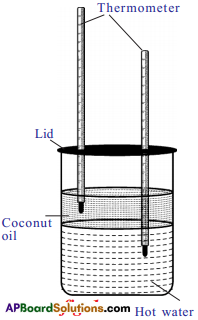
Answer:

  • Aluminium reacts with dil. HCl and releases hydrogen gas with formation of Aluminium chloride.
    AP SSC 10th Class Chemistry Solutions Chapter 9 Classification of Elements- The Periodic Table 11
  • Aluminium reacts with NaOH solution and releases hydrogen gas.
  • AP SSC 10th Class Chemistry Solutions Chapter 9 Classification of Elements- The Periodic Table 12
  • The above two reactions says that Aluminium is amphoteric.
  • Aluminium does not react with water at room temperature.
  • This concludes that the properties of Aluminium are in between a metal and non¬metal. So it behaves like a metalloid.

Question 25.
Collect the information about reactivity of VIIIA group elements (noble gases) from internet or from your school library and prepare a report on their special character when compared to other elements of periodic table. (AS4)
Answer:
Reactivity of Noble gases :

  • The noble gases show extremely low chemical reactivity.
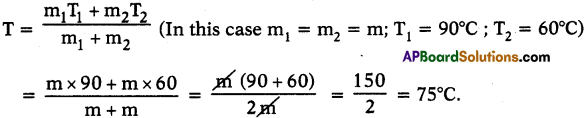
  • He and Ne do not form chemical compounds.

  • Xenon, krypton and argon show only minor reactivity.
  • The reactivity order follows like this : Ne < He < Ar < Kr < Xe < Rn.
  • Xenon can form compounds like XeF2, XeF4 and XeF6, etc.

Reasons for low reactivity :

  • The extremely low reactivity of noble gases is due to stable electronic configuration.
  • But as we move from top to bottom the reactivity increases. So xenon can form some compounds with high electronegative elements.

AP SSC 10th Class Chemistry Solutions Chapter 9 Classification of Elements- The Periodic Table

Question 26.
Collect information regarding metallic character of elements of IA group and prepare report to support the idea of metallic character increases in a group as we move from top ro bottom. (AS4)
Answer:
Metallic character of IA group elements :

  1. Alkali metals exhibit many of the physical properties common to metals but their densities are lower than those of other metals.
  2. Alkali metals have one electron in their outer shell which is loosely bound.
  3. They have largest atomic radii of the elements in their respective periods.
  4. The lower ionization energies result in their metallic properties and high reactivities.
  5. An alkali metal can easily lose its valence electron to form positive ion.
  6. So they have greater metallic character.
  7. The metallic character increases as we move from top to bottom in group due to addition of another shell, it is easy to lose electron.

Question 27.
How do you appreciate the role of electronic configuration of the atoms of elements in periodic classification? (AS6)
(OR)
How does electronic configuration help in the classification of elements in modern periodic table?
Answer:
The quantity is electronic configuration.

  1. Modern periodic table is based on electronic configuration. So elements are arranged in ascending order of their atomic numbers.
  2. The chemical properties of elements depend on valence electrons. The elements in same group have same number of valence electrons. So the elements belonging to same group have similar properties.
  3. So the construction of modern periodic table mainly depends on electronic configuration.
  4. Thus electronic configuration plays a major role in the preparation of modern periodic table. So its role is thoroughly appreciated.

Question 28.
Without knowing the electronic configurations of the atoms of elements Mendeleeff still could arrange the elements nearly close to the arrangements in the Modern periodic table. How can you appreciate this? (AS6)
Answer:

  • Mendeleeff took consideration about chemical properties while arranging the elements. So the arrangement of elements is close to arrangement of elements in Modern periodic table.
  • For this, he violated his periodic law.
  • He left some gaps for elements, later those elements are discovered.
  • So the efforts of Mendeleeff should be thoroughly appreciated.

Question 29.
Comment on the position of hydrogen in periodic table. (AS7)
Answer:

  • Hydrogen is the element which has easier atomic structure than any other element.
  • Electron configuration of hydrogen is Is1. It has one proton in its is nucleus and one electron in its is orbital.
  • Hydrogen combines with halogens, oxygen and sulphur to form compounds having similar formulae just like alkali metals.
  • Similarly, just like halogens, hydrogen also exists as diatomic molecule and combine with metals and non-metals to form covalent compounds.
  • As alkali metals hydrogen can lose one electron and accept one electron as halogens.
  • So in periodic table, its place may be in IA or VIIA group.
  • But based on electronic configuration of hydrogen, it is placed in IA group.

AP SSC 10th Class Chemistry Solutions Chapter 9 Classification of Elements- The Periodic Table

Question 30.
How do the positions of elements in the periodic table help you to predict its chemical properties? Explain with an example. (As7)
Answer:
1) The physical and chemical properties of atoms of the elements depend on their electronic configuration, particularly the outer shell configurations.

2) Elements are placed in the periodic table according to the increasing order of their electronic configuration.

3) The elements in a group possess similar electronic configurations. Therefore all the elements in a group should have similar chemical properties.
Ex : Consider K

  • It is the element in 4th period 1st group.
  • Electron configuration : 1s² 2s² 2p6 3s² 3p6 4s¹.
  • Differentiating electron enters into s-orbital. Hence it belongs to s-block.
  • It is on the left side of the periodic table. Hence it is a metal.
  • It is ready to lose one electron to get octet configuration. Hence its reactivity is more.
  • It is Alkali metal.
  • All alkali metals react with both acids and bases and releases H2 gas.

Fill In The Blanks

1. Lithium, ……………… and potassium constitute a Dobereiner’s triad.
2. ……………… was the basis of the classifications proposed by Dobereiner, Newlands, and Mendeleeff.
3. Noble gases belong to ……………… group of periodic table.
4. The incomplete period of the modern periodic table is
5. The element at the bottom of a group would be expected to show …………….. metallic character than the element at the top

Answer:

  1. Sodium
  2. Atomic weight
  3. VIIIA or 18 group
  4. 7<sup>th</sup>
  5. higher

Multiple Choice Questions

1. Number of elements present in period – 2 of the long form of periodic table …………
A) 2
B) 8
C) 18
D) 32
Answer:
B) 8

2. Nitrogen (Z = 7) is the element of group V of the periodic table. Which of the following is the atomic number of the next element in the group?
A) 9
B) 14
C) 15
D) 17
Answer:
C) 15

AP SSC 10th Class Chemistry Solutions Chapter 9 Classification of Elements- The Periodic Table

3. Electronic configuration of an atom is 2, 8, 7. To which of the following elements would it be chemically similar?
A) Nitrogen (Z = 7)
B) Fluorine (Z = 9)
C) Phosphorous (Z – 15)
D) Argon (Z = 18)
Answer:
B) Fluorine (Z = 9)

4. Which of the following is the most active metal?
A) lithium
B) sodium
C) potassium
D) rubidium
Answer:
D) rubidium

10th Class Chemistry 9th Lesson Classification of Elements-The Periodic Table InText Questions and Answers

10th Class Chemistry Textbook Page No. 129

Question 1.
Can you establish the same relationship with the set of elements given in the remaining rows?
Answer:
Yes, we can establish the approximately same relationship between other elements given in the table.

Question 2.
Find average atomic weights of the first and third elements in each row and compare it with the atomic weight of the middle element. What do you observe?
Answer:
The atomic weight of middle element is arithmetic mean coverage of first and third elements.

10th Class Chemistry Textbook Page No. 135

Question 3.
What is atomic number?
Answer:
The number of positive charges (protons) in the atom of element is the atomic number of element.

10th Class Chemistry Textbook Page No. 142

Question 4.
How does the valency vary in a period on going from left to right?
Answer:
It does not follow a regular trend when we move from left to right in a period. First, it increases and then decreases and finally ‘O’ for inert gases.

AP SSC 10th Class Chemistry Solutions Chapter 9 Classification of Elements- The Periodic Table

Question 5.
How does the valency vary on going down a group?
Answer:
The valency is constant when we move from top to bottom in a group because the number of valence electrons are same for same group elements.

10th Class Chemistry Textbook Page No. 144

Question 6.
Do the atom of an element and its ion have same size?
Answer:
No, the positive ion has smaller size than neutral atom whereas negative ion has greater size than neutral atom.

Question 7.
Which one between Na and Na+ would have more size? Why?
Answer:

  • The atomic number of Sodium is 1 and it has 11 protons and 11 electrons with outer electron as 3s¹ whereas Na+ ion has 11 protons but only 10 electrons.
  • The 3s shell of Na+ has no electron in it.
  • So the outer shell configuration is 2s²2p6.
  • As proton number is more than electrons, the nucleus of Na+ ion attracts outer shell electrons with strong nuclear force.
  • As a result the Na+ ion shrinks in size.
  • Therefore, the size of Na+ ion is less than Na atom.

AP SSC 10th Class Chemistry Solutions Chapter 9 Classification of Elements- The Periodic Table

Question 8.
Which one between Cl and Cl would have more size? Why?
Answer:

  • The electronic configuration of chlorine (Cl) atom is 1s2 2s² 2p6 3s² 3p5 and the electronic configuration of chloride (Cl) ion is 1s² 2s² 2p6 3s² 3p6.
  • Both chlorine and chloride ions have 17 protons each but there are 17 electrons in chlorine atom, whereas 18 electrons in chloride ion.
  • Therefore, the nuclear attraction is less in Cl ion when compared with chlorine atom.
  • Therefore the size of the chlorine (Cl) atom is less size than chloride of Cl ion.

Question 9.
Which one in each of the following pairs is larger in size? Why?
a) Na, Al
b) Na, Mg+2
c) S2-, Cl
d) Fe2+, Fe3+
e) C4-, F.
Answer:
a) Na has larger size because Sodium and Aluminium are third period elements in which Na is left to Al. As we move from left to right in a period atomic size decreases.

b) Mg2+ has smaller size because Mg2+ has 10 electrons and 12 protons whereas Na has 11 electrons and 11 protons. So the distance between nucleus and outermost orbital is less in Mg2+ due to greater nuclear attraction.

c) S2- has, larger size because S2- has 18 electrons and 16 protons and Cl has 18 electrons and 17 protons. So nuclear attraction over outermost orbital is more in Cl when compared with S2-. So S2- has larger size.

d) In Fe2+ it has 26 protons and 24 electrons whereas for Fe3+ it has 26 protons and 23 electrons. So nuclear attraction over outermost orbital is more in Fe3+. So Fe3+ has smaller size (or) Fe2+ has larger size.

e) C4- has 6 protons and 10 electrons whereas F has 9 protons and 10 electrons. So nuclear attraction is less in C4-. So size of C4- is more than F.

10th Class Chemistry Textbook Page No. 129

Question 10.
What relation about elements did Dobereiner want to establish?
Answer:
Dobereiner wanted to give a relationship between the properties of elements and their atomic weights.

Question 11.
The densities of calcium (Ca) and barium (Ba) are 1.55 and 3.51 gem-3 respectively. Based on Dobereiner’s law of triads can you give the approximate density of strontium (Sr)?
Answer:
Molecular weight is directly proportional to density.

So density of strontium is mean of calcium and barium according to Dobereiner.
∴ Density of strontium = [latex]\frac{1.55+3.51}{2}[/latex] = 2.53.

10th Class Chemistry Textbook Page No. 130

Question 12.
Do you know why Newlands proposed the law of octaves? Explain your answer in terms of the modern structure of the atom.
Answer:

  • John Newlands found that when elements were arranged in the ascending order of their atomic weights, they appeared to fall into seven groups.
  • Each group contained elements with similar properties.
  • If we start with hydrogen and move down, the next eighth element is fluorine, and then next eighth element is chlorine and the properties of these elements are similar.
  • Similarly, if we start from Lithium their eighth element is Sodium and next eighth element is potassium. These show similar properties.

AP SSC 10th Class Chemistry Solutions Chapter 9 Classification of Elements- The Periodic Table

Question 13.
Do you think that Newlands’ law of octaves is correct? Justify.
Answer:
No, there are some limitations of Newlands’ model:

  • There are instances of two elements fitted into the same slot. Eg : Cobalt and Nickel.
  • Certain elements, totally dissimilar in their properties, were fitted into the same group.
  • Law of octaves holds good only for the elements up to Calcium.
  • Newlands’ periodic table was restricted to only 56 elements and did not leave any room for new elements.
  • Newlands had taken consideration about active pattern sometimes without caring the similarities.

10th Class Chemistry Textbook Page No. 134

Question 14.
Why did Mendeleeff have to leave certain blank spaces in his periodic table? What is your explanation for this?
Answer:
1) Mendeleeff predicted that some elements which have similar properties with the elements in a group are missing at that time.
2) So he kept some blanks in the periodic table by writing ’eka’ to the name of the element immediately above the empty space.
3) Later these elements are discovered and they are fitted into those empty spaces.

Question 15.
What is your understanding about Ea2O3, EsO2?
Answer:

  • Mendeleeff predicted that after aluminium there was another element namely eka- aluminium (Ea) and after silicon, there was another element namely eka-silicon (Es).
  • He also gave the formulae of those oxides as Ea203 and Es02.
  • Later those elements are discovered namely gallium and germanium and Ea2O3 and EsO2 as Ga2O3 and GeO2.

10th Class Chemistry Textbook Page No. 135

Question 16.
All alkali metals are solids but hydrogen is a gas with diatomic molecules. Do you justify the inclusion of hydrogen in first group with alkali metals?
Answer:
No, hydrogen shows the properties of both alkali metals and halogens. Still the position of hydrogen has some questions. So it was kept just above alkali metals in first group.

10th Class Chemistry Textbook Page No. 141

Question 17.
Why are lanthanoids and actinoids placed separately at the bottom of the periodic table?
Answer:
The properties of these elements do not coincide with other elements because the valence electron enters 4f and 5f orbitals respectively. So they are placed separately at the bottom of the periodic table.

Question 18.
If lanthanoids and actinoids are inserted within the table, imagine how the table would be?
Answer:
It looks very big in size, and it is difficult to identify, as these elements have similar properties.

10th Class Chemistry Textbook Page No. 145

Question 19.
Second ionization energy of an element is higher than its first ionization energy. Why?
Answer:

  • The energy required to remove an electron from unipositive ion is called second ionisation energy.
  • It is difficult to remove an electron from unipositive ion when compared with neutral atom due to an increase in nuclear attraction.
  • So always second ionisation energy is higher than first ionisation energy.

10th Class Chemistry Textbook Page No. 146

Question 20.
The calculated electron gain enthalpy values for alkaline earth metals and noble gases are positive. How can you explain this?
Answer:

  • Generally alkaline earth metals having one, two or three valence electrons prefer to lose electrons in order to get inert gas configuration. So it is difficult to add electron to alkaline earth metals. So they have positive electron gain enthalpy values.
  • Noble gases are stable. So they do not prefer to take electrons. So they have positive electron gain enthalpy.

AP SSC 10th Class Chemistry Solutions Chapter 9 Classification of Elements- The Periodic Table

Question 21.
The second period element, for example, ‘F’ has less electron gain enthalpy than the third period element of the same group for example ‘Cl’. Why?
Answer:

  • Electron gain enthalpy values decrease in a group as we go down and increase from left to right along a period.
  • But the size of Fluorine is small compared chlorine.
  • So it is difficult to add electron to fluorine.
  • So fluorine has less electron gain enthalpy.

10th Class Chemistry 9th Lesson Classification of Elements- The Periodic Table Activities

Activity – 1

Question 1.
Observe the following table. Establish the relationship of other elements given in the table.
AP SSC 10th Class Chemistry Solutions Chapter 9 Classification of Elements- The Periodic Table 13
Answer:
AP SSC 10th Class Chemistry Solutions Chapter 9 Classification of Elements- The Periodic Table 14

Activity – 2

Question 2.
Some main group elements of s-block and p-block have family names as given in the following table.
Observe the long form of a periodic table and complete the table with proper information.
AP SSC 10th Class Chemistry Solutions Chapter 9 Classification of Elements- The Periodic Table 15
Answer:
AP SSC 10th Class Chemistry Solutions Chapter 9 Classification of Elements- The Periodic Table 16

Activity – 3

Question 3.
Collect valencies of first 20 elements.
Answer:
AP SSC 10th Class Chemistry Solutions Chapter 9 Classification of Elements- The Periodic Table 17

AP SSC 10th Class Physics Solutions Chapter 5 Refraction of Light at Plane Surfaces

AP State Board Syllabus AP SSC 10th Class Physics Solutions Chapter 5 Refraction of Light at Plane Surfaces Textbook Questions and Answers.

AP State Syllabus SSC 10th Class Physics Solutions 5th Lesson Refraction of Light at Plane Surfaces

10th Class Physics 5th Lesson Refraction of Light at Plane Surfaces Textbook Questions and Answers

Improve Your Learning

Question 1.
Why is it difficult to shoot a fish swimming in water? (AS1)
(OR)
If the fish is swimming in water, why it is difficult to shoot?
(OR)
A shooter finds it difficult to shoot a fish swimming in water. Why?
Answer:
Due to refraction of light, it is difficult to shoot a fish swimming in water.

Reason :
The light rays coming from the fish towards shooter, bend at water-air interface. So, shooter sees only image of the fish, but not actual fish.

AP SSC 10th Class Physics Solutions Chapter 5 Refraction of Light at Plane Surfaces

Question 2.
The speed of light in a diamond is 1,24,000 km/s. Find the refractive index of diamond if the speed of light in air is 3,00,000 km/s. (AS1)
Answer:
Speed of light in diamond = 1,24,000 km/s
Speed of light in vacuum = 3,00,000 km/s
AP SSC 10th Class Physics Solutions Chapter 5 Refraction of Light at Plane Surfaces 1

Question 3.
Refractive index of glass relative to water is 9/8. What is the refractive index of water relative to glass? (AS1)
Answer:
Refractive index of glass relative to water = [latex]\frac{n_{g}}{n_{w}}=\frac{9}{8}[/latex]
∴ Refractive index of water relative to glass = [latex]\frac{\mathrm{n}_{\mathrm{w}}}{\mathrm{n}_{\mathrm{g}}}=\frac{8}{9} \cdot\left[\because \mathrm{n}_{12}=\frac{1}{\mathrm{n}_{21}}\right][/latex]

Question 4.
The absolute refractive index of water is 4/3. What is the critical angle ? (AS1)
Answer:
Absolute refractive index of water = 4/3
AP SSC 10th Class Physics Solutions Chapter 5 Refraction of Light at Plane Surfaces 2
Critical angle of water = C = 48°5′ = 48.5°.

Question 5.
Determine the refractive index of benzene if the critical angle is 42°. (AS1)
Answer:
Critical angle of benzene = 42°.
AP SSC 10th Class Physics Solutions Chapter 5 Refraction of Light at Plane Surfaces 3

Question 6.
Explain the formation of mirage. (AS1)
(OR)
How is the mirage formed? Explain.
(OR)
A person walking on a road observed some water being present on the road but when he went there actually he did not find water. What is that actually formed called? Explain that process.
(OR)
Sometimes during the hot summer at noon time on tar roads, it appears that there is water on the road, but there would really be no water. What do you call this phenomenon? Explain why it happens.
(OR)
Why do you see a mirage the road on a hot summer day?
Answer:

  • During hot summer day, air just above the road surface is very hot and the air at higher altitudes is cool.
  • We know that refractive index of air increases with density.
  • So, the cooler air at the top has greater refractive index than hotter air just above the road.

AP SSC 10th Class Physics Solutions Chapter 5 Refraction of Light at Plane Surfaces 4

  • Light travels faster through the thinner hot air than the denser cool air above it.
  • On hot days, the temperature decreases with height.
  • Thus the refractive index of air increases with height.
  • When the light from a tall object such as tree or from the sky passes, through a medium just above the road whose refractive index decreases towards ground, suffers refraction and takes a curved path because of total internal reflection.
  • This refracted light reaches the observer in a direction shown as in second figure.
  • This appears to the observer that the ray is reflected from ground.
  • Hence we will see water on road, which is the virtual image of sky and an inverted image of tree on the road.
  • Such virtual images of distant high objects cause the optical illusion called ‘mirage’.

AP SSC 10th Class Physics Solutions Chapter 5 Refraction of Light at Plane Surfaces

Question 7.
How do you verify experimentally that [latex]\frac{\sin i}{\sin r}[/latex] is a constant? (AS1)
(OR)
Explain the experiment that shows the relation between angle of incidence and angle of refraction through figure.
(OR)
Write an experiment to obtain the relation between angle of incidence and angle of refraction.
Answer:
Aim:
Identifying relation between angle of incidence and angle of refraction.

Materials required :
A plank, white chart, protractor, scale, small black painted plank, a semi-circular glass disc of thickness nearly 2 cm pencil and laser light.

Procedure :
AP SSC 10th Class Physics Solutions Chapter 5 Refraction of Light at Plane Surfaces 5 AP SSC 10th Class Physics Solutions Chapter 5 Refraction of Light at Plane Surfaces 6

  1. Take a wooden plank which is covered with white chart.
  2. Draw two perpendicular lines, passing through the middle of the paper as shown in the figure (a).
  3. Let the intersecting point be O.
  4. Mark one line as NN which is normal to the another line marked as MM.
  5. Here MM represents the line drawn along the interface of two media and NN represents the normal drawn to this line at ‘O’.
  6. Take a protractor and place it along NN in such a way that its centre coincides with ‘O’ as shown in figure (b).
  7. Then mark the angles from 0° to 90° on both sides of the line NN.
  8. Repeat the same on the other side of the line NN.
  9. The angles should be represented on circular line.
  10. Now place semi circular glass disc so that its diameter coincides with the interface line (MM) and its centre coincides with the point O.
  11. Take the laser light and send it along NN in such a way that the laser propagates from air to glass through the interface at point O and observe the way of laser light coming from other side of disc.
  12. There is no deviation.
  13. Send Laser light along a line which makes 15° (angle of incidence) with NN and see that it must pass through point O.
  14. Measure its corresponding angle of refraction.
  15. Repeat the experiment with angle of incidences of 20°, 30°, 40°, 50° and 60° and note the corresponding angles of refraction.

Observation :

  • Find sin i, sin r for every i and r note down the values in table.

AP SSC 10th Class Physics Solutions Chapter 5 Refraction of Light at Plane Surfaces 7

  • Evaluate [latex]\frac{\sin i}{\sin r}[/latex] for every incident angle i.
  • We get [latex]\frac{\sin i}{\sin r}[/latex] as constant.
  • That is the relationship between angle of incidence and angle of refraction.
  • The ratio of sin i and sin r is called refractive index.

Question 8.
Explain the phenomenon of total internal reflection with one or two activities. (AS1)
Answer:
Procedure :

  1. Place the semi-circular glass disc in such a way that its diameter coincides with interlace line MM and its center coincides with point O’.
  2. Now send light from the curved side of the semicircular glass disc.
  3. The light travels from denser medium to rarer medium.
  4. Start with angle of incidence (i), equals to 0° and observe for refracted on other side of the disc.
  5. It does not deviate into its path when entering rarer medium.
  6. Send laser light along angles of incidence 5°, 10°, 15°, etc. and measure the angle of refraction.
  7. And tabulate the results in the given table.

Observation :

  • Make a table shown below and note the values ‘i’ and ‘r’.

AP SSC 10th Class Physics Solutions Chapter 5 Refraction of Light at Plane Surfaces 8

  • At particular angle of incidence, the refracted ray does not come out but grazes the interface separating the air and glass. This angle is called critical angle.
  • When the angle of incidence is greater than critical angle, the light ray gets reflected into denser medium at the interface, i.e. light never enters rarer medium. This phenomenon is called total internal reflection.

AP SSC 10th Class Physics Solutions Chapter 5 Refraction of Light at Plane Surfaces

Question 9.
How do you verify experimentally that the angle of refraction is more than angle of incidence when light rays travel from denser to rarer medium? (AS1)
(OR)
When the light rays travel from denser to rarer medium, how can you explain, the angle of refraction is more than angle of incidence experimentally?
Answer:
Procedure :
AP SSC 10th Class Physics Solutions Chapter 5 Refraction of Light at Plane Surfaces 9
AP SSC 10th Class Physics Solutions Chapter 5 Refraction of Light at Plane Surfaces 10

  • Take a metal disc. Use a protractor and mark angles along its edge as shown in the figure.
  • Arrange two straws at the centre of the disc, in such a way that they can be rotated freely about the centre of the disc.
  • Adjust one of the straws to make an angle 10°.
  • Immerse half of the disc vertically into the water, filled in a transparent vessel. While dipping, verify that the straw at 10° must be inside the water.
  • From the top of the vessel, try to view the straw which is inside the water as shown in the figure.
  • Then adjust the other straw which is outside of the water until both straws look like they are in a single straight line.
  • Then take the disc out of the water and observe the two straws on it. You will find that they are not in a single straight line.
  • Measure the angle between the normal and second straw. Note the values in the following table.

AP SSC 10th Class Physics Solutions Chapter 5 Refraction of Light at Plane Surfaces 11

  • Do the same for various angles and find the corresponding angles of refraction and note them in the table.

Observation :
We will find the angle of refraction is more than angle of incidence.
i. e., r > i.

Conclusion :
When light travels from denser (water) to rarer (air) it bends away from the normal.

Question 10.
Take a bright metal ball and make it black with soot in a candle flame. Immerse it in water. How does it appear and why? (Make hypothesis and do the above experiment) (AS2)
Answer:
AP SSC 10th Class Physics Solutions Chapter 5 Refraction of Light at Plane Surfaces 12

  • The black metallic .ball appears to be raised up in the water because the path of the ray changes its direction at the interface, separating the two media, i.e., water and air.
  • This path is chosen by light ray so as to minimize time of travel between ball and eye.
  • This can be possible only when the speed of light changes at interface of two media.
  • In another way the speed of light is different in different media.

Hypothesis :
Speed of light changes when it travels from one medium to another medium.

Question 11.
Take a glass vessel and pour some glycerine into it and then pour water up to the brim. Take a quartz glass rod. Keep it in the vessel. Observe the glass rod from the sides of the glass vessel.
1) What changes do you notice?
2) What could be the reasons for these changes? (AS2)
Answer:

  1. We cannot see the glass rod in glycerine but we can see the rod in water.
  2. We can also observe an apparent image of glass rod in water.
  3. Reasons:
    i) Glycerine has essentially same refractive index as glass.
    ii) So, any light passing through these is bent equally.
    iii) Since both are transparent, it is not possible for our eye to distinguish the boundary by a change in the angle of reflection, and the glass seems to vanish.
    iv) But, the refractive index of glass and water are different.
    v) So the glass rod is visible to our eye in water. .

Question 12.
Do Activity-7 again. How can you find critical angle of water? Explain your steps briefly. (AS3)
Answer:
AP SSC 10th Class Physics Solutions Chapter 5 Refraction of Light at Plane Surfaces 13
Procedure:

  1. Take a cylindrical transparent vessel.
  2. Place a coin at the bottom of the vessel.
  3. Now pour water until you get the image of the coin on the water surface.
  4. This is due to total internal reflection.

Critical angle of water :

  1. Refractive index of water = 1.33
  2. The sine of critical angle of water = [latex]\frac{1}{\text { Refractive index }}[/latex]
  3. Sin C = [latex]\frac{1}{\text { 1.33 }}[/latex] ⇒ sin C = 0.7518.
    ∴ C = 8.7°
  4. ∴ The critical angle of water = 48.7°.

AP SSC 10th Class Physics Solutions Chapter 5 Refraction of Light at Plane Surfaces

Question 13.
Collect the values of refractive index of the following media. (AS4)

Water, coconut oil, flint glass, crown glass, diamond, benzene and hydrogen gas.

Answer:

Medium Refractive Index
1. Water 1.33
2. Coconut oil 1.445
3. Flint glass 1.65
4. Crown glass 1.52
5. Diamond 2.42
6. Benzene 1.50
7. Hydrogen gas 1.000132

Question 14.
Collect information on working of optical fibres. Prepare a report about various uses of optical fibres in our daily life. (AS4)
(OR)
What do you know about the working of optical fibres and make a report of various uses of optical fibres in our daily life?
(OR)
How are the optical fibres working? What are the various uses of optical fibres in our daily life?
Answer:
1) An optical fibre is very thin fibre made of glass or plastic having radius about a micrometer (10-6 m).
2) A bunch of such thin fibres form a light pipe.
AP SSC 10th Class Physics Solutions Chapter 5 Refraction of Light at Plane Surfaces 14

Working :
1. Optical fibre having three parts-namely core (n = 1, 7), clading (n = 1, 6) and shielding.
2. The ray of light AB gets refracted at point ‘B’ into core and incident at ‘C’ with angle of incidence i (i > c).

AP SSC 10th Class Physics Solutions Chapter 5 Refraction of Light at Plane Surfaces 15
3. The angle of incidence is greater than the critical angle and hence total internal reflection takes place.
4. The light is thus transmitted along the fibre.
5. The optical fibre is also based on ‘Fermat’s principle.

Uses :

  1. Optical fibres are used in ‘endoscopy’ to see the internal organs like throat, stomach, intestines, etc.
  2. Optical fibres are used in transmitting communication signals through light pipes.
  3. Optical fibres are used in international telephone cables laid under the sea, in large computer networks, etc.
  4. In optical fibre about 2000 telephone signals appropriately mixed with light waves may be simultaneously transmitted through a typical optical fibre.

Question 15.
Take a thin thermocol sheet. Cut it in circular discs of different radii like 2 cm, 3 cm, 4 cm, 4.5 cm, 5 cm etc. and mark centers with sketch pen. Now take needles of length nearly 6 cm. Pin a needle to each disc at its centre vertically. Take water in a large opaque tray and place the disc with 2 cm radius in such a way that the needle is inside the water as shown in figure. Now try to view the free end (head) of the needle from surface of the water.
AP SSC 10th Class Physics Solutions Chapter 5 Refraction of Light at Plane Surfaces 17
1) Are you able to see the head of the needle?
Now do the same with other discs of different radii. Try to see the head of the needle, each time.
Note : The position of your eye and the position of the disc on water surface should not be changed while repeating the Activity with’other discs.
2) At what maximum radius of disc, were you not able to see the free end of the needle ?
3) Why were you not able to view the head of the nail for certain radii of the discs ?
4) Does this Activity help you to find the critical angle of the medium (water) ?
5) Draw a diagram to show the passage of light ray from the head of the nail in different situations. (AS4)
Answer:
AP SSC 10th Class Physics Solutions Chapter 5 Refraction of Light at Plane Surfaces 29
1. Yes, we can see head of the needle.

2. Height of the pin = 6 cm
Radius of the disc = x cm
Critical angle of water = C = 48.7°
Tan C = 48.7°
[latex]\frac{x}{6}[/latex] = 1.138 ⇒ x = 6.828 cm
So, at radius of 6.8 cm we cannot see the free end of the needle.

3. Because the light rays coming from object undergoing total internal reflection by touching the surface of disc.

4. Yes, we can find critical angle.
Refractive index of air (n2) = 1.003 ; Refractive index of water (n1) = 1.33
Sin C = [latex]\frac{n_{2}}{n_{1}}=\frac{1.003}{1.33}[/latex] = 0.7541 ⇒ C = 48.7°

5.
AP SSC 10th Class Physics Solutions Chapter 5 Refraction of Light at Plane Surfaces 18

Question 16.
Explain the refraction of light through the glass slab with a neat ray diagram. (AS5)
(OR)
Draw a glass slab diagram and explain the refraction of light through glass slab.
(OR)
Write the procedure of a lab Activity to understand lateral shift of light rays through a glass slab.
(OR)
How can you find lateral shift using glass slab?
Answer:
Aim :
A) Determination of position and nature of image formed by a glass slab.
B) Understanding lateral and vertical shift.
C) Determination of refractive index of given glass slab.

Materials required :
Plank, chart paper, clamps, scale, pencil, thin glass slab and pins.

AP SSC 10th Class Physics Solutions Chapter 5 Refraction of Light at Plane Surfaces 16

Procedure :

  1. Place a piece of chart on a plank. Clamp it. Place a glass slab in the middle of the paper.
  2. Draw border line along the edges of the slab by using a pencil. Remove it. You will get a figure of a rectangle.
  3. Name the vertices of the rectangle as A, B, C and D.
  4. Draw a perpendicular at a point on the longer sides (AB) of the rectangle.
  5. Now draw a line, from the point of intersection where side AB of rectangle and perpendicular meet, in such a way that it makes 30° angle with the normal.
  6. This line represents the incident ray falling on the slab and the angle it makes with normal represents angle of incidence.
  7. Now place the slab on the paper in such a way that it fits in the rectangle drawn. Fix two identical pins on the line making 30° angle with normal, such that they stand vertically with same height.
  8. By looking at the two pins from the other side of the slab, fix two pins in such a way that all pins appear to be along a straight line.
  9. Remove the slab and take out pins. Draw a straight line by joining the dots formed by the pins up to the edge CD of the rectangle.
  10. This line represents emergent ray of the light.
  11. Draw a perpendicular to the line CD where our last line drawn meets the line CD.
  12. Measure the angle between emergent ray and normal.
  13. This is called angle of emergence.
  14. The angle of incidence and angle of emergence are equal.
  15. Incident emergent rays are parallel.
  16. The distance between the parallel rays is called shift.

Question 17.
Place an object on the table. Look at the object through the transparent glass slab. You will observe that it will appear closer to you. Draw a ray diagram to show the passage of light ray in this situation. (AS5)
Answer:
AP SSC 10th Class Physics Solutions Chapter 5 Refraction of Light at Plane Surfaces 19

Question 18.
What is the reason behind the shining of diamond and how do you appreciate it? (AS6)
(OR)
For which reason is the diamond shining and how is it appreciable?
Answer:

  • The critical angle of diamonds is very low, i.e., 24.4°.
  • So if a light ray enters diamond, it undergoes total internal reflection.
  • It makes the diamond shine brilliant.
  • So total internal reflection is main cause of brilliance of diamonds.
  • Majority of people are attracted towards diamonds due to this property.
  • So we have to thoroughly appreciate total internal reflection for brilliance of diamonds.

AP SSC 10th Class Physics Solutions Chapter 5 Refraction of Light at Plane Surfaces

Question 19.
How do you appreciate the role of Fermat’s principle in drawing ray diagrams? (AS6)
(OR)
How do you admire the role of Fermat’s principle in drawing ray diagrams? Fermat’s principle: The light ray always travels in a path which needs shortest possible time to cover distance between two points.
This principle has lot of importance on optics. This is used in

  1. Laws of reflection (i.e., angle of incidence = angle of reflection)
  2. Laws of refraction (Snell’s law)
  3. To derive refractive index of a medium.
  4. To derive refractive index of glass slab.
    So, I appreciate the Fermat’s principle.

Question 20.
A light ray is incident on air-liquid interface at 45° and is refracted at 30°. What is the refractive index of the liquid? For what angle of incidence will the angle between reflected ray and refracted ray be 90°? (AS7)
Answer:
i) Given that angle of incidence (i) = 4S°
angle of refraction (r) = 30°
AP SSC 10th Class Physics Solutions Chapter 5 Refraction of Light at Plane Surfaces 20

ii) Given that angle between reflected and refracted ray is 90°.
We know angle of incidence = angle of reflection
∴ Angle of refraction (r) = 90 – angle of incidence
= 90 – i
AP SSC 10th Class Physics Solutions Chapter 5 Refraction of Light at Plane Surfaces 21
Critical angle = 54.7°. This angle is also known as polarising angle.

Question 21.
Explain why a test tube immersed at a certain angle in a tumbler of water appears to have a mirror surface from a certain viewing position. (AS7)
Answer:
When a test tube is immersed at a certain angle in a tumbler of water appears to have
a mirror surface from a certain viewing positions due to total internal reflection.
AP SSC 10th Class Physics Solutions Chapter 5 Refraction of Light at Plane Surfaces 22
Explanation :

  • The critical angle for glass is 42°.
  • The glass and air in test tube works as denser and rarer mediums.
  • The rays of light while travelling through water strike glass – air interface of test tube at an angle of more than 42° (i > c) they get totally internal reflected as shown figure.
  • When these reflected rays reach the eye, they appear to come from the surface of test tube itself.
  • Now the test tube appears like silvary.

AP SSC 10th Class Physics Solutions Chapter 5 Refraction of Light at Plane Surfaces

Question 23.
In what cases does a light ray not deviate at the interface of two media? (AS7)
Answer:

  1. When a light ray incident is perpendicular to the interface of surface, it does not undergo deviation.
  2. When a light ray incident is more than critical angle, it does not undergo deviation (refraction) but it undergoes reflection to come back into the original medium.

Question 25.
When we sit at camp fire, objects beyond the fire seen swaying. Give the reason for it. (AS7)
(OR)
What are the reasons for the objects beyond the fire seen swaying, when we sit at camp fire?
Answer:

  • The temperature of the surrounding air changes due to convection of heat by the camp fire.
  • This leads to chang in density and refractive index of air, continuously.
  • The continuous change in refractive index of air changes the refracted path of the light ray.
  • This is the cause for swaying of an object.

Question 26.
Why do stars appear twinkling? (AS7)
(OR)
What is the reason for the appearance of stars like twinkling?
Answer:

  • The twinkling of a star is due to atmospheric refraction of star light.
  • The atmosphere consists of a number of layers of varying densities.
  • When light rays coming from a star pass through this layers and undergo refraction for several times.
  • Thats why stars appear twinkling.

AP SSC 10th Class Physics Solutions Chapter 5 Refraction of Light at Plane Surfaces

Question 27.
Why does a diamond shine more than a glass piece cut to the same shape? (AS7)
(OR)
What is the reason for shining of diamond brightly as compared to glass piece cut?
Answer:

  • The critical angle of a diamond is very low (i.e., 24.4°).
  • So if a light ray enters a diamond it definitely undergoes total internal reflection.
  • Whereas it is not possible with glass piece cut to the same shape.
  • So diamond shines more than a glass piece.

Fill In The Blanks

1. At critical angle of incidence, the angle of refraction is ……………… .
2. n1 sin i = n2 sin r, is called ……………… .
3. Speed of light in vacuum is ……………… .
4. Total internal reflection takes place when a light ray propagates from …………. to …………… medium.
5. The refractive index of a transparent material is 3/2. The speed of the light in that medium is …………… .
6. Mirage is an example of ……………… .
Answer:

  1. 90°
  2. Snell’s law
  3. 3 × 10⁸ m/s
  4. denser, rarer
  5. 2 × 10⁸ m/s
  6. optical illusion / total internal reflection

Multiple Choice Questions

1. Which of the following is Snell’s law?
AP SSC 10th Class Physics Solutions Chapter 5 Refraction of Light at Plane Surfaces 30
Answer:
B)

2. The refractive index of glass with respect to air is 2. Then the critical angle of glass air interface is ………………….
A) 0°
B) 45°
C) 30°
D) 60°
Answer:
C) 30°

3. Total internal reflection takes place when the light ray travels from …………….. .
A) rarer to denser medium
B) rarer to rarer medium
C) denser to rarer medium
D) denser to denser medium
Answer:
C) denser to rarer medium

AP SSC 10th Class Physics Solutions Chapter 5 Refraction of Light at Plane Surfaces

4. The angle of deviation produced by the glass slab is …………… .
A) 0°
B) 20°
C) 90°
D) depends on the angle formed by the light ray and normal to the slab
Answer:
D) depends on the angle formed by the light ray and normal to the slab

10th Class Physics 5th Lesson Refraction of Light at Plane Surfaces Additional Questions and Answers

Question 1.
Derive Snell’s law.
(OR)
Prove n1 sin i = n2 sin r.
(OR)
Derive the Snell’s formula from Fermat’s principle.
(OR)
Derive the formula in realtion with and of incidence and angle of refraction.
Answer:
Let X be the path and A be the point above X and B be the point below X.
Now, we have to find the way from A to B.

  1. Let us try to calculate how long it would take to go from A to B by the two paths through point D and another through point C.
  2. If we draw a perpendicular DE, between two paths at D, we see that the path on line is shortened by the amount EC.
  3. On the other hand, in the water, by drawing corresponding perpendicular CF we find that we have to go to the extra distance DF in water. These times must be equal since we assumed there was no change in time between two paths.
  4. Let the time taken by the man to travel from E to C and D to F be ∆t and v1 and v2 be the speeds of the running and swimming. From figure we get,
    EC = v1 ∆t and DF = v2 ∆t
    ⇒ [latex]\frac{\mathrm{EC}}{\mathrm{DF}}=\frac{\mathrm{v}_{1}}{\mathrm{v}_{2}}[/latex] ………….. (1)
  5. Let i and r be the angles measured between the path ACB and normal NN, perpendicular to shore line X.

AP SSC 10th Class Physics Solutions Chapter 5 Refraction of Light at Plane Surfaces 23 AP SSC 10th Class Physics Solutions Chapter 5 Refraction of Light at Plane Surfaces 24

10th Class Physics 5th Lesson Refraction of Light at Plane Surfaces InText Questions and Answers

10th Class Physics Textbook Page No. 56

Question 1.
Why should you see a mirage as a flowing water?
Answer:

  • A mirage is a naturally occuring optical phenomenon, in which light rays are bent to produce a displaced image of distant objects or the sky.
  • As light passes from colder air (higher place) to warmer air (lower place), the light ray bends away from the direction of the temperature gradient.
  • Once the rays reach the viewer’s eye, the visual cortex interprets it as if it traces back along a perfectly straight “line of sight”. However this line is at a tangent to the path the ray takes at the point it reaches the eye.
  • The result is that an “inferior image ” of the sky above appears on the ground.
  • The viewer may incorrectly interprets this sight as water that is reflecting the sky, which is to the brain, a more reasonable and common occurrence.

Question 2.
Can you take a photo of a mirage?
Answer:

  • Yes, I can take a photo of a mirage.
  • Our eye can catches the total internal reflected rays.
  • So, camera lens also catches the same.

10th Class Physics Textbook Page No. 46

Question 3.
What difference do you notice in fig 2(a) and Fig 2(b) with the respect to refracted rays?
(OR)
Draw the ray diagram of refraction in between denser and rarer medium.
AP SSC 10th Class Physics Solutions Chapter 5 Refraction of Light at Plane Surfaces 27
Answer:
In figure 2(a) the light ray bends towards normal whereas in 2(b) the light ray bends away from the normal.

Question 4.
Is there any relation between behaviour of refracted rays and speed of the light?
Answer:
Yes. The speed of light changes when it travels from one medium to another medium. So the light may bend towards normal or away from normal.

10th Class Physics Textbook Page No. 47

Question 5.
Why db different material media possess different values of refractive indices?
Answer:
Refractive index depends on nature of material. So different media have different values of refractive indices.

10th Class Physics Textbook Page No. 48

Question 6.
On what factors does the refractive index of a medium depend?
Answer:
Refractive index depends on (1) Nature of material and (2) Wavelength of light used.

10th Class Physics Textbook Page No. 49

Question 7.
Can we derive the relation between the angle of incidence and the angles of refraction theoretically?
Answer:
Yes, we can derive the relation between angle of incidence and angles of refraction theoretically. We can get nt sin i = n2 sin r.

10th Class Physics Textbook Page No. 53

Question 8.
Is there any chance that angle of refraction is equal to 90° ? When does this happen?
Answer:
Yes, when angle of incidence is equal to critical angle then angle of refraction is equal to 90°.

10th Class Physics Textbook Page No. 54

Question 9.
What happens to light when the angle of incidence is greater than critical angle?
Answer:
When the angle of incidence is greater than critical angle, the light ray gets reflected into denser medium at the interface, i.e., light never enters rarer medium. This phenomenon is called total internal reflection.

10th Class Physics Textbook Page No. 57

Question 10.
How does light behave when a glass slab is introduced in its path?
Answer:
The light ray undergoes refraction two times.

10th Class Physics 5th Lesson Refraction of Light at Plane Surfaces Activities

Activity – 1

Question 1.
Procedure :
Take some water in a glass tumbler. Keep a pencil in it. See the pencil from one side of glass and also from the top of the glass.
Observation:

1. How does it look?
Answer:
From the side it appears to be bent. From the top it appears as it is raising.

AP SSC 10th Class Physics Solutions Chapter 5 Refraction of Light at Plane Surfaces

2. Do you find any difference between two views?
Answer:
Yes, the position of pencil is different.

Activity – 2

Question 2.
Procedure :

  1. Go to a long wall (of length of 30 feet) facing the Sun. Go to the one end of a wall and ask someone to bring a bright metal object near the other end of the wall.
  2. When the object is few inches from the wall, it will distort and we will see a reflected image on the wall as though the wall were a mirror.

Observation:

Why is there an image of the object on the wall?
Answer:
The image is due to refraction of light.

Activity-3 Refraction

Question 3.
Procedure: –

  1. Take a shallow vessel with opaque walls such as a mug, a tin or a pan.
  2. Place a coin at the bottom of the vessel.
  3. Move away from the vessel until we cannot see the coin (fig. 2). Ask someone to fill the vessel with water. When the vessel is filled with water the coin comes back into view (fig. 3).

AP SSC 10th Class Physics Solutions Chapter 5 Refraction of Light at Plane Surfaces 25

1. Why are you able to see the coin when the vessel is filled with water?
Answer:
The ray of light originated from the coin does not reach your eye when the vessel is empty. Hence you are not able to see the coin. But the coin becomes visible after the vessel is filled with water.

2. How is it possible? Do you think that the ray reaches your eye when the vessel is filled with water?
Answer:
Yes, it reaches the second instance.

3. What happens to the light ray at interface between water and air?
Answer:
It bends towards the normal.

AP SSC 10th Class Physics Solutions Chapter 5 Refraction of Light at Plane Surfaces

4. What could be the reason for this bending of the light ray in the second instance?
Answer:
It is based on Fermat’s principle, which states that the light ray always travels in a path which needs shortest possible time to cover the distance between the two points.

Activity – 4

Question 4.
Prove that when light ray travels from denser to rarer medium it bends away from the normal.
Answer:
AP SSC 10th Class Physics Solutions Chapter 5 Refraction of Light at Plane Surfaces 9
AP SSC 10th Class Physics Solutions Chapter 5 Refraction of Light at Plane Surfaces 10
Procedure :

  1. Take a metal disc. Use protractor and mark angles along its edge as shown in the figure.
  2. Arrange two straws from the centre of the disk.
  3. Adjust one of the straws to the angle 10°.
  4. Immerse half of the disc vertically into the water, filled in a transparent vessel.
  5. Inside the water the angle of straw should be at 10°.
  6. From the top of the vessel try to view the straw which is inside the water.
  7. Then adjust the other straw which is outside the water until both straws are in a single straight line.
  8. Then take the disc out of the water and observe the two straws on it.
  9. We will find that they are not in a single straight line.
  10. It could be seen from the side view while half of the disc is inside the water.
  11. Measure the angle between the normal and second straw. Draw table for various angles and corresponding angles of refraction.

Observation :
We observe that ‘r’ is greater than ‘i’ in all cases and when light travels from
denser to rarer medium it bends away from the normal.

Activity – 6

Question 5.
Why can we not see a coin placed in water from the side of glass?
Answer:
Procedure :

  1. Take a transparent glass tumbler and coin.
  2. Place a coin on a table and place glass on the coin.
  3. Observe the coin from the side of the glass. We can see the coin.
  4. Now fill the glass with water and observe the coin from the side of the glass tumber.
  5. Now we cannot see the coin because the coin rises up due to refraction.

Activity – 7

Question 7.
Why can we see the coin in water from top? What is the phenomenon behind that?
Answer:
AP SSC 10th Class Physics Solutions Chapter 5 Refraction of Light at Plane Surfaces 13
Procedure :

  1. Take a cylindrical transparent vessel. Place a coin at the bottom of the vessel.
  2. Now pour water until we will get the image of the coin on the water surface.
  3. This is due to total internal reflection.

Activity – 8

Question 8.
Write an Activity to find refractive index of glass slab by calculating vertical shift.
(OR)
Explain the experiment with glass slab in determination of refraction through vertical shift.
Answer:
AP SSC 10th Class Physics Solutions Chapter 5 Refraction of Light at Plane Surfaces 26
Procedure :

  1. Take a glass slab and measure the thickness of the slab.
  2. Take a white chart and fix it on the table.
  3. Place the slab in the middle of the chart.
  4. Draw line around it.
  5. Remove the slab from its place.
  6. The lines form a rectangle. Name the vertices of it as A. B, C and D. ‘
  7. Draw a perpendicular to the longer line AB of the rectangle at any point on it.
  8. Place slab again in the rectangle ABCD.
  9. Take a needle. Place at a point P in such a way that its length is parallel to the AB on the perpendicular line at a distance of 20 cm from the slab.
  10. Now take another needle and by seeing at the first needle from the other side of the slab, try to keep the needle so that it forms a straight line with the first needle. 1 1)
  11. Remove the slab and observe the positions of the needles.
  12. They are not in same line.
  13. Draw a perpendicular line from the second needle to the line on which the first needle is placed.
  14. Take the intersection point as Q.
  15. The distance between P and Q is vertical shift.
  16. We will get the same vertical shift placing needle at different distances.
  17. AP SSC 10th Class Physics Solutions Chapter 5 Refraction of Light at Plane Surfaces 28

AP SSC 10th Class Maths Bits with Answers in English and Telugu

Andhra Pradesh SCERT AP State Board Syllabus SSC 10th Class Maths Important Bits with Answers in English and Telugu Medium are part of AP Board Solutions Class 10.

Students can also read AP Board Solutions Class 10 Maths for board exams.

AP State Syllabus 10th Class Maths Important Bits with Answers in English and Telugu

10th Class Maths Bits in English Medium

10th Class Maths Bits (Old Syllabus)

10th Class Maths Bits in Telugu Medium (Old Syllabus)

AP Bit Bank