AP SSC 10th Class Chemistry Solutions Chapter 14 Carbon and its Compounds

AP State Board Syllabus AP SSC 10th Class Chemistry Solutions Chapter 14 Carbon and its Compounds Textbook Questions and Answers.

AP State Syllabus SSC 10th Class Chemistry Solutions 14th Lesson Carbon and its Compounds

10th Class Chemistry 14th Lesson Carbon and its Compounds Textbook Questions and Answers

Improve Your Learning

Question 1.
Name the simplest hydrocarbon. (AS1)
Answer:
The simplest hydrocarbon is alkane called Methane (CH4). It’s an aliphatic, saturated compound of Hydrogen and Carbon.

Question 2.
What are the general molecular formulae of alkanes, alkenes and alkynes? (AS1)
Answer:
General molecular formula of alkane is CnH2n+2.
General molecular formula of alkene is CnH2n.
General molecular formula of alkyne is CnH2n-2.

AP SSC 10th Class Chemistry Solutions Chapter 14 Carbon and its Compounds

Question 3.
Name the carboxylic acid used as a preservative. (AS1)
Answer:
Vinegar with chemical formula CH3COOH is used as preservative. 5 – 8% of solution of acetic acid or ethanoic acid in water is called vinegar and it is used widely as preservative in pickles.

Question 4.
Name the product other than water formed on burning of ethanol in air. (AS1)
Answer:
C2H3OH + 3O2 → 2CO2 + 3H2O + Energy
So, the product other than water formed on burning of ethanol in air is carbon dioxide (CO2).

Question 5.
Give the IUPAC name of the following compounds. If more than one compound is possible, name all of them. (AS1)
i) An aldehyde derived from ethane.
ii) A ketone derived from butane.
iii) A chloride derived from propane.
iv) An alcohol derived from pentane.
Answer:
i) An aldehyde derived from ethane is ethanal. Its formula is CH3CHO.
ii) A ketone derived from butane. Its IUPAC name is Butanone.
Its chemical formula is CH3COCH2CH3
It is also known as methyl ethyl ketone. (Its general name)

iii) A chloride derived from propane.
A) 1-Chloro propane. Its formula is CH3CH2CH2Cl.

AP SSC 10th Class Chemistry Solutions Chapter 14 Carbon and its Compounds 1
iv) An alcohol derived from pentane :
A) 1-Pentanol. Its formula is CH3CH2CH2CH2CH2OH.
B) 2-Pentanol. Its formula is CH3CHOH CH2CH2CH3
C) 3-Pentanol. Its formula is CH3CH2 CHOH CH2CH3

Question 6.
A mixture of oxygen and ethyne is burnt for welding ; can you tell why a mixture of ethyne and air is not used? (AS1)
Answer:

  • Ethyne when burnt in the presence of oxygen gives enough heat that can be used for welding.
  • Whereas if it is burnt in air which contains nitrogen, CO2 and other inactive gaseous contents, sufficient oxygen is not available for burning ethyne to give the required heat.

Question 7.
Explain with the help of a chemical equation, how an addition reaction is used in vegetable ghee industry. (AS1)
Answer:

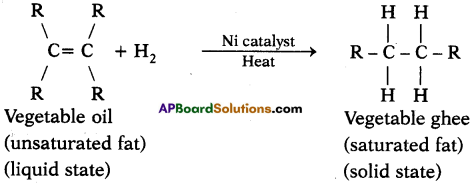
  • The addition of hydrogen to an unsaturated hydrocarbon to obtain a saturated hydrocarbon is called hydrogenation. The process of hydrogenation takes place in the presence of nickel or palladium metals as catalyst.
  • The process of hydrogenation has an important industrial application. It is used to prepare vegetable ghee (or vanaspati ghee) from vegetable oils.
  • Vegetable oils are unsaturated fats having double bonds between some of their carbon atoms.
  • When a vegetable oil (like groundnut oil) is heated with hydrogen in the presence of finely divided nickel as catalyst, a saturated oil called vegetable ghee (or vanaspati ghee) is formed. This a reaction is called hydrogenation of oils and it can be represented as follows.
AP SSC 10th Class Chemistry Solutions Chapter 14 Carbon and its Compounds 18

Here vegetable oil is a liquid whereas vegetable ghee is a solid (or a semi solid).

Question 8.
a) What are the various possible structural formulae of a compound having molecular formula C3H6O? (AS1)
b) Give the IUPAC names of the above possible compounds and represent them in structures. (AS1)
c) What is the similarity in these compounds? (AS1)
Answer:
a) They are CH3COCH3and CH3 CH2 CHO

b) i) The IUPAC name of CH3COCH3 is propanone.
ii) The IUPAC name of CH3 CH2 CHO is propanal.

AP SSC 10th Class Chemistry Solutions Chapter 14 Carbon and its Compounds 19

Question 9.
Name the simplest ketone apfl write its molecular formula. (AS1)
Answer:
Acetone is the simplest ketone. Its molecular formula is CH3COCH3 Its IUPAC name is propanone.

Question 10.
What do we call the Self linking property of carbon? (AS1)
Answer:
The property of self combination (or linking) of carbon atoms to form long chains is useful to us because it gives rise to an extremely large number of carbon compounds (or organic compounds). This is known as catenation.

AP SSC 10th Class Chemistry Solutions Chapter 14 Carbon and its Compounds

Question 11.
Name the compound formed by heating ethanol at 443 K with excess of cone. H2SO4. (AS1)
(OR)
What is the compound formed when ethyhalcohol (Ethanol) is dehydrated ? Write the chemical equation of the reaction.
Answer:
1. When ethanol is heated with excess of cone. H2SO4 at 443 K (170° C), it gets dehydrated to form ethene (which is an unsaturated hydrocarbon).

2. During dehydration of ethanol molecules (CH3 – CH2OH), H from the CH3 group and OH from CH2OH group are removed in the form of a water molecule (H2O) regulating in the formation of this molecule (CH2 = CH2).
3. In this reaction concentrated sulphuric acid acts as a dehydrating agent.

Question 12.
Give an example for esterification reaction. (AS1)
Answer:
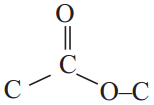
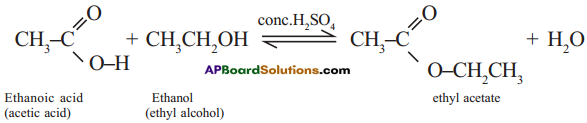
The reaction between carboxylic acid and an alcohol in the presence of cone. H2SO4 to form a sweet odoured substance, ester with the functional group
AP SSC 10th Class Chemistry Solutions Chapter 14 Carbon and its Compounds 3
is called esterification.

Ex: Ethanoic acid (carboxylic acid) reacts with Ethanol (alcohol) and forms ethyl acetate.
AP SSC 10th Class Chemistry Solutions Chapter 14 Carbon and its Compounds 4

Question 13.
Name the product obtained when ethanol is oxidized by either chromic anhydride or alkaline potassium permanganate. (AS1)
(OR)
If the ethanol is oxidized by either chromic anhydride or alkaline potassium permanganate, what is the product obtained from them?
Answer:
Ethanol (Ethyl alcohol) undergoes oxidation to form the product of Acetaldehyde and finally Acetic acid.

AP SSC 10th Class Chemistry Solutions Chapter 14 Carbon and its Compounds 20

Question 14.
Write the chemical equation representing the reaction of preparation of ethanol from ethane. (AS1)
Answer:
1. Ethane in the absence of air on heating forms ethene

AP SSC 10th Class Chemistry Solutions Chapter 14 Carbon and its Compounds 5

2. Then Ethanol is prepared on large scale from ethene by the addition of water vapour to it in the presence of catalyst like P2O5, Tungsten oxide at high pressure and temperature.

AP SSC 10th Class Chemistry Solutions Chapter 14 Carbon and its Compounds 6

Question 15.
Write the IUPAC name of the next homologous of CH3OHCH2CH3. (AS1)
Answer:
The IUPAC name of the next homologous of CH3OHCH2CH3 is HO-CH3CH2CH2CH3 1 – butanol.

Question 16.
Define homologous series of carbon compounds. Mention any two characteristics of homologous series. (AS1)
Answer:
1. The series of carbon compounds in which two successive compounds differ by – CH2 unit is called homologous series.
Ex : 1) CH4, C2H6, C3H8, ………………..
2) CH3OH, C2H5OH, C3H7OH, ………………..

2. If we observe above series of compounds, we will notice that each compound in the series differs by – CH2 unit by its successive compound.

3. Characteristics of homologous series :
i) They have one general formula.
Ex : alkanes (CnH2n+2), alkynes (CnH2n-2), alcohols (CnH2n+1) OH, etc.
ii) Successive compounds in the series possess a difference of (-CH2) unit.
iii) They have similar chemical properties.

AP SSC 10th Class Chemistry Solutions Chapter 14 Carbon and its Compounds

Question 17.
Give the names of functional groups
(i) – CHO
(ii) – C = O. (AS1)
(OR)
Write the names of the given functional groups
(i) – CHO
(ii) – C = O
Answer:
i) – CHO → aldehyde
ii) – C = O → ketone

Question 18.
Why does carbon form compounds mainly by covalent bonding? (AS1)
Answer:
Since carbon atoms can achieve the inert gas electron arrangements only by the sharings of electrons, therefore, carbon always forms covalent bonds.

Question 19.
Allotropy is a property shown by which class substance: elements, compounds or mixtures? Explain allotropy with suitable examples. (AS1)
Answer:

1. Allotropy is a property shown by the elements.

2. The property of an element to exist in two or more physical forms having more or less similar chemical properties but different physical properties is called allotropy.

3. The different forms of the element are called allotropes and are formed due to the difference in the arrangement of atoms.

4. Example for allotropes : Allotropes of carbon.

Allotropes of carbon are classified into two types. They are
1) Amorphous forms,
2) Crystalline forms.

5) Amorphous forms of carbon:
Coal, coke, wood, charcoal, animal charcoal, lampblack, gas carbon, petroleum coke, sugar charcoal.

6) Crystalline forms of carbon :
Diamond, graphite and buckminsterfullerene.

Question 20.
Explain how sodium ethoxide is obtained from ethanol. Give chemical equations. (AS1)
Answer:
As ethanol is similar to water molecule (H2O) with C2H5 group in place of hydrogen, it reacts with metallic sodium to liberate hydrogen and form sodium ethoxide.

AP SSC 10th Class Chemistry Solutions Chapter 14 Carbon and its Compounds 7

Question 21.
Describe with chemical equation how ethanoic acid may be obtained from ethanol. (AS1)
Answer:
Ethyl alcohol (Ethanol) undergoes oxidation to form the product Acetaldehyde and finally acetic acid (Ethanoic acid).

AP SSC 10th Class Chemistry Solutions Chapter 14 Carbon and its Compounds 8

Question 22.
Explain the cleansing action of soap. (AS1)
Answer:
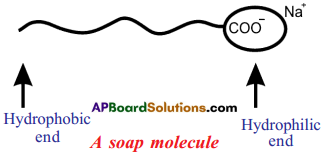
When a dirty cloth is put in water containing dissolved soap, the hydrocarbon ends of the soap molecules in the micelle attach to the oil or grease particles present on the surface of dirty clothes.
AP SSC 10th Class Chemistry Solutions Chapter 14 Carbon and its Compounds 9

Question 24.
Explain the structure of graphite in terms of bonding and give one property based on this structure. (AS1)
(OR)
Why does graphite act as lubricant?
Answer:
AP SSC 10th Class Chemistry Solutions Chapter 14 Carbon and its Compounds 10

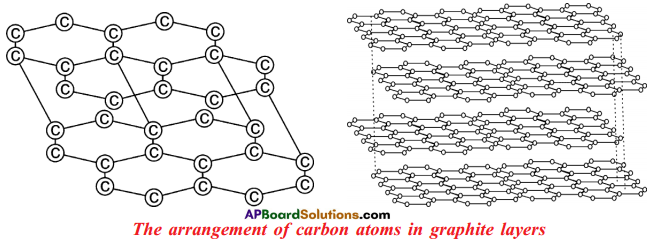
  • Graphite forms a two dimensional layer structure with C – C bonds within the layers.
  • There are relatively weak interactions between the layers.
  • In the layer structure, the carbon atoms are in a trigonal planar environment.
  • This is consistent with each carbon atom in sp² hybridisation.
  • Interactions between the sp² orbitals (overlaps) lead to the formation of C – C bonds.
  • Each carbon atom is with one unhybridised ‘p’ orbital.
  • The unhybridised ‘p’ orbitals interact to form a π system that is delocalised over the whole layer.
  • The interactions known as London dispersion forces between the layers which are separated by a distance of 3.35 A° are weakened by the presence of water molecules so that it is easy to cleave graphite.
  • For this reason graphite is used as lubricant and as the lead in pencils.

Question 25.
Name the acid present in vinegar. (AS1)
Answer:
1) The acid present in vinegar is Ethenoic acid or acetic acid (CH3COOH).
2) 5 – 8% solution of acetic acid in water is called vinegar.

Question 26.
What happens when a small piece of sodium is dropped into ethanol? (AS2)
Answer:
Ethanol reacts with sodium to liberate hydrogen and form sodium ethoxide.

AP SSC 10th Class Chemistry Solutions Chapter 14 Carbon and its Compounds 11

Question 27.
Two carbon compounds A and B have molecular formula C3H8 and C3H6 respectively. Which one of the two is most likely to show addition? Justify your answer. (AS2)
Answer:
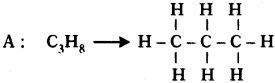
AP SSC 10th Class Chemistry Solutions Chapter 14 Carbon and its Compounds 12
• It is a saturated hydrocarbon. It shows substitution reaction.
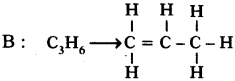
AP SSC 10th Class Chemistry Solutions Chapter 14 Carbon and its Compounds 13
• This is an unsaturated hydrocarbon. Hence it shows addition to become saturated. During the reactions, addition of reagent takes place at the double bonded carbon atoms.

Justification :
In the following, C3H6 undergoes addition reaction.

AP SSC 10th Class Chemistry Solutions Chapter 14 Carbon and its Compounds 14

Question 28.
Suggest a test to find the hardness of water and explain the procedure. (AS3)
(OR)
How do you test whether a given water sample is soft or hard?
Answer:

  • Take about 10 ml hard water (well water or hand pump water) in a test tube.
  • Add five drops of soap solution to it.
  • Shake the test tube vigorously.
  • We see that no lather is formed at first.
  • Only a dirty white curd like scum is formed on the surface of water.
  • From this, we conclude that soap does not form lather easily with hard water.
  • We have to add much more soap to obtain lather with hard water.

Question 29.
Suggest a chemical test to distinguish between ethanol and ethanoic acid and explain the procedure. (AS3)
Answer:

  1. Take ethanol and ethanoic acid in two different test tubes.
  2. Add nearly 18 g of sodium bicarbonate (NaHCO3) to each test tube.
  3. Lots and lots of bubbles and foam will be observed from the test tube containing ethanoic acid. This is due to release of CO2.
    NaHCO3 + CH3COOH → CH3COONa + H2O + CO2
  4. Ethanol will not react with sodium bicarbonate and thus we won’t observe any change in the test tube containing ethanol.
    Thus we can separate ethanol from ethanoic acid.

AP SSC 10th Class Chemistry Solutions Chapter 14 Carbon and its Compounds

Question 30.
An organic compound ‘X’ with a molecular formula C2H6O undergoes oxidation with alkaline KMnO4 and forms the compound ‘Y’, that has molecular formula C2H4O2. (AS3)
i) Identify ‘X’ and ‘Y’.
Answer:
X is Ethanol is CH3CH2OH and T is Ethanoic acid, i.e., CH3COOH.

ii) Write your observation regarding the product when the compound X is made to react with compound IT which is used as a preservative for pickles.
Answer:
Ethyl alcohol undergoes oxidation to form the product Acetaldehyde and finally Acetic acid.

AP SSC 10th Class Chemistry Solutions Chapter 14 Carbon and its Compounds 15
Here CH3COOH is used as preservative for pickles.

When X reacts with Y it forms ethyl acetate and water which is called esterification reaction.
CH3COOH + C2H5OH → CH3COOC2H5 + H2O

Question 31.
Prepare models of methane, ethane, ethene and ethyne molecules using clay balls and matchsticks. (AS4)
Answer:
Stick and ball model :
1) Methane (CH4) :
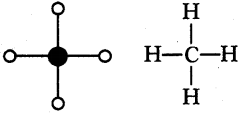
AP SSC 10th Class Chemistry Solutions Chapter 14 Carbon and its Compounds 21
2) Ethane (C2H6):
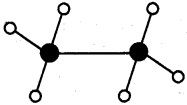
AP SSC 10th Class Chemistry Solutions Chapter 14 Carbon and its Compounds 22

3) Ethene (C2H4):
AP SSC 10th Class Chemistry Solutions Chapter 14 Carbon and its Compounds 23

4) Ethyne (C2H2)
AP SSC 10th Class Chemistry Solutions Chapter 14 Carbon and its Compounds 24

Question 32.
Collect information about artificial ripening of fruits by ethylene. (AS4)
Answer:

  • Seasonal fruits like mango, banana, papaya, sapota and custard apple are often harvested in nature. But due to unripe condition they are subsequently allowed to ripen by natural release of ripening harmone (ethylene) from the fruit.
  • However, natural ripening in some fruits is a slow process, which leads to high weight loss, desiccation of fruits and under ripening. With the rapid development of fruit trade, artificial ripening has become essential and the methods practised earlier by small traders are smoking and calcium carbide treatment.
  • Fruits ripened with calcium carbide though seem attractive and colourful are inferior in taste, flavour and spoil faster.
  • Government of India has banned the use of calcium carbide for artificial ripening of fruits under PFA Act 8-44AA, 1954.
  • Artificial ripening of fruits by using the above steps spoils the health of consumers, so we should not use such type of fruits.
  • Government has to take serious action on the fruit sellers who are practising the above said methods.

Question 33.
Draw the electronic dot structure of ethane molecule (C2H6). (AS6)
Answer:
C2H6:
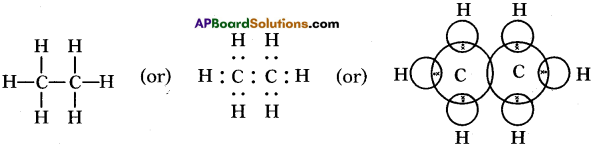
AP SSC 10th Class Chemistry Solutions Chapter 14 Carbon and its Compounds 16

Question 34.
How do you appreciate the role of esters in everyday life? (AS6)
Answer:

  • Esters are usually volatile liquids having sweet or pleasant smell.
  • They are also said to have fruity smell.
  • Esters are used in making artificial perfumes.
  • This is because of the fact that most of the esters have a pleasant smell.
  • Esters are also used as flavouring agents.
  • This means that esters are used in making artificial flavours and essences used in ice-cream, sweets and cool drinks.
  • The alkaline hydrolysis of esters is known as saponification (Soap making).
  • That’s why we can appreciate the role of esters in everyday life.

Question 35.
How do you condemn the use of alcohol as a social practice? (AS7)
Answer:

  • Consumption of alcohol in the form of beverages is harmful to health.
  • It causes severe damage to blood circulation system.
  • Addiction to alcohol drinking leads to heart diseases and damages the liver.
  • It also causes ulcers in small intestines due to increased acidity and damages the digestive system.
  • Alcohol which is consumed in raw form under the names liquor, gudumba which is more harmful to health due to adulteration.
  • Alcohol mixed with pyridine is called denatured spirit. Consumption of denatured spirit causes blindness and death.
  • Hence use of alcohol is a social evil which harms the society.

AP SSC 10th Class Chemistry Solutions Chapter 14 Carbon and its Compounds

Question 36.
An organic compound with molecular formula C2H4O2 produces brisk effervescence on addition of sodium carbonate/bicarbonate.
Answer the following :
a) Identify the organic compound. (AS1)
Answer:
The organic compound is Ethanoic acid (CH3COOH).

b) Write the chemical equation for the above reaction. (AS1)
Answer:

AP SSC 10th Class Chemistry Solutions Chapter 14 Carbon and its Compounds 17

c) Name the gas evolved. (AS2)
Answer:
CO2

d) How will you test the gas evolved? (AS3)
Answer:
1) Pass the evolved gas through lime water in a test tube.
2) We will find that lime water turns milky.
3) Only CO2 gas can turn lime water milky.

e) List two important uses of the above compound. (AS1)
Answer:
1) Dilute ethanoic acid (CH3COOH) is used as a food preservative in the preparation of pickles and sauces.
2) Ethanoic acid is used for making cellulose acetate which is an important artificial fibre.

Question 37.
1 ml glacial acetic acid and 1 m/of ethanol are mixed together in, a test tube. Few drops of concentrate sulphuric acid is added in the mixture are warmed in a water bath for 5 min.
Answer the following:
a) Name the resultant compound formed.
b) Represent the above change by a chemical equation.
c) What term is given to such a reaction?
d) What are the special characteristics of the compound formed?
Answer:
a) Ethyl acetate.

AP SSC 10th Class Chemistry Solutions Chapter 14 Carbon and its Compounds 25
c) Esterification
d) It has fruity smell or pleasant smell.

Fill In The Blanks

1. Carbon compounds containing double and triple bonds are called ………………….
2. A compound which is basic constituent of many cough syrups ………………………
3. Very dilute solution of ethanoic acid is ………………..
4. A sweet odour substance formed by the reaction of an alcohol and a carboxylic acid is ………………
5. When sodium metal is dropped in ethanol …………………. gas will be released.
6. The functional group present in methanol is …………………….
7. IUPAC name of alkene containing 3 carbon atoms is ………………….
8. The first member of homologous series among alkynes is ……………………
9. The product that is formed by dehydration of ethanol in cone, sulphuric acid is ………………….
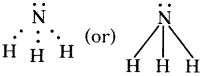
10. Number of single covalent bonds in ammonia are ………………..
11. Type of reactions shown by alkanes is ……………….
Answer:

  1. unsaturated compounds
  2. ethanol
  3. vinegar
  4. ester
  5. H2
  6. – OH (Alcohol)
  7. propene
  8. ethyne (C2H2)
  9. ethene (C2H4)
  10. 3
  11. substitutional

Multiple Choice Questions

1. Which of the four test tubes containing the following chemicals shows the brisk effervescence when dilute acetic acid was added to them?
i) KOH
ii) NaHCO3
iii) K2CO3
iv) NaCl
A) i & ii
B) ii & iii
C) i & iv
D) ii & iv
Answer:
B) ii & iii

2. Which of the following solution of acetic acid in water can be used as preservative?
A) 5-10%
B) 10-15%
C) 15-20%
D) 100%
Answer:
A) 5-10%

AP SSC 10th Class Chemistry Solutions Chapter 14 Carbon and its Compounds

3. The suffix used for naming an aldehyde is
A) – ol
B) – al
C) – one
D) – ene
Answer:
B) – al

4. Acetic acid, when dissolved in water, it dissociates into ions reversibly because it is a
A) weak acid
B) strong acid
C) weak base
D) strong base
Answer:
A) weak acid

5. Which one of the following hydrocarbons can show isomerism?
A) C2H4
B) C2H6
C) C3H8
D) C4H10
Answer:
D) C4H10

6. Combustion of hydrocarbon is generally accompanied by the evolution of
A) Heat
B) Light
C) Both heat and light
D) Electric current
Answer:
C) Both heat and light

7. 2 ml of ethanoic acid was taken in each of the three test tubes A, B and C and 2 ml, 4 ml and 8 ml water was added to them respectively. A clear solution is obtained in:
A) Test tube A only
B) Test tubes A & B only
C) Test tubes B and C only
D) All the test tubes
Answer:
D) All the test tubes

AP SSC 10th Class Chemistry Solutions Chapter 14 Carbon and its Compounds

8. If 2 ml of acetic acid was added slowly in drops to 5 ml of water then we will notice
A) The acid forms a separate layer on the top of water
B) Water forms a separate layer on the top of the acid
C) Formation of a clear and homogenous solution
D) Formation of a pink and clear solution
Answer:
C) Formation of a clear and homogenous solution

9. A few drops of ethanoic acid were added to solid sodium carbonate. The possible results of the reactions are
A) A hissing sound was evolved
B) Brown fumes evolved
C) Brisk effervescence occurred
D) A pungent smelling gas evolved
Answer:
C) Brisk effervescence occurred

10. When acetic acid reacts with ethyl alcohol, we add cone. H2SO4, it acts as and the process is called
A) Oxidizing agent, saponification
B) Dehydrating agent, esterification
C) Reducing agent, esterification
D) Acid and esterification
Answer:
B) Dehydrating agent, esterification

10th Class Chemistry 14th Lesson Carbon and its Compounds InText Questions and Answers

10th Class Chemistry Textbook Page No. 254

Question 1.
Can carbon get helium configuration by losing four electrons from the outer shell?
Answer:

  • If carbon loses four electrons from the outer shell, it has to form C4+ ions.
  • This requires huge amount of energy which is not available normally.
  • Therefore C4+ formation is also a remote possibility.
  • Carbon has to satisfy its tetravalency by sharing electrons with other atoms.
  • It has to form four covalent bonds either with its own atoms or atoms of other elements.

10th Class Chemistry Textbook Page No. 255

Question 2.
How do carbon atoms form bonds in so many different ways?
Answer:
As per valence bond theory, the four unpaired electrons in a carbon atom is main cause to form many bonds.

AP SSC 10th Class Chemistry Solutions Chapter 14 Carbon and its Compounds

Question 3.
Explain the four unpaired electrons in carbon atom through excited state.
Answer:
Electronic configuration of carbon (ground state):
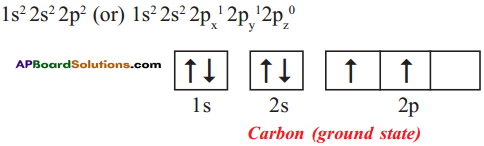
AP SSC 10th Class Chemistry Solutions Chapter 14 Carbon and its Compounds 34

Electronic configuration of carbon (excited state):
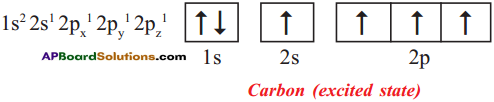
AP SSC 10th Class Chemistry Solutions Chapter 14 Carbon and its Compounds 35

10th Class Chemistry Textbook Page No. 256

Question 4.
Where does this energy to excite electron come from?
Answer:

  • We have to understand that free carbon atom would not be in excited state under normal conditions.
  • When the carbon atom is ready to form bonds with other atoms, the energy required for excitation is taken up from bond energies, which are the liberated energies when bonds are formed between carbon atom and other atoms.

Question 5.
In methane (CH4) molecule all four carbon – hydrogen bonds are identical and bond angle HCH is 109°28′. How can we explain this?
Answer:
In excited state, carbon atom has three unpaired electrons in p-orbitals and one electron in s-orbital. These four valence electrons are with different energies. These orbitals combine to form four identical orbitals. Four hydrogen atoms form four identical C -H bonds with bond angle 109° 28′. This is called hybridisation.

AP SSC 10th Class Chemistry Solutions Chapter 14 Carbon and its Compounds

Question 6.
How do these energetically unequal valence electrons form four equivalent covalent bonds in methane molecule?
Answer:
1) When bonds are formed, energy is released and the system becomes more stable. If carbon forms four bonds rather than two, still more energy is released and so the resulting molecule becomes even more stable.
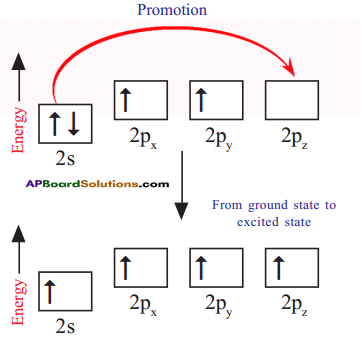
AP SSC 10th Class Chemistry Solutions Chapter 14 Carbon and its Compounds 36

2) The energy difference between the 2s and 2p orbitals is very small. When carbon atom is ready to form bonds it gets a small amount of energy from bond energies and gets excited to promote an electron from the 2s to the empty 2p to give four unpaired electrons.

3) We have got four unpaired electrons ready for bonding, but these electrons are in two different kinds of orbitals and their energies are different.

4) We are not going to get four identical bonds unless these unpaired electrons are in four identical orbitals.

10th Class Chemistry Textbook Page No. 257

Question 7.
How to explain the four orbitals of carbon containing unpaired electrons as energetically equal?
Answer:
With hybridisation we explai n the four orbitals of carbon containing unpaired electrons are energetically equal.
Ex : Methane (CH4).

10th Class Chemistry Textbook Page No. 258

Question 8.
How do you explain the ability of C – atom to form two single covalent bonds and one double bond?
Answer:
Ethylene (CH2 = CH2) explains the ability of carbon atom to form two single covalent bonds and one double bond.
Ex:
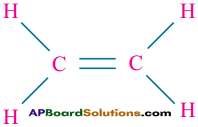
AP SSC 10th Class Chemistry Solutions Chapter 14 Carbon and its Compounds 37

10th Class Chemistry Textbook Page No. 259

Question 9.
How do you explain the ability of carbon atom to form one single bond and one triple bond?
Answer:
Ethyne (HC [latex]\equiv[/latex] CH) explains the ability of carbon atom to form one single bond between one hydrogen and carbon, and one triple bond between carbon and carbon.
Ex : H – C [latex]\equiv[/latex] C – H.

10th Class Chemistry Textbook Page No. 260

Question 10.
What are bond angles H[latex]\widehat{\mathbf{C}}[/latex]H in CH4, C2H4 and C2H2 molecules?
Answer:
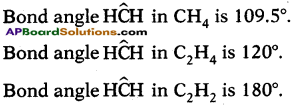
AP SSC 10th Class Chemistry Solutions Chapter 14 Carbon and its Compounds 38

10th Class Chemistry Textbook Page No. 262

Question 11.
How do you understand the markings (writings) of a pencil on a paper?
Answer:

  1. When we write with a pencil, the inter layer attractions breakdown and leave graphite layers on the paper.
  2. It is easy to remove pencil marks from paper with an eraser because, the layers do not bind strongly to the paper.

10th Class Chemistry Textbook Page No. 265

Question 12.
Allotting completely one special branch in chemistry to compounds of only one element. Is it justified when there are so many elements and their compounds but not with any special branches?
Answer:

  1. We understand that all molecules that make life possible carbohydrates, proteins, nucleic acids, lipids, hormones, and vitamins contain carbon.
  2. The chemical reactions that take place in living systems are of carbon compounds.
  3. Food that we get From nature, various medicines, cotton, silk and fuels like natural gas and petroleum almost all of them are carbon compounds.
  4. Synthetic fabrics, plastics, synthetic rubber are also compounds of carbon.
  5. Hence, carbon is a special element with the largest number of compounds:

10th Class Chemistry Textbook Page No. 266

Question 13.
What are hydrocarbons?
Answer:
The compounds containing only carbon and hydrogen in their molecules are called hydrocarbons.

AP SSC 10th Class Chemistry Solutions Chapter 14 Carbon and its Compounds

Question 14.
Do all the compounds have equal number of C and H atoms?
Answer:
No. All the compounds do not have equal number of C and H atoms.

10th Class Chemistry Textbook Page No. 269

Question 15.
Observe the following two structures.
a) CH3 – CH2 – CH2 – CH3
b)
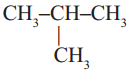
AP SSC 10th Class Chemistry Solutions Chapter 14 Carbon and its Compounds 39
i) How about their structures? Are they same?
Answer:
No, they are not same compounds.

ii) How many carbon and hydrogen atoms are there in (a) and (b) structures?
Answer:
Carbon – 4 ; Hydrogen – 10.

iii) Write the condensed molecular formulae for (a) and (b), do they have same molecular formulae?
Answer:
C4H10; Yes.

Question 16.
Can carbon form bonds with the atoms of other elements?
Answer:
Carbon forms compounds not only with atoms of hydrogen but also with atoms of other elements like oxygen, nitrogen, sulphur, phosphorus, halogens, etc.

10th Class Chemistry Textbook Page No. 272

Question 17.
What do you mean by nomenclature of Organic componds?
Answer:
Nomenclature of organic chemistry is systematic method of naming organic compound.

AP SSC 10th Class Chemistry Solutions Chapter 14 Carbon and its Compounds

Question 18.
What is the basis for nomenclature?
Answer:
The basic of the nomenclature is number of carbons in the parent chain in a compound.

10th Class Chemistry Textbook Page No. 273

Question 19.
What are the word – root and suffix?
Answer:
Word root:
Word root indicates the number of carbon atoms in the longest possible continuous carbon chain also known as parent chain.

Suffix :
Suffix is added immediately after the word root. It is two types

1) Primary Suffix :
It is used to indicate the degree of saturation or unsaturation of the main chain.

2) Secondary Suffix :
It is used to indicate the main functional group in the organic compound.

10th Class Chemistry Textbook Page No. 274

Question 20.
What do you mean by the term ‘alkyl’?
Answer:
Alkyl:
Alkyl is a substituent, that is attached to the molecular fragment.
General formula of alkyl is CnH2n + 1

10th Class Chemistry Textbook Page No. 278

Question 21.
Can we write the structure of a compound if the name of the compound is given?
Answer:
Yes, we can write the structure of a compound if the name of the compound is given.

10th Class Chemistry Textbook Page No. 279

Question 22.
Why do sometimes cooking vessels get blackened on a gas or kerosene stove?
Answer:
Because of the inlets of air getting closed, the fuel gases do not completely undergo combustion. Hence, it forms a sooty carbon form which gets coated over the vessels.

10th Class Chemistry Textbook Page No. 280

Question 23.
Do you know what is a catalyst?
Answer:
A catalyst is a substance which regulates the rate of a given reaction without itself finally undergoing any chemical change.

10th Class Chemistry Textbook Page No. 281

Question 24.
Do you know how the police detect whether suspected drivers have consumed alcohol or not?
Answer:

  1. The police officer asks the suspect to blow air into a plastic bag through a mouth piece of the detecting instrument which contains crystals of potassium-di-chromate (K2Cr2O7).
  2. As K2Cr2O7 is a good oxidizing agent, it oxidizes any ethanol in the driver’s breath to ethanal and ethanoic acid.
  3. Orange Cr2O72- changes to bluish green Cr3+ during the process of the oxidation of alcohol.
  4. The length of the tube that turned into green is the measure of the quantity of alcohol that had been drunk.
  5. The police even use the IR Spectra to detect the bonds C – OH and C – H of CH3 – CH2OH.

10th Class Chemistry Textbook Page No. 283

Question 25.
What are esters?
Answer:
AP SSC 10th Class Chemistry Solutions Chapter 14 Carbon and its Compounds 3
The compounds which contain the functional group and the general formula R – COO – R’, where R and R’ are alkyl groups or phenyl groups, are known as “Esters”.

10th Class Chemistry Textbook Page No. 284

Question 26.
What is a true solution?
Answer:
A true solution is that in which the solute particles dispersed in the solvent are less than 1 nm in diameter.

10th Class Chemistry Textbook Page No. 286

Question 27.
What is the action of soap particles on the greasy cloth?
Answer:

  • Soaps and detergents make oil and dirt present on the cloth come out into water, thereby making the cloth clean.
  • Soap has one polar end and one non-polar end.
  • The polar end is hydrophilic in nature and this end is attracted towards water.
  • The non-polar end is hydrophobic in nature and it is attracted towards grease or * . ; oil on the cloth, but not attracted towards water.
  • When soap is dissolved in water, its hydrophobic ends attach themselves to dirt and remove it from the cloth.
  • The hydrophobic end of the soap molecules move towards the dirt or grease particles. ’
  • The hydrophobic ends attach to the dirt particle and try to pull out.
  • The molecules of soap surround the dirt particle at the centre of the cluster and form a spherical structure called micelle.
  • These micelles remain suspended in water like particles in a colloidal solution.
  • The various micelles present in water do not come together to form a precipitate as each micelle repels the other because of the ion-ion repulsion.
  • Thus, the dust particles remain trapped in micelles and are easily rinsed away with water.
  • Hence, soap micelles remove dirt by dissolving it in water.

10th Class Chemistry Textbook Page No. 280

Question 28.
Why we are advised not to use animal fats for cooking?
Answer:

  • Animal fats have recently been implicated as the cause of heart disease and obesity. So, we are advised not to use animal fats for cooking.
  • Excess animal fat is stored in lipocytes, which expand in size until the fat is used for fuel.

AP SSC 10th Class Chemistry Solutions Chapter 14 Carbon and its Compounds

Question 29.
Which oil is recommended for cooking? Why?
Answer:
Canola oil :

  • A recent entrant into the Indian market Canola is flying off the shelves.
  • Canola oil which is made from the crushed seeds of the Canola plant, is said to be amongst the healthiest of cooking oils.
  • It has the lowest saturated fat content of any oil.
  • It’s seen as a healthy alternative as it’s rich in monosaturated fats and is high in omega-3 and omega a fats.
  • It has a medium smoking point and is an oil that works well for fruits, baking, sauteing, etc.

10th Class Chemistry 14th Lesson Carbon and its Compounds Activities

Activity – 1

Question 1.
Observe the structural formula of the following hydro carbons and write their names in your notebook.
Answer:
1) CH3 – CH2 – CH = CH2
Sol. But-l-ene
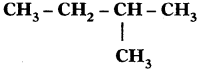
AP SSC 10th Class Chemistry Solutions Chapter 14 Carbon and its Compounds 26
Sol. 2-Methyl butane

3) CH3 – CH2 – CH2 – CH2 – CH2 – CH3
Sol. Hexane
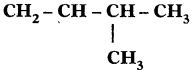
AP SSC 10th Class Chemistry Solutions Chapter 14 Carbon and its Compounds 27
Sol. 3-Methyl, but-l-ene

5)
AP SSC 10th Class Chemistry Solutions Chapter 14 Carbon and its Compounds 28
Sol. Prop-l-yne

Activity-2

Question 2.
Read the names of the following hydro carbons and draw their structures in your notebook.
1. 2,2-Dimethyl hexane
Sol.
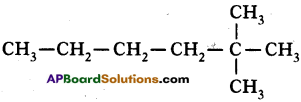
AP SSC 10th Class Chemistry Solutions Chapter 14 Carbon and its Compounds 29

2. But-l-yne
Sol. CH3 – CH2 – C = CH

3. 3-Methyl Pent-2-ene
Sol.
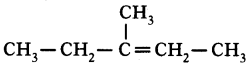
AP SSC 10th Class Chemistry Solutions Chapter 14 Carbon and its Compounds 30

4. But-1.2-diene
Sol. CH3 – CH3 = c = CH2

5. Hept-2 en, 4-yne
Sol.

AP SSC 10th Class Chemistry Solutions Chapter 14 Carbon and its Compounds 31

Activity – 3

Question 3.
Write an activity to show esterification reactions.
Answer:
The compound formed is ester. The process is called esterification.
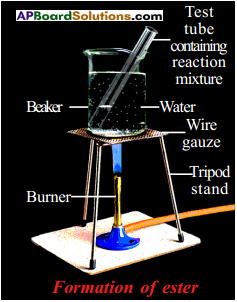
AP SSC 10th Class Chemistry Solutions Chapter 14 Carbon and its Compounds 32

  1. Take 1 ml of ethanol and 1 ml of glacial acetic acid along with a few drops of concentrated sulphuric acid in a test tube.
  2. Warm it in a water bath or a beaker containing water for at least five minutes.
  3. Pour the warm contents into a beaker containing 20-50 ml of water and observe the odour of the resulting mixture.
  4. We will notice that the resulting mixture is sweet odoured subatance.
  5. This substance is nothing but ethyl acetate, an ester.
  6. This reaction is called esterification reaction.

Activity – 4

Question 4.
Write an activity to show soap solution separates oil from water.
Answer:
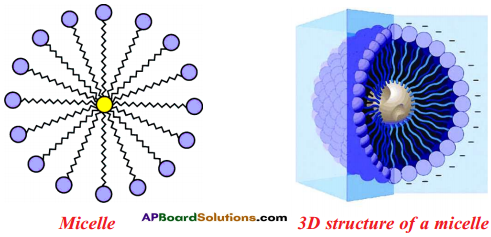
AP SSC 10th Class Chemistry Solutions Chapter 14 Carbon and its Compounds 33

  1. Take about 10 ml of water each in two test tubes.
  2. Add a drop of oil to both the test tubes.
  3. Label them as A and B.
  4. Add a few drops of soap solution to test tube B.
  5. Now shake both the test tubes vigorously for the same period of time.
  6. We can see the oil and water layers separately in both the test tubes immediately after we stop shaking them.
  7. Leave the test tubes undisturbed for sometime and observe.
  8. The oil layer separates out first in which test tube we added drops of soap solution.
 

AP Board 9th Class Biology Solutions Chapter 4 Movement of Materials Across the Cell Membrane

AP State Syllabus AP Board 9th Class Biology Solutions Chapter 4 Movement of Materials Across the Cell Membrane Textbook Questions and Answers.

AP State Syllabus 9th Class Biology Solutions 4th Lesson Movement of Materials Across the Cell Membrane

9th Class Biology 4th Lesson Movement of Materials Across the Cell Membrane Textbook Questions and Answers

Improve Your Learning

Question 1.
The structure which controls the entry and exit of the materials through the cell is
A) Cell wall
B) Cell membrane
C) Both
D) None of them
Answer:
Cell membrane.

Question 2.
Fill in the blanks.
a) The smell of flowers reaches us through the process of …………………..
Answer:
Diffusion

b) The MIC gas of Bhopal tragedy was spread throughout the city through the process of …………………
Answer:
Diffusion

c) Water enters the potato osmometer due to a process called ………………
Answer:
Osmosis

d) The fresh grape wrinkles, if kept in salt water because of …………………
Answer:
Osmosis

AP Board 9th Class Biology Solutions Chapter 4 Movement of Materials Across the Cell Membrane

Question 3.
What do you mean by permeability of membrane? Explain with suitable example.
Answer:
Allowing only certain materials to pass through the membrane is called permeability.

Example :

  1. The cell membrane is very much permeable to gases such as carbondioxide, oxygen, nitrogen and fat solvent compounds such as alcohol, ether and chloroform.
  2. It is impermeable to polysaccharides, phospholipids and proteins.

Question 4.
If the dried vegetables are kept in water they become fresh. What is the reason?
Answer:

  1. The dried vegetables have less water content and high salt concentration in cells.
  2. When they are kept in water they absorb water and become fresh.
  3. The water enter into the vegetables by a process known as osmosis.

Question 5.
Name the process by which we can get fresh water from sea water.
Answer:
Reverse Osmosis.

AP Board 9th Class Biology Solutions Chapter 4 Movement of Materials Across the Cell Membrane

Question 6.
What will happen to a marine fish if kept in fresh water aquarium? Support your answer with reasons.
Answer:
The marine fish dies.
Reasons:

  1. Usually marine fishes have high concentration of salts in their body.
  2. When they are kept in fresh water, the water from the fresh water aquarium enters the body of fishes due to osmosis.
  3. More amount of fresh water enters the cells of fish. This results in bursting of cells and fish dies.

Question 7.
Why do the doctors administer saline (salt solution) only, but not the distilled water?
Answer:

  • Distilled water causes cells to lyse, so injecting distilled water into a vein will cause some degree of haemolysis.
  • Haemolysis is the rupture of red blood cells.
  • Large amount of distilled water would cause much more damage not just limited to haemolysis and also cause brain damage or cardiac arrest and death.
  • That is why fluids are administered to patients as saline (which include appropriate amount of salt)

AP Board 9th Class Biology Solutions Chapter 4 Movement of Materials Across the Cell Membrane

Question 8.
What will happen if 50% glucose solution (dextrose) is injected intravenously (into vein)?
Answer:

  • 50% glucose solution (dextrose) is used for reduction of increased cerebrospinal pressure and cerebral edema.
  • If 50% glucose solution is injected intravenously it may produce allergic reactions in sensitive persons.
  • The allergic reactions include nervous excitement infection at the joint site, tissues necrosis, venous thrombosis extending from the site of injection etc.
  • Hence concentrated dextrose (glucose) should be administered via central vein only after suitable dilution.

Question 9.
What will happen if cells do not have ability of permeability?
Answer:

  1. If the cells do not have ability of permeability they would not be able to carryout any of their fundamental life functions.
  2. Oxygen, glucose, fats, proteins and vitamins are needed by cells to perform life process.
  3. Mature cells become impermeable to any molecules or atoms it would die of toxicity and it would not be able to remove its wastes.

Question 10.
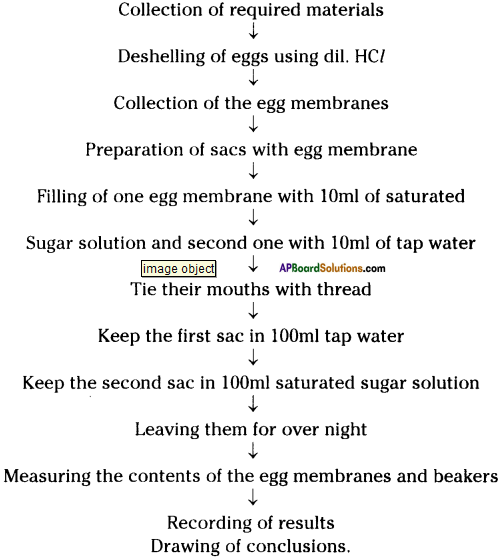
Draw the flow chart showing different stages in doing the experiment with egg.
Answer:
AP Board 9th Class Biology Solutions Chapter 4 Movement of Materials Across the Cell Membrane 1

Question 11.
You have purchased a coconut in the market. By shaking it you found there is less water in coconut. Can you fill the coconut with water without making a hole to the coconut?
Answer:

  • No, it is not possible to fill the coconut with water without making a hole.
  • The husk of coconut is mostly made up of sclerenchymatous cells which are dead.
  • Osmosis do not takes place in dead cells.
  • It is not possible to fill the coconut with water without making a hole.

AP Board 9th Class Biology Solutions Chapter 4 Movement of Materials Across the Cell Membrane

Question 12.
What are your observations in experiments to know about diffusion?
Answer:
Observations in experiments to know about diffusion are :

  1. Materials kept in medium (water/air) get dissolves in the medium.
  2. These dissolved molecules gradually move randomly in all directions. (from center to periphery)
  3. They move from higher concentration to lower concentration.
  4. This movement occures till these molecules spread equally throughout the medium.

Question 13.
Discuss with your friends and write the list of incidences where diffusion occurs.
Answer:

  • A sugar cube in a glass of milk/water diffuses throughout it and make it sweet.
  • The smell of cookies diffuses through the house as they bake.
  • Tea leaf pigments diffuse through the tea bag into the water to give it colour and taste.
  • Air freshner/deodorent molecules diffuse into the air when put on so we can smell it.
  • If the cooking gas is leaked it spreads all over the house through diffusion.
  • CO2 bubbles in soft drink diffuses out of soda leaving the soda flat.
  • Robbin Blue drops diffuses in water, making the water blue.
  • Agarbatti, mosquito repellents work on the principle of diffusion.

Question 14.
How diffusion is useful in everyday life?
Answer:

  • A wilted carrot made firm again by soaking in water.
  • Cigarette smoke. It diffuses into air and spreads through the room.
  • A sugar cube in a glass of water that is not stirred will dissolve slowly and the sugar molecules will distribute over the water by diffusion.
  • The smell of cookies diffuses through the house as they bake.
  • Tea leaf pigments diffuse through the tea bag to give the water its colour and taste of tea.
  • Air freshner / deodorant molecules diffuse into the air when put on. So we can smell it.
  • If the cooking gas is leaked, it spreads all over the house through diffusion.
  • CO2 bubbles in soft drink diffuses out of our soda leaving our soda flat.
  • Air freshners, agarbatti, mosquito repellents work on the principle of diffusion.

AP Board 9th Class Biology Solutions Chapter 4 Movement of Materials Across the Cell Membrane

Question 15.
Give examples of three daily life activities in which osmosis is involved?
Answer:

  • Water enters into the roots through osmosis.
  • In our body waste materials are filtered from the blood.
  • Osmosis helps in the opening and closing of stomata.

9th Class Biology 4th Lesson Movement of Materials Across the Cell Membrane Activities

Activity – 1

Question 1.
Look at the substances in the table identify the (✓) substances that should go into the cell and should go out of the cell?
Answer:

Substance Should go into the cell Should go out of the cell
Oxygen
Glucose
Proteins
Fats
Vitamins
Minerals
Carbondioxide
Wastes

Procedure :

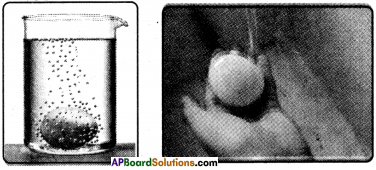
  • Keep the raw eggs in dil HCl / toilet cleaning acid for 4 to 5 hours.
  • Take out the egg with the help of table spoon.
  • Wash the eggs under tap water.

AP Board 9th Class Biology Solutions Chapter 4 Movement of Materials Across the Cell Membrane 2

  • Measure the circumference of each egg with long strip of paper, as its widest place, and mark on the paper with pen or pencil.
  • Prepare a concentrated salt solution in a beaker.
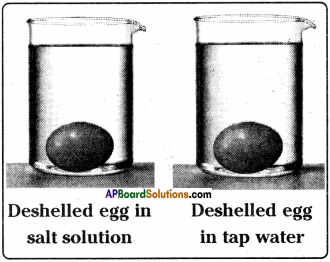
  • Place one egg in the beaker with tap water and place the other in the salt water.

AP Board 9th Class Biology Solutions Chapter 4 Movement of Materials Across the Cell Membrane 3

  • Leave the beakers for 2 to 4 hours.
  • Take the eggs out, wipe them and measure the circumference with the same strip of paper. Mark on the paper with pen or pencil.

Observation :
The egg placed in salt water shrinks, the egg placed in the tap water swells.

Result:

  • Shrinking of egg placed in the salt water is due to exosmosis in which water molecules leave the cell.
  • Swelling of egg placed in the tap water is due to endosmosis in which water molecules enter the cell.

Lab Activity – 3

Question 2.
Prepare semi-permeable membranes and conduct an experiment to prove osmosis with it.
Answer:
Preparing semi-permeable membranes.
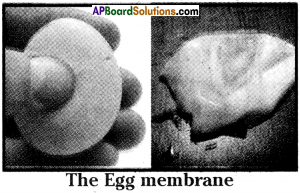
AP Board 9th Class Biology Solutions Chapter 4 Movement of Materials Across the Cell Membrane 4

  • Take two raw eggs.
  • Keep the two eggs in dil. HCl for 4 to 5 hours.
  • The shells which are made of calcium carbonate (CaCO3) are dissolved.
  • Wash the eggs under tap water.
  • Carefully pierce a pencil sized hole in the egg membrane and drain the contents.
  • Wash the membrane with fresh water. Now the semi-permeable membrane is ready for use.

Experiment of osmosis with egg membranes :
AP Board 9th Class Biology Solutions Chapter 4 Movement of Materials Across the Cell Membrane 5

Aim :
To prove osmosis through semi- permeable membrane of an egg.

Materials required :
Two egg membranes, three beakers, sugar, water, thread, measuring jar, disposable syringe.
AP Board 9th Class Biology Solutions Chapter 4 Movement of Materials Across the Cell Membrane 6

Procedure :

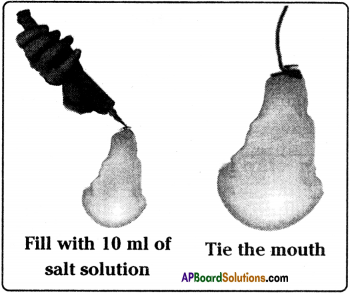
  1. Take one egg membrane and fill it with 10 ml of saturated sugar solution with a syringe.
  2. Tie its mouth with a thread.
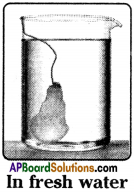
  3. Measure 100 ml of tap water in a beaker.
  4. Keep the egg membrane in fresh water beaker.
  5. Leave it for overnight.
  6. Take the second egg membrane and fill it with 10 ml of tap water with the syringe.
  7. Prepare 100 ml of saturated sugar solution and keep the egg membrane in it.
  8. Leave it for overnight.
  9. Measure the contents of the egg membranes and beakers.

Observations:

  1. Water entered into the egg membrane in which sugar solution is filled. So size of the membrane increased.
  2. Water left from the egg membrane in which water is filled. The size of the membrane decreased.
    Result: Water move across membranes from solutions of one concentration to the other through a process called osmosis.

Activity – 4

Question 3.
How do you observe the diffusion of coffee powder in water? Write your findings.
Answer:

  1. Take half bowl water.
  2. Prepare a small ball of coffee powder.
  3. Slowly put in water and observe.

Observations:

  1. The ball of coffee powder starts dissolving in water.
  2. The water around the coffee powder will appear dark in colour.
  3. As time progresses, all the water in the beaker becomes coloured.
  4. Initially pale in colour and slowly all the water in the beaker becomes uniformly coloured. Coffee powder molecules diffuse into the water forming uniform colour.

Activity – 5

Question 4.
Observe the diffusion of potassium permanganate in water. Write your findings.
Answer:

  • Keep a crystal of KMNO4 (Potassium permanganate) in the centre of the petridish with the help of a forceps.
  • Carefully fill the petridish with water.
  • Observe the movement of pink colour in the petridish every minute.
  • Also observe the spreading of colour from centre to periphery.

Observations:

  1. Potassium permanganate crystal starts dissolving in water.
  2. The water around the crystal will appear in pink colour.
  3. As time progresses all the water in the beaker becomes coloured.
  4. Initially pale in colour and slowly all the water in the beaker become uniformly pink coloured.

Diffusion :
The permanganate molecules moves from higher concentration to lower concentration in water through diffusion.

Activity – 6

Question 5.
How do you observe the diffusion of copper sulphate in water? Write your findings.
Answer:

  • Keep a small crystal of copper sulphate in the center of the petridish with the help of a forceps.
  • Carefully fill the petridish with water.
  • Observe the movement of blue colour in the petridish every minute.
  • Also observe the spreading of colour from centre to periphery.

Observations :

  1. Copper sulphate crystal starts dissolving in water.
  2. The water around the crystal will appear in blue color.
  3. As time progresses, all the water in the beaker becomes coloured.
  4. Initially pale blue in colour and slowly all the water in the beaker becomes uniformly blue in color.

Diffusion :
The copper sulphate molecules move from higher concentration to lower concentration in water through diffusion.

AP SSC 10th Class Chemistry Solutions Chapter 13 Principles of Metallurgy

AP State Board Syllabus AP SSC 10th Class Chemistry Solutions Chapter 13 Principles of Metallurgy Textbook Questions and Answers.

AP State Syllabus SSC 10th Class Chemistry Solutions 13th Lesson Principles of Metallurgy

10th Class Chemistry 13th Lesson Principles of Metallurgy Textbook Questions and Answers

Review of Your Previous Knowledge

Question 1.
Can you mention some articles that are made up of metals?
Answer:
Jewellery, conducting wires, utensils, etc.

Question 2.
Do metals exist in nature in the form same as that we use in our daily life?
Answer:
No, they exist as ores and minerals.

AP SSC 10th Class Chemistry Solutions Chapter 13 Principles of Metallurgy

Question 3.
Have you ever heard the words like ore, mineral and metallurgy?
Answer:
Yes, these words are related to extraction of metals.

Question 4.
Do you know how these metals are obtained?
Answer:
These metals are generally extracted from their ores.

Improve Your Learning

Question 1.
List three metals that are found in nature as oxide ores.
Answer:
The three metals that are found in nature as oxide ores are

  1. Bauxite (Al2O3 2H2O)
  2. Haematite (Fe2O3)
  3. Zincite (ZnO).

Question 2.
List three metals that are found in nature in uncombined form.
Answer:
The three metals that are found in nature in uncombined form are

  1. Gold
  2. Silver
  3. Platinum.

Question 3.
Write a note on dressing of ore in metallurgy.
(OR)
What is concentration of Ore? List various physical methods that are used to enrich the ore.
Answer:

  • Ores that are mined from the earth are usually contaminated with large amount of impurities such as soil and sand, etc.
  • Concentration or dressing means, simply getting rid of as much of the unwanted rocky material as possible from the ore. The impurities like sand and clay are called gangue.

The physical methods adopted in dressing of the ore or enriching the ore depends upon the difference between physical properties of ore and gangue.

Methods of dressing or concentration of the ore:
1. Hand picking :
If the ore particles and the impurities are different in one of the properties like colour, size, etc. using that property, the ore particles are handpicked separating them from other impurities.

2. Washing:

  • We use washing method with water to separate dust from rice, dal and vegetable fruits, etc.
  • Ore particles are crushed and kept on a slopy surface. They are washed with controlled flow of water. Less densive impurities are carried away by water flow, leaving the more densive ore particles behind.

3. Froth flotation:
This method is mainly useful for sulphide ores. The ore with impurities is finely powdered and kept in water taken in a flotation cell. Air under pressure is blown to produce froth in water. Froth so produced, takes the ore particles to the surface whereas impurities settle at the bottom. Froth is separated and washed to get ore particles.

4. Magnetic separation:
If the ore or impurity, one of them is magnetic substance and the other is non-magnetic substance, they are separated using electromagnets.

AP SSC 10th Class Chemistry Solutions Chapter 13 Principles of Metallurgy

Question 4.
What is an ore? On what basis a mineral is chosen as an ore?
Answer:
Ore :
A mineral from which a metal can be extracted economically and conveniently is called ore.
A mineral is chosen as an ore if the mineral is economical and profitable to extract.

Example:
Aluminium is the common metal in the Earth’s crust in all sorts of minerals. It is economically feasible and profitable to extract from bauxite which contains 50-70% of aluminium oxide.

Question 5.
Write the names of any two ores of iron.
Answer:
The names of two ores of iron :

  1. Haematite (Fe2O3)
  2. Magnetite (Fe3O4).

Question 6.
How do metals occur in nature ? Give examples to any two types of minerals.
Answer:

  • The earth’s crust is the major source of metals.
  • Sea water also contains some soluble salts such as sodium chloride and magnesium chloride etc.
  • Some metals like gold (Au), silver (Ag) and copper (Cu) are available in nature in free state as they are least reactive.
  • Other metals are found in nature in the combined form due to their more reactivity.
  • The elements or compounds of the metals which occur in nature in the earth’s crust are called minerals.

Examples :
Minerals in oxide form :
Bauxite, Zincite, Magnetite, etc.

Minerals in sulphide form :
Copper iron pyretes, Galena, etc.

AP SSC 10th Class Chemistry Solutions Chapter 13 Principles of Metallurgy

Question 7.
Write short notes on froth flotation process.
(OR)
Which method is useful for concentration of sulphide ore? Explain the method.
Answer:
Froth Floatation process :

  • This method is mainly useful for sulphide ores which have no wetting property whereas impurities get wetted.
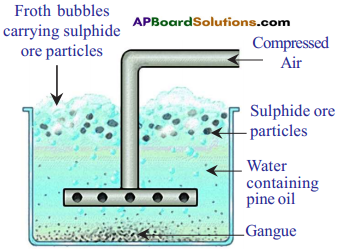
  • The ore with impurities is finely powdered and kept in water taken in a floatation cell.

AP SSC 10th Class Chemistry Solutions Chapter 13 Principles of Metallurgy 1
Froth floatation process for the concentration of sulphide ores

  • Air under pressure is blown to produce froth in water.
  • Froth so produced takes the ore particles to the surface whereas impurities settle at the bottom.
  • Froth is separated and washed to get ore particles.

Question 8.
When do we use magnetic separation method for concentration of an ore? Explain with an example.
(OR)
Write the name of the method we use to separate the ore or impurity in which one of them is magnetic substance. Draw a neat diagram indicating the method.
Answer:
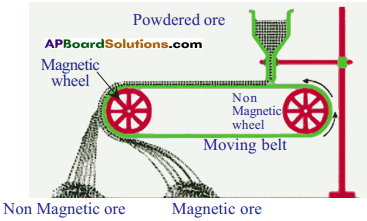
If the ore or impurity, one of them is magnetic substance and the other non-magnetic substance they are separated using electromagnets.
Ex :
Iron from iron ore (Fe3O4) is separated from its impurity by passing through a magnetic field. The field attracts magnetic ore (Iron) and repels the non-magnetic impurities.
AP SSC 10th Class Chemistry Solutions Chapter 13 Principles of Metallurgy 2

Question 9.
Write short notes on each of the following :
i) Roasting
ii) Calcination
iii) Smelting
Answer:
i) Roasting :
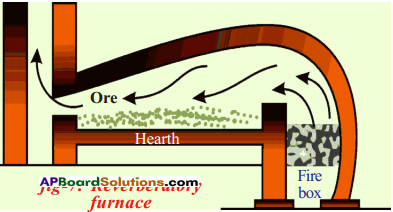
Roasting is a pyrochemical process in which the ore is heated in the presence of oxygen or air, below its melting point. Generally, reverberatory furnace is used for roasting.
Ex:
Zinc blende on heating with oxygen in reverberatory furnace forms zinc oxide as solid and liberating sulphur dioxide as gas.
2Zns(s) + 3O2(g) → 2ZnO(s) + 2SO2(g)

ii) Calcination :
Calcination is a pyrochemical process in which the ore is heated in the absence of air. The ore gets generally decomposed in this process.
Ex: MgCO3(s) → MgO(s) + CO2(g)

iii)Smelting:
Smelting is a pyrochemical process, in which the ore is mixed with flux and fuel, then is strongly heated.

AP SSC 10th Class Chemistry Solutions Chapter 13 Principles of Metallurgy

Question 10.
What Is the difference between roasting and calcination? Give one example for each.
(OR)
Roasting and Calcination are the methods to extract crude metals from ores. What is the difference between Roasting and Calcination?
Answer:

Roasting Calcination
1. Roasting is a pyrochemical process in which the ore is heated in the presence of air below its melting point. 1. Calcination is a pyrochemical process in which the ore is heated in the absence of air.
2. It is an oxidation reaction. 2. It is a decomposition reaction.
3. It requires oxygen. 3. It doesn’t require oxygen.
4. It is suitable to sulphide ores. 4. It is suitable to carbonate ores.
5. Ex : 2ZnS + 3O2 → 2ZnO + 2SO2 5. Ex : CaCO3 → CaO + CO2

Question 11.
Define the terms:
i) gangue
ii) slag.
Answer:
i) Gangue:
The impurity present in the ore is called gangue.
(or)
Unwanted impurity associated with ore.

ii) Slag:
The impurities found from molten metal during poling process of refining are called slag.

Question 12.
Magnesium is an active metal if it occurs as a chloride in nature, which method of reduction is suitable for its extraction?
Answer:

  • The method of reduction which is useful for chloride of magnesium which is active is electrolytic reduction.
  • Fused MgCl2 is electrolysed with steel cathode (-) and graphite anode (+). The metal (Mg) will be deposited at cathode and chlorine gas liberates at the anode.
    At cathode : Mg2+ + 2 e → Mg
    At anode : 2 Cl → Cl2 + 2e

AP SSC 10th Class Chemistry Solutions Chapter 13 Principles of Metallurgy

Question 13.
Mention two methods which produce very pure metals.
Answer:
Methods which produce very pure metals are :

  1. Electrolytic Reduction
  2. Smelting.

(OR)

  1. Distillation
  2. Poling.

Question 14.
Which method do you suggest for extraction of high reactivity metals? Why?
Answer:
1.The only method which is suitable for extraction of high reactivity metals is electrolysis of their fused compounds.

2. Other methods are not suitable due to following reasons :
a) Simple reduction methods like heating with C, CO, etc. to reduce the ores of these metals are not suitable because the temperature required for the reduction is too high and more expensive.

b) Electrolysis of their aqueous solutions are also not preferable because water in the solution would be discharged at the cathode in preference to the metal ions.

Question 15.
Suggest an experiment to prove that the presence of air and water is essential for corrosion. Explain the procedure.
(OR)
Write the experimental procedure to prove that water and air are essential for rusting of iron articles.
(OR)
How can you prove that the presence of air and humid are essential for corrosion?
(OR)
Explain in brief, an experiment to prove that the presence of air and water are essential for corrosion.
Write the precautions to be taken in the experiment to show air and water are essential for rusting iron articles and also write the experimental procedure.
Answer:
Aim :
To prove that the presence of air and water is essential for corrosion or for rusting of iron articles.

Apparatus :
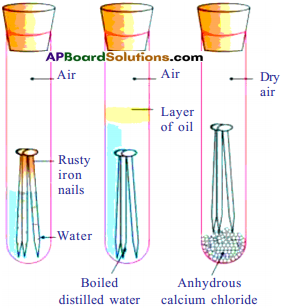
3 boiled test tubes, 3 corks, boiled distilled water, anhydrous calcium chloride, clean iron nails.

AP SSC 10th Class Chemistry Solutions Chapter 13 Principles of Metallurgy 3

Procedure :

  • Take three test tubes and place clean iron nails in each of them.
  • Label these test tubes A, B and C. Pour some water in test tube A and cork it.
  • Pour boiled distilled water in test tube B, add about 1 ml of oil and cork it. The oil will float on water and prevent the air from dissolving in the water.
  • Put some anhydrous calcium chloride in test tube C and cork it. Anhydrous calcium chloride will absorb the moisture.
  • Leave these test tubes for a few days and then observe.
  • We will observe that iron nails rust in test tube A, but they do not rust in test tubes B and C.

Observation :

  • In test tube A, the nails are exposed to air and water. Hence, the nails rusted.
  • In test tube B, the nails are exposed only to water, but not to air, because the oil float on water and prevent the air from dissolving in the water. Hence, the nails are not rusted.
  • In test tube C, the nails are exposed to dry air, because anhydrous calcium chloride will absorb the moisture, if any, from the air. Hence, the nails are not rusted.

Conclusion :
From the above experiment we can prove that air and water are essential for corrosion.

AP SSC 10th Class Chemistry Solutions Chapter 13 Principles of Metallurgy

Question 16.
Collect information about extraction of metals of low reactivity silver, platinum and gold and prepare a report.
(OR)
Prepare a report with the collected information about extraction of metals of low reactivity silver, platinum and gold.
Answer:
Extraction of Silver:

  1. Silver can be extracted from Ag2S by using displacement from aqueous solution.
  2. Ag2S is dissolved in KCN solution to get dicyanoargentate (I) ions.
  3. From these ions Ag is precipitated by treating with Zinc dust powder.
    Ag2S + 4 CN → 2 [Ag(CN)2] + S2-
    2[Ag(CN)2](aq) + Zn(s) → [Zn(CN)4]2-(aq) + 2Ag(s)

Extraction of Gold :

  1. Gold is extracted from gold ore like electrum. Impurities are separated from the gold by treating gold ore with a weak cyanide solution.
  2. Zinc is added and a chemical reaction takes place which separates the gold from ore.
  3. Pure gold is removed from the solution with a filter press.

Extraction of Platinum:

  1. The extraction of platinum from ore is a complex process and includes milling the ore, a froth flotation process, and smelting at high temperatures.
  2. This removes the base metals, notably iron and sulphur and concentrate platinum.

Question 17.
Draw the diagram showing
i) Froth flotation
ii) Magnetic separation.
(OR)
Draw a neat diagram and label the parts that shows froth floatation process for the concentration of sulphide ore.
Answer:
i)
AP SSC 10th Class Chemistry Solutions Chapter 13 Principles of Metallurgy 1
ii)
AP SSC 10th Class Chemistry Solutions Chapter 13 Principles of Metallurgy 2

Question 18.
Draw a neat diagram of reverberatory furnace and label it neatly.
(OR)
Draw a neat labelled diagram of a reverberatory furnace.
Answer:
AP SSC 10th Class Chemistry Solutions Chapter 13 Principles of Metallurgy 4

Question 19.
What is activity series? How does it help in extraction of metals?
Answer:
Activity Series :
We can arrange metals in descending order of their reactivity. This series of writing metals is called activity series.

Uses of activity series the extraction of metals :

  • Activity series is extremely useful in extraction of metals because we can judge the nature of metal and how it exists.
  • High reactive metals like K, Na, Ca, Mg and Al are so reactive that they are never found in nature in free state.
  • The moderate reactive metals like Zn, Fe, Pb, etc. are found in the earth’s crust mainly as oxides, sulphides and carbonates.
  • The least reactive metals like Au, Ag, Pt are found even in free state in nature.

Question 20.
What is thermite process? Mention its applications in daily life.
Answer:
Thermite Process :

  • Thermite process is the chemical reaction which takes place between metal oxides and aluminium.
  • When highly reactive metals such as sodium, calcium, aluminium, etc. are used as reducing agents, they displace metals of lower reactivity from the compound.
  • This reaction is highly exothermic. The amount of heat evolved is so high that the metals can he directly converted into molten state.

Applications in daily life :

  • The reaction if Iron (III) oxide (Fe203) with aluminium is used to join railing of railway tracks or cracked machine parts.
    2 Al + Fe2O3 → Al2O3 + 2 Fe + Heat.
  • And also used for joining of cracked metal utensils in the house.

AP SSC 10th Class Chemistry Solutions Chapter 13 Principles of Metallurgy

Question 21.
Where do we use hand picking and washing methods in our daily life ? Give examples.
How do you correlate these examples with enrichment of ore?
Answer:
Daily life examples for hand picking:

  • Separating mud particles from rice is an example for hand picking because the colour and size of these two are different.
  • Similarly, the ore particles and the impurities are different in one of the properties like colour, size, etc. are separated by hand picking.

Daily life examples for washing :

  • We can clean some vegetables like potatoes by controlled flow of water. Less densive impurities are carried away by the flow leaving the more densive potatoes.
  • Similarly, ores are washed with controlled flow of water. Less densive impurities i are carried away by water flow, leaving the more densive ore particles behind.

Fill In The Blanks

1. The method is suitable to enrich the sulphide ores.
2. Arranging metals in the decreasing order of their reactivity is called
3. The method suitable for purification of low boiling metals.
4. Corrosion of iron occurs in the presence of and
5. The chemical process in which the ore is heated in the absence of air is called
Answer:

  1. Froth flotation
  2. activity series
  3. distillation
  4. air, water
  5. calcination

Multiple Choice Questions

1. The impurity present in the ore is called ………………….
A) Gangue
B) Flux
C) Slag
D) Mineral
Answer:
A) Gangue

2. Which of the following is a carbonate ore?
A) Magnesite
B) Bauxite
C) Gypsum
D) Galena
Answer:
A) Magnesite

AP SSC 10th Class Chemistry Solutions Chapter 13 Principles of Metallurgy

3. Which of the following is the correct formula of Gypsum?
A) CuSO4 • 2 H2O
B) CaSO4 • ½ H2O
C) CuSO4 • 5 H2O
D) CaSO4 • 2 H2O
Answer:
D) CaSO4 • 2 H2O

4. The oil used in the froth flotation process is
A) kerosene oil
B) pine oil
C) coconut oil
D) olive oil
Answer:
B) pine oil

5. Froth flotation is method used for the purification of ………………. ore.
A) sulphide
B) oxide
C) carbonate
D) nitrate
Answer:
A) sulphide

6. Galena is an ore of ………………..
A) Zn
B) Pb
C) Hg
D) Al
Answer:
B) Pb

7. The metal that occurs in the native form is ………………
A) Pb
B) Au
C) Fe
D) Hg
Answer:
B) Au

AP SSC 10th Class Chemistry Solutions Chapter 13 Principles of Metallurgy

8. The most abundant metal in the earth’s crust is …………………
A) silver
B) aluminium
C) zinc
D) iron
Answer:
B) aluminium

9. The reducing agent in thermite process is ………………….
A) Al
B) Mg
C) Fe
D) Si
Answer:
A) Oxidise

10. The purpose of smelting an ore is to ……………….. it.
A) Oxidise
B) Reduce
C) Neutralise
D) None of these
Answer:
B) Reduce

10th Class Chemistry 13th Lesson Principles of Metallurgy InText Questions and Answers

10th Class Chemistry Textbook Page No. 238

Question 1.
How are the metals present in nature?
Answer:
Some metals like gold (Au), silver (Ag) and copper (Cu) are available in nature in free sjate. Other metals mostly are found in nature in the combined form.

10th Class Chemistry Textbook Page No. 240

Question 2.
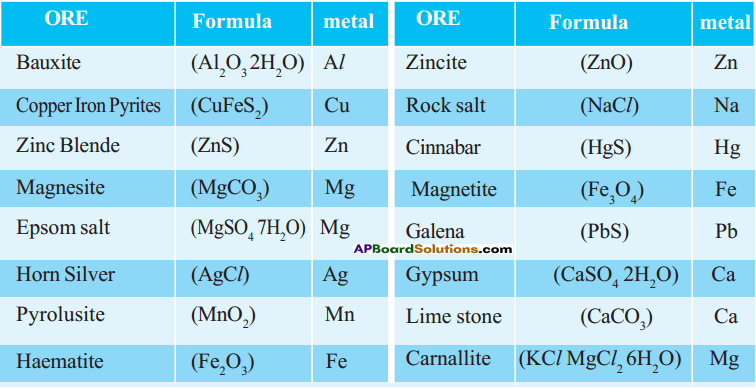
What metals can we get from the ores mentioned in the Table – 1?
Answer:
The metals are Aluminium (Al), Copper (Cu), Magnesium (Mg), Silver (Ag), Manganese (Mn), Iron (Fe), Zinc (Zn), Sodium (Na), Mercury (Hg), Lead (Pb), Calcium (Ca).

Question 3.
Can you arrange metals in the order of their reactivity?
Answer:
The order of reactivity is like this : Ag < Cu < Pb < Mn < Fe < Zn < Al < Mg < Ca < Na.

AP SSC 10th Class Chemistry Solutions Chapter 13 Principles of Metallurgy

Question 4.
What do you notice in Table – 2?
Answer:
We notice that ores of many metals are oxides and sulphides. ______

Question 5.
Can you think how we get these metals from their ores?
Answer:
We can get metals from their ores by using various extracting techniques.

Question 6.
Does the reactivity of a metal and form of its ore (oxides, sulphides, chlorides, carbonates, sulphates) has any relation with process of extraction?
Answer:
Yes, they have relation. Metals like K, Na, Ca, Mg and Al are so reactive. They exist in all forms whereas moderate reactive metals like Zn, Fe, Pb, etc. exist as oxides, sulphides and carbonates. The least reactive metals are found even in free state.

Question 7.
How are metals extracted from mineral ores?
Answer:
The extraction of a metal from its ores involves mainly in three states. They are :

  1. Concentration or Dressing
  2. Extraction of crude metal
  3. Refining or purification of the metal.

10th Class Chemistry Textbook Page No. 248

Question 8.
Do you know why corrosion occurs?
Answer:
Corrosion occurs due to reaction of metal with both air and water.

AP SSC 10th Class Chemistry Solutions Chapter 13 Principles of Metallurgy

Question 9.
What are the conditions under which iron articles rust?
Answer:
Iron articles get rust due to both air and water.

10th Class Chemistry Textbook Page No. 251

Question 10.
What is the role of furnace in metallurgy?
Answer:
Furnace is used to carry out pyrochemical process in metallurgy.

Question 11.
How do furnaces bear large amounts of heat?
Answer:
Furnaces have metallic lining. So they bear large heats.

AP SSC 10th Class Chemistry Solutions Chapter 10 Chemical Bonding

Question 12.
Do all furnaces have same structure?
Answer:
No, they have different structures.

10th Class Chemistry Textbook Page No. 239

Question 13.
Do you agree with the statement “All ores are minerals but all minerals need not be ores.? Why?
Answer:

  • Yes, I agree with the statement. The elements or compounds of the metals which occur in nature in the earth’s crust are called minerals whereas ore is a mineral from which the metal is profitably extracted.
  • For example, aluminium exists in two mineral forms that is clay and bauxite. But aluminium is mainly extracted from bauxite which contains 70% aluminium oxide.
  • So Bauxite is an ore of aluminium whereas clay is not ore.
  • So all ores are minerals but all minerals need not be ores.

10th Class Chemistry 10th Lesson Principles of Metallurgy Activities

Activity – 1
1. How do you classify ores based on their formula?
Answer:
1) Look at the following ores.
AP SSC 10th Class Chemistry Solutions Chapter 13 Principles of Metallurgy 5

2) Identify the metal present in each ore.
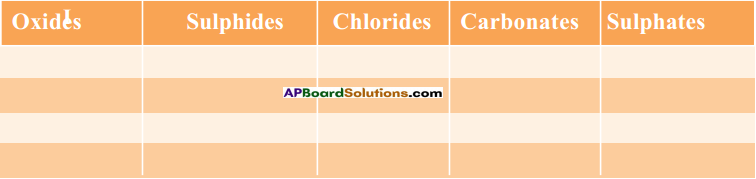
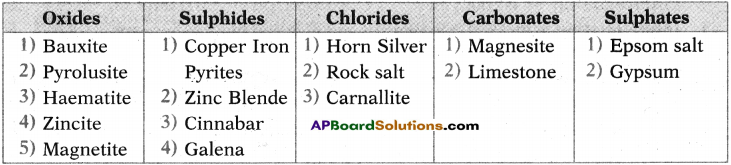
3) Classification of ores as oxides, sulphides, chlorides, carbonates, and sulphates as follows :
AP SSC 10th Class Chemistry Solutions Chapter 13 Principles of Metallurgy 6
AP SSC 10th Class Chemistry Solutions Chapter 13 Principles of Metallurgy 7

AP Board 9th Class Biology Solutions Chapter 9 Adaptations in Different Ecosystems

AP State Syllabus AP Board 9th Class Biology Solutions Chapter 9 Adaptations in Different Ecosystems Textbook Questions and Answers.

AP State Syllabus 9th Class Biology Solutions 9th Lesson Adaptations in Different Ecosystems

9th Class Biology 9th Lesson Adaptations in Different Ecosystems Textbook Questions and Answers

Improve Your Learning

Question 1.
What do you understand by adaptations in organisms and why do they adapt? (AS 1)
Answer:

  • The ways and means that organisms adapt or develop over a certain period of time in different conditions for better survival are adaptation of organisms.
  • Adaptation is a feature that is common in any population because it provides some improvement for better survival.

AP Board 9th Class Biology Solutions Chapter 9 Adaptations in Different Ecosystems

Question 2.
With the help of two examples, explain how these organisms have adapted themselves in the ecosystem? (AS 1)
Answer:

  • Mangroves grow in a wet and salty place.
  • They have evolved to have curious looking projections from their roots called pneu- matophores or knees.
  • These pneumatophores develop from the lateral roots that are growing near the surface, and protrude upto 12 inches out of the soil.
  • Pneumatophores aid the plants in maintaining adequate root respiration in a watery environment.
  • We don’t find such structures in plants growing around us.
  • Another example is in kaiabanda, the leaves are reduced to spines so that there is little transpiration loss and water is stored in the tissues of the stem (succulent stems)
  • This helps the plant to live in conditions of water scarcity as we come across in deserts.
  • With the above two examples, we can say that these organisms have adapted them-selves in the ecosystem.

Question 3.
Collect some aquatic plants- cut the leaves and stems. Observe them under microscope and record your observations like presence air /absence of air spaces etc. and answer the below. (AS 3)
a) Are there any other reasons for their floating?
Answer:
The bodies of aquatic plants are delicate with more than 80% of their weight consisting of water.

b) Draw a diagram of what you have observed under microscope.
AP Board 9th Class Biology Solutions Chapter 9 Adaptations in Different Ecosystems 5

Question 4.
What special adaptations can be seen in the following organisms? (AS 1)
a) mangrove trees
b) camel
c) fish
d) dolphins
e) planktons

a) Mangrove trees :
Answer:
AP Board 9th Class Biology Solutions Chapter 9 Adaptations in Different Ecosystems 1

  1. Mangroves grow in a wet and salty place near the sea shore.
  2. From their roots arise pneumatophores or knees.
  3. These pneumatophores develop from the lateral roots that are growing near the surface and protrude upto 12 inches out of the soil.
  4. Pneumatophores. aid the plants in maintaining adequate root respiration in a watery environment.

b) Camel:
Answer:
AP Board 9th Class Biology Solutions Chapter 9 Adaptations in Different Ecosystems 2

  1. In camel hump stores fat fordater use.
  2. Long eyelashes protects eye from sand.
  3. Nostrils closes voluntarily to protect from blowing sand.
  4. Long legs keeps the body away from hot ground.

c) Fish :
Answer:’

  1. The body is covered by scales.
  2. Fishes bear specialised structures to swim like fins.
  3. Fishes have floaters in their body (special structures of their digestive canals) to be able to inhabit particu¬lar levels in the water body.
  4. Fishes respire with gills.

AP Board 9th Class Biology Solutions Chapter 9 Adaptations in Different Ecosystems 3 AP Board 9th Class Biology Solutions Chapter 9 Adaptations in Different Ecosystems 4

d) Dolphins:
Answer:
Dolphins have adapted to their environment in the following ways :
Fins shape – A dolphins tail goes up and down to help it dive up to get the air. The shape of their fins also help to propel them through the water.

To help dolphins save oxygen while they dive under water, their heart beat slower during a dive and their blood is diverted from other parts of their body to their heart, lungs and brain. They also save oxygen via muscles, which have a protein called myo-globin which in turn stores oxygen.

They have a blubber or fat which provides insulation helping the dolphin stay warmer under cold water.

They have a body covering of skin. The upper most layer of skin produces an oil which forms a film that cover the dolphin’s body.

Being mammal dolphin breathe with lungs rather than gills. So they breathe from a blow hole which closes before the dolphin goes into the water. The long nose helps the dolphin to fight sharks and their teeth help them to catch fish.

They have well developed echo location by which they locate other animals and also communicate with each other.

e) Planktons:
Answer:
Microscopic photosynthetic organisms like planktons have droplets of oil in their cells that keeps them float.

AP Board 9th Class Biology Solutions Chapter 9 Adaptations in Different Ecosystems

Question 5.
If an animal of euphotic zone has to survive in abyssal zone, what adaptations are required to survive there? (AS 1)
Answer:
Adaptations required to survive in abyssal zone are :

  1. The animals should have wide mouths and huge curved teeth which prevent escape of any prey.
  2. Absence of skeleton, flattened bodies are required.
  3. Animals should have special structures that produce light on their bellies, around their eyes, and at the sides of their bodies.
  4. The animals should show bioluminescence in the dark waters.

Question 6.
Marine water fishes drink more water than fresh water fishes. Do you agree? Justify.
Answer:

  • Yes, marine water fishes drink more water than fresh water fishes.
  • Because several marine fishes have a lower internal salt concentration than that of the water they swim in.
  • So they tend to dehydrate as water is lost by osmosis.
  • To compensate, they drink large amount of water and excrete the salts both via their kidneys and through highly specialised cells in the gills.

Question 7.
Visit a nearby pond or lake. Record the organisms you have observed and their adaptations. (AS 4)
Answer:

  • Nearby pond or lake consists of three zones namely littoral zone, limnetic zone, and profundal zone.
  • In the topmost littoral zone, the edge of a water body is home to snails, insects, several crustaceans, fishes and amphibians, and the eggs and larvae of dragonflies.
  • Predators present are tortoise, snakes, and ducks.
  • Adaptations : Several organisms have well developed sight, usually have dull and greyish bodies, and are fast swimmers.
  • Limnetic zones contains fresh water fish, crustaceans like daphnia, cyclops, and small shrimps are present.
  • Floating- plants like water hyacinth, wolfia, pistia along with algae are present.
  • Adaptations seen in the plants this zone are presence of air space, leaves covered with wax, etc.
  • In the profundal zone scavengers and predators for example crustaceans, crabs, fishes like eels and snails, turtles are present.
  • They adapt themselves by feeding on dead animals that settle down.

Question 8.
Draw a lake showing different zones. Why are they called so? (AS 5)
Answer:
Zones of Lake :
AP Board 9th Class Biology Solutions Chapter 9 Adaptations in Different Ecosystems 6
1) Littoral zone :
The zone close to shore. They reaches all the way. Plants living in this zone perform photosynthesis.

2) Limnetic zone :
Sunlit part of the lake surrounded by the littoral zone. This zone extends at a depth where sunlight penetrates.

3) Profundal zone :
It is much colder and denser than previous zones.

Question 9.
Collect information of one lake from internet and prepare a table of organisms adapted at different zones.
Answer:
Different zones in lakes and types of organisms present:
1) The littoral zone :
a) The topmost and warmest zone at the edge of a water body is home to snails, clams, insects, several crustaceans, fishes and amphibians and eggs and larvae of dragonflies.
b) Plants like mosses, water lily, vallisneria, hydrilla etc. are found along with several types of algae.
c) Predators of this zone are tortoise, snakes and ducks.

2) The limnetic zone :
a) This zone contains variety of fresh water fish with bright shiny scales.
b) Transparent or whitish bodied crustaceans like daphnia, cyclops, small shrimps are also found in this zone.
c) There are different types of floating plants like water hyacinth wolfia, pistia along with a variety of algae.

3) The profundal zone :
a) Mostly heterotrophs are present.
b) Scavengers and predators like crustaceans, crabs, fishes like eels and glossogobius (isika dondu), snails, turtles etc are present.
c) Many kinds of bacteria are also present in this zone that help in decomposition.

AP Board 9th Class Biology Solutions Chapter 9 Adaptations in Different Ecosystems

Question 10.
Write the effect of temperature on the organisms adapted in a lake and pond in a tabular form. (AS 1)
Answer:

  • In deeper lakes during summer only the surface water is heated up while the deeper layer remain cold. During summer the ponds dry up.
  • In tropical regions water gets heated up and evaporates in lakes. During average temperatures the water in the pond heated up and evaporates.
  • The requirements necessary to the organisms like oxygen and nutrients gets decreased in the lake.
  • The salinity of the water increases, concentration of oxygen decreases and availability of food decreases in pond during average temperatures.
  • In the cold regions upper layers of the lake gets frozen during winter and lower layers does not.
  • The entire pond gets frozen during winter.
  • Aquatic animals in tropics undergo aestivation or hybernation to overcome extreme cold or hot seasons.

Question 11.
Amphibians are wonderful creatures on the earth. How do you appreciate their adaptation? (AS 6)
Answer:

  • Amphibian body has small waist, no neck. Streamlined body shape helps in swimming.
  • Skin is thin and moist allows gaseous exchange in cutaneous respiration.
  • Front legs used to keep the front portion of the body off the ground.
  • Hind legs able to jump great distances and change direction quickly.
  • Eyes are positioned on top of head gives the frog a wide angled visual field.
  • Mouth is very large and broad can able to catch and eat large prey.
  • Tongue attached at front of mouth enables it stick the prey when caught.
  • Frogs start their lives as aquatic tadpoles with gills to breathe. As tadpole grows into frogs lungs replace the gills and allows frog to breathe on land.

Question 12.
Some animals and plants survive only in certain conditions. Nowadays human activities cause damage to these conditions. What do you think about this? (AS 7)
Answer:

  • Human activities are causing lot of damage to biodiversity.
  • Human activities such as deforestation, overgrazing, conversion of forest land to agricultural land, hunting and indiscriminate killing of animals for their products, and pollution can endanger the plant and animal species.
  • If proper care is not taken plants and animals may disappear totally from the surface of the earth.

Question 13.
In the chapter on ecosystem, we had studied about the mangrove ecosystems. What kind of abiotic conditions did you study in them? (AS 1)
Answer:
Kinds of abiotic conditions in mangrove ecosystems are soil, pH, oxygen, nutrients, winds and currents, light, temperature, humidity, tides, salinity.

AP Board 9th Class Biology Solutions Chapter 9 Adaptations in Different Ecosystems

Question 15.
Are there any rivers meeting in the Bay of Bengal in the Coringa ecosystem? Collect information and make a note on them.
Answer:

  • Coringa mangrove is situated South of Kakinada Bay and is about 150 km South of Visakhapatnam.
  • Coringa is named after the river Coringa.
  • Coringa mangroves receive fresh water from Coringa and Gaderu rivers, distributors of Gautami, Godavari rivers, and neritic waters from Kakinada Bay.
  • Numerous creeks and canal traverse this coringa ecosystem.

Question 17.
The Murrel (Korramatta) and Rohu are fishes found in rivers. Will they be able to live in the coringa ecosystem ? Give reasons for your answer.
Answer:

  • Yes, Murrel and Rohu be able to live in the coringa ecosystem.
  • Because coringa ecosystem gets fresh water from rivers coringa, Gaderu and distributories of Gautami, Godavari rivers.
  • If the salinity of the water in the coringa ecosystem increases, the water enters the body of fresh water fishes.
  • The water can be excreted in the form of urine, but to maintain a suitable salt bal¬ance fresh water fish need to reabsorb salt through the kidneys and salt collecting cells in gills.

Question 18.
How the frogs got protected themselves from cold and heat?
Answer:

  • Frogs are cold blooded animals so they can’t tolerate extreme cold or heat conditions.
  • They protect themselves from extreme cold conditions by a process called hibernation (winter sleep) and from extreme heat conditions by Aestivation (summer sleep)
  • During these processes they burrow deep in the ground and remain motionless until the conditions are favourable.
  • During this period the rate of metabolic activities slow down and the animal goes into a nearly unconscious sleepy condition.

AP Board 9th Class Biology Solutions Chapter 9 Adaptations in Different Ecosystems

Question 19.
How do you appreciate the processing protection pebble plants from the enemies?
Answer:

  • Pebble plants are also called living stones.
  • They protect themselves from their enemies by adapting themselves to their habitat.
  • They survive by living partly underground.
  • They avoid being eaten by blending in with surrounding rocks.
  • Leaves of these plants are not green as in almost all higher plants, but various shades of cream, grey and brown, patterned with darker windowed areas, dots and red lines.
  • The markings on the top surface disguise the plant in its surroundings (camouflage)
  • Thus, they adopt wonderfully to their habitats and protect themselves from their enemies.

9th Class Biology 9th Lesson Adaptations in Different Ecosystems InText Questions and Answers

9th Class Biology Textbook Page No. 131

Question 1.
What is a habitat?
Answer:
Habitat is the immediate environment occupied by an organism or the living place of an organism.

Question 2.
Is a tree habitat only for a crow?
Answer:’
No. Tree is a habitat for variety of birds and insects.

AP Board 9th Class Biology Solutions Chapter 9 Adaptations in Different Ecosystems

Question 3.
In what way an ecosystem is different from habitat?
Answer:
In ecosystem biotic and abiotic components are present. Habitat is the place where organisms live in an ecosystem.

9th Class Biology Textbook Page No. 134

Question 4.
You may know animals that live in water. Do you find in them any suitable characters adapted to live in water? Write a note on them in your notebook.
Answer:

  • Structural adaptations in the bodies like presence of special air spaces.
  • Such air spaces help them to swim and float in water.
  • The aquatic organisms bear specialized structures to swim like flippers as in turtles and fins in fishes.
  • Fishes, dolphins have floaters in their body to be able to inhabit particular levels in the water body.

9th Class Biology Textbook Page No. 135

Question 5.
In what way flexible stem is useful to the aquatic plants?
Answer:

  • In aquatic plants flexible stem contains a parenchymatous tissue known as arenchyma.
  • Arenchyma consists of number of air filled spaces.
  • These air spaces help the plant to float on water.

9th Class Biology Textbook Page No. 137

Question 6.
Observe the table and answer the following questions.
Answer:

a) How many zones can you see in the figure basis of light penetration? Name them.
Answer:
Three zones are present. They are eu- photic zone, bathyal zone and abyssal zone.

b) What types of abiotic conditions do you find as per the given table?
Answer:
Light, temperature and depth.

c) What will effect adaptation to marine life other than the conditions shown in the table and figure?
Answer:
Salinity, oxygen, rainfall, regular windflow, soil, pH, nutrients, humid-ity, oceanic currents effect adaptation to marine life.

d) What happens to the temperature and pressure as depth increases?
Answer:
As depth increases temperature decreases and pressure increases.

e) Which zone has more animals? Guess why.
Answer:

  1. Bathyal zone has more animals. Because the conditions in this zone are suitable for the organisms to grow.
  2. Red and brown kelps are the primary producers. They provide food to other organisms in that zone.

9th Class Biology Textbook Page No. 139

Question 7.
Does Pulikat lake of Nellore come under fresh water ecosystem or not? Why?
Answer:

  • Pulikat lake of Nellore comes under marine or salt water ecosystem.
  • Because the salinity of water in the lake is 3.5%.
  • Main salts present in the Pulikat lake are sodium and potassium.

9th Class Biology Textbook Page No. 140

Question 8.
‘Think, how webbed feet helps ducks?
Answer:

  1. Webbed feet of birds help them to adapt conditions on land as well as in water.
  2. Webbed feet have enabled them to be good swimmers.

AP Board 9th Class Biology Solutions Chapter 9 Adaptations in Different Ecosystems

Question 9.
Why cranes have long legs and long beaks?
Answer:

  1. Cranes have long, thin legs wander through the mud shallows searching for insects.
  2. Long beak help them in searching of insects in the mud.

9th Class Biology Textbook Page No. 141

Question 10.
How are marine ecosystems different from fresh water ones?
Answer:

  1. The saliny of water in marine ecosystem is 3.5% whereas it is 1.8% in fresh water.
  2. Marine ecosystems are huge and they make up about three-fourths of the earths surface.
  3. The number of organisms present in marine ecosystems are more when compared to fresh water ecosystem.

Question 11.
Write two types of adaptations you find in marine ecosystems, different from fresh water ecosystems.
Answer:

  • Many marine animals have blubber fur insulation from the cold and some fish have an antifreeze like substance in their blood to keep it flowing.
  • Marine animals must regulate the interaction of fresh water and salt water in their bodies.
  • Specially developed kidneys, gills and body functions help to maintain salt concentrations across members through osmosis.

Question 12.
What are the similarities in adaptation on the basis of light penetration in the two aquatic ecosystems?
Answer:

  • In both the aquatic ecosystems, light penetrates upto a depth of zoom only.
  • The light intensity is sufficient to perform photosynthesis.
  • In the low light intensities below 200 mts depth is sufficent to perform photosynthesis by some kelps.
  • Due to the lack of light in abyssal and profundal zones, usually scavengers and predators exists.

9th Class Biology Textbook Page No. 142

Question 13.
Which zone do you think, when compared to marine ecosystems, is absent in fresh water ecosystem?
Answer:
Benthic zone is absent in fresh water ecosystem when compared to marine ecosystem.

AP Board 9th Class Biology Solutions Chapter 9 Adaptations in Different Ecosystems

Question 14.
What would be a major factor leading to different types of adaptations in marine, fresh water ecosystems?
Answer:
Light would be a major factor leading to different types of adaptation in marine, fresh water ecosystems.

Question 15.
Do all plants shed their leaves at same time in a year throughout the world?
Answer:

  1. No. Some plants in temperate regions shed their leaves before the winter starts.
  2. In tropical regions some plants shed their leaves before the start of summer.

9th Class Biology Textbook Page No. 143

Question 16.
Are thorny leaves also an adaptation to temperature?
Answer:

  1. No. They are not adaptation to temperature.
  2. They are adaptation to protect themselves from the animals who eat them.

Question 17.
If the trees have broad leaves at the time of snow fall season what will happen?
Answer:
If the trees have broad leaves at the time of snow fall season, the branches of tree can break due to the weight of snow gathered on each leaf and branch during snow fall.

Question 18.
Why polar bear has thick fur on its body?
Answer:

  1. Polar bear has thick fur coat or hair covering on their bodies.
  2. The fur act as insulator preventing heat loss from its body.

AP Board 9th Class Biology Solutions Chapter 9 Adaptations in Different Ecosystems

Question 19.
In what way thick skin helps the seal to protect from cold weather?
Answer:

  1. In the thick layer of skin, fat is deposited in seals.
  2. The thick layer of fat deposited under their act as insulators preventing heat loss from its body.
  3. The fat not only insulates the body but helps in producing heat and energy.

9th Class Biology Textbook Page No. 132

Question 20.
Can you give some examples of fleshy leaf plants?
Answer:
Yes. Bryophyllum, Aloe, and Agave are the examples for fleshy leaved plants.

Question 21.
Why xerophytic plants do not have broad leaves?
Answer:
To prevent the excessive loss of water through respiration xerophytic plants do not have broad leaves.

Question 22.
You may see Kittanara, a xeric plant, grown as fence around crop fields in some areas in our state. Actually those places are not desert. How can they grow there?
Answer:
They grow there because this plant shows adaptations in that places.

9th Class Biology Textbook Page No. 133

Question 23.
Do all animals living in desert conditions show adaptations?
Answer:
Yes, all animals living in desert conditions show adaptations.

AP Board 9th Class Biology Solutions Chapter 9 Adaptations in Different Ecosystems

Question 24.
Why some animals have scales on their body?
Answer:

  1. Scales mainly protect the animals from environment.
  2. In desert animals scales allow them to retain moisture by preventing the evaporation of water through the skin.
  3. This allows the animal to become dehydrated and animal requires small amount of water to survive.

Question 25.
Why the animals that lives in burrows usually comeout during night time only?
Answer:
To protect themselves from extreme hot conditions, animals that live in burrows usually comeout during night time only.

9th Class Biology Textbook Page No. 139

Question 26.
Which organism among jelly fishes and decomposers present in euphotic zone?
Answer:
Jelly fishes are present in euphotic zone.

Question 27.
What kinds of adaptations can be seen in the organisms of the euphotic zone?
Answer:

  1. The organisms living in this zone are mostly floaten and swimmen.
  2. Animals in this zone usually have shiny bodies reflecting light away to merge with shiny water surface are transparent.
  3. These usually have sharp vision.

Question 28.
What kind of adaptations can be seen in the organisms of abyssal zone?
Answer:

  • The larger animals in abyssal zone have wide mouths and huge curved teeth which prevent escape of any prey.
  • Absence of skeleton, flattened bodies are some other characteristics observed.
  • Some animals also have special structures that produce light on their bellies, around their eyes and at the sides of their bodies.
  • Some animals shows bioluminiscence in the dark waters.

Question 29.
What differences can you find in the animals of bathyal zone when compared to animals of euphotic and abyssal zones?
Answer:

  • Most of the plants found in this zone are the red and brown kelps, sponges, corals even animals with tubular bodies like squids and large animals like whales, etc.
  • Some of the animals in the bathyal zone have a flat body like the ray fishes.
  • Big eyes sensitive to very dimlight may present in bathyal zone animals.

AP Board 9th Class Biology Solutions Chapter 9 Adaptations in Different Ecosystems

Question 30.
How organisms of different zones of marine ecosystem are adapted?
Answer:

  • The animals of euphotic zone are mostly floaters and swimmers.
  • Animals in this zone usually have shiny bodies reflecting light away to merge with shiny water surface.
  • Animals of euphotic zone have very sharp vision.
  • Some of the animals in bathyal zone have a flat body like the ray fishes.
  • The animals may have big eyes sensitive to very dim light in bathyal zone.
  • Absence of skeleton, flattened bodies are some adaptations found in animals of abyssal zone.
  • Some animals in abyssal zone may have special structures that produce light on – their bellies, around their eyes and at the sides of their bodies.
  • Some animals in abyssal zone shows bioluminiscence in the dark waters.

9th Class Biology Textbook Page No. 141

Question 31.
Organisms of the oceans have a lesser salt content in their bodies than the seawater around 3.5%. The fluid could drain out of the body of the organisms into the sea. This could be dangerous and fatal to the organism. How do they survive under such conditions?
Answer:

  • Several marine species have a lower internal salt concentration than that of the water they swim in. So they tend to dehydrate as water is lost by osmosis.
  • To compensate, they drink large amounts of water and excrete the salts both via their kidneys and through highly specialised cells in the gills.

Question 32.
Can fish in estuarine ecosystem survive in river as well as in sea?
Answer:

  • Yes, fish in estuarine ecosystem survive in river as well as in sea.
  • Two of the main challenges of estuarine life are the variability in salinity and sedimentation.
  • Many species of fish living in estuarine have various methods of control to the salt shifts.
  • They regulate the salt concentrations using osmoregulaters.

9th Class Biology 9th Lesson Adaptations in Different Ecosystems Activities

Activity – 1

Question 1.
i) Take a Kalabanda (Aloevera) and a Balsam plant in two separate pots.
ii) Water each of them with two tablespoons of water.
iii) Do not water them for a week.
iv) Observe the condition of the plants after a week.

Observations :
a) Which plant showed growth?
Answer:
Kalabanda plant showed growth.

b) Which plant dried first? Why?
Answer:
Balsam plant dried first. Because Balsam plants are not watered regularly. They need water to grow.

Activity – 2

Question 2.
i) Collect an aquatic plant out of a water body (e.g. Duck weed, Hydrilla, Vallisneria etc.) ii) Carry it back home and plant it in a pot and water it.
Observations :
a) From the above activity we see that some plants dry up without water very quickly, while other can grow even with very little water.
b) Each of these plants are adapted to the conditions in their surroundings on the basis of need of water.

Activity – 3

Question 3.
You know some of the animals that reside in and around lake or pond. Make a list of those animals and the characteristics of their body.
List of animals and reside in and around lake or pond :
Insects : Dragonfly, Damsefly, Mayfix, Stonefly, Dobsofly, Caddisfly, Cranefly, Water bugs, Beetles, etc.

Crustaceans Cray fish, Scuds, Shrimps
Molluscs Snails
Annelids Leeches
Fish Blugill, Bass, Catfish, Sculpin, Minnow
Reptiles Snakes, turtles
Amphibia Frogs

Characteristics of the body of animais living in and around lake:

Animals Characteristics
1) Mosquito The body is segmented and it is a carrier of diseases.
2) Shrimps ‘ These are small, bottom dwelling crustaceans with a trans­lucent exoskeleton.
3) Snails A soft bodied animal with a hard protective shell.
4) Swan Swans are long necked water birds, webbed feet are present.
5) Crayfish Fresh water crustaceans with four pairs of walking legs. Body is segmented with head and thorax united.
6) Dragonfly it is a flying insect with a long abdomen. Body is elongated with two pairs of transparent wings.
7) Earthworm It is a little animal with a long, soft body and no legs.
8) Fish It lives in the water and breathe with gills.
9) Goldfish It is a type of crap that makes a nice pet, kept in aquariums and swims with fins.
10) Toads The skin is dry and leathery. Toads are amphibians with poison glands, short legs and snout like parotid glands. Drier skin. Webbed feet helps in walking and swimming.
11) Leech The body is segmented. It sucks blood of other animals.

AP SSC 10th Class Physics Solutions Chapter 11 Electric Current

AP State Board Syllabus AP SSC 10th Class Physics Solutions Chapter 11 Electric Current Textbook Questions and Answers.

AP State Syllabus SSC 10th Class Physics Solutions 11th Lesson Electric Current

10th Class Physics 11th Lesson Electric Current Textbook Questions and Answers

Review of Your Previous Knowledge

Question 1.
What do you mean by electric current?
(OR)
Define electric current.
Answer:
Electric current is defined as the amount of charge crossing any cross-section of the conductor in one second.

Question 2.
Which type of charge (positive or negative) flows through an electric wire when it is connected in an electric circuit?
Answer:
Negative type of charge flows through an electric wire when it is connected in an electric circuit.

AP SSC 10th Class Physics Solutions Chapter 11 Electric Current

Question 3.
Is there any evidence for the motion of charge in daily life situations?
Answer:
Yes, lightning is a live example.

Improve Your Learning

Question 1.
Explain how electron flow causes electric current with Lorentz – Drude theory of electrons. (AS1)
(OR)
How does electron flow cattle elfectric current with Lorentz – Drude theory of electrons? Explain.
Answer:
Lorentz – Drude theory :

  1. Lorentz – Drude proposed that conductors like metals contain a large number of free electrons.
  2. The positive ions are fixed in their locations. The arrangement of the positive ions is called lattice.
  3. The negative ions (electrons) move randomly in lattice in an open circuit.
  4. When the lattice is closed the electrons are arranged in ordered motion.
  5. When the electrons are in order motion, there will be a net charge (crossing through any cross section.
  6. This order motion of electrons is called electric current.

Question 2.
How does a battery work? Explain. (AS1)
(OR)
How does a battery maintain a constant potential difference between its terminals?
Answer:
Working of a battery :

  • A battery consists of two metal plates (positive electrode = anode and negative electrode = cathode) and a chemical (electrolyte).
  • The electrolyte between the two metal plates consists of positive and negative ions which move in opposite directions.
  • The electrolyte exerts a chemical force on these ions and makes them move in a specified direction.
  • Depending upon the nature of the chemical, positive ions move towards one of the plates and accumulate on that plate.
  • As a result of this accumulation of charges on this plate it becomes anode.
  • Negative ions move in a direction opposite to the motion of positive ions and accumulate on the other plate.
  • As a result of this the plate becomes negatively charged called cathode.
  • This accumulation of different charges on respective plates continues till both plates are sufficiently charged.
  • But the ions in motion experience electric force when sufficient number of charges are accumulated on the plates.
  • The motion of ions continues towards their respective plates till the chemical force is equal to electric force.
  • Thus the battery works.

AP SSC 10th Class Physics Solutions Chapter 11 Electric Current

Question 3.
Write the difference between potential difference and emf. (AS1)
Answer:
Potential Difference:
Work done by the electric force on unit charge is called potential difference.
[latex]\mathbf{V}=\frac{\mathbf{W}}{q}=\frac{\mathbf{F} l}{\mathbf{q}}[/latex]

Electromotive force (emf):
The work done by the chemical force to move unit positive charge from negative terminal to positive terminal of the battery.
[latex]\varepsilon=\frac{W}{q}=\frac{F d}{q}[/latex]

Question 4.
How can you verify that the resistance of a conductor is temperature dependent? (AS1)
(OR)
How do you prove increase in temperature affects the resistance with an activity?
Answer:
Resistance :
The resistance of a conductor is the obstruction offered to the flow of electrons in a conductor.

Resistance is temperature dependent:
Aim:
To show that the value of resistance of a conductor depends on temperature for constant voltage between the ends of the conductor.

Materials required :

  1. A bulb
  2. A battery
  3. Key
  4. Insulated wire
  5. Multimeter

AP SSC 10th Class Physics Solutions Chapter 11 Electric Current 18
Procedure :

  1. Take a bulb and measure the resistance when it is in open circuit using a multimeter.
  2. Note the value of resistance in your notebook.
  3. Connect a circuit with components as shown in figure.
  4. Switch on the circuit. After few minutes, measure the resistance of the bulb again.
  5. Note this value in your notebook.

Observation :

  1. The value of resistance of the bulb in second instance is more than the resistance of the bulb in open circuit.
  2. The bulb gets heated.

Result:
The increase in temperature of the filament in the bulb is responsible for increase in resistance of the bulb.

Question 5.
What do you mean by electric shock? Explain how it takes place. (AS1)
Answer:
Electric shock:
The electric shock is combined effect of potential difference, electric current, and resistance of the human body.

  • An electric shock can be experienced when there exists a potential difference between one part of the body and another part.
  • When current flows through human body, it chooses the path which offers low resistance.
  • The resistance of a body is not uniform throughout it.
  • As long as current flow continues inside the body, the current and resistance of human body go on changing inversely.
  • This is called the electric shock.

AP SSC 10th Class Physics Solutions Chapter 11 Electric Current

Question 6.
Derive [latex]\mathbf{R}=\frac{\rho l}{\mathbf{A}}[/latex]. (AS1)
(OR)
What are laws of resistance and derive a formula for resistance.
Answer:
Resistance of a conductor is directly proportional to the length of the conductor,
i.e., R ∝ l ………………….. (1)
Resistance of a conductor is inversely proportional to the cross-section area of the conductor.
i.e., R ∝ [latex]\frac{1}{\mathrm{~A}}[/latex] ………………….. (2)
From (1) and (2) R ∝ [latex]R \propto \frac{l}{A} \Rightarrow R=\frac{\rho l}{A}[/latex]
where ρ is a constant,
ρ is called specific resistance or resistivity.

Question 7.
How do you verify that resistance of a conductor is proportional to the length of the conductor for constant cross-section area and temperature? (AS1)
Answer:
AP SSC 10th Class Physics Solutions Chapter 11 Electric Current 27

  • Collect manganin wires of different lengths with the same cross-sectional areas.
  • Make a circuit as shown in figure.
  • Connect one of the manganin wires between the ends P and Q.
  •  Measure the value of the current using the ammeter.
  • Repeat the same for other lengths of the wires.
  • Note the values of currents.
  • We notice that the current decreases with increase in the length of the wire.
    ∴ R ∝ l (at constant temperature and cross-section area) …………… (1)
  • Do the same with manganin wires with equal lengths but different cross-section area.
  • We notice that the resistance was more when the cross-section area was less.
    ∴ R ∝ [latex]\frac{1}{\mathrm{~A}}[/latex] ………………. (2)
    ∴ R ∝ [latex][latex]\frac{1}{\mathrm{~A}}[/latex][/latex]
    Thus we verify l and A.

Question 8.
Explain Kirchhoff’s laws with examples. (AS1)
(OR)
Write two examples of Kirchhoffs laws and explain it.
Answer:
Kirchhoff’s laws :
Two simple rules called Kirchhoff’s rules are applicable to any DC circuit containing batteries and resistors connected in any way.
The two laws are (i) Junction law and (ii) Loop law.

i) Junction law :
AP SSC 10th Class Physics Solutions Chapter 11 Electric Current 2
Here P is called junction point where conducting wires meet. The junction law states that, at any junction point in a circuit where the current can divide, the sum of the currents into the junction must equal the sum of the currents leaving the junction.
i.e., I1 + I4 + I6 = I2 + I3 + I5
This law is based on the conservation of charge.

ii) Loop law:
AP SSC 10th Class Physics Solutions Chapter 11 Electric Current 3
Loop law states that, the algebraic sum of the increases and decreases in potential difference (voltage) across various components of the circuit in a closed circuit loop must be zero.
AP SSC 10th Class Physics Solutions Chapter 11 Electric Current 4
This law is based on the conservation of energy.

Question 9.
What is the value of 1 KWH in Joules? (AS1)
Answer:
1 KWH = 1 KW x 1h
= 1000 W × 60 min = 1000 W × 60 × 60 s = 3.6 × 10⁶ Ws = 3.6 × 10⁶ J.
∴ 1 KWH = 3.6 × 10⁶ J.

Question 10.
Explain overloading of household circuit. (AS1)
Answer:
AP SSC 10th Class Physics Solutions Chapter 11 Electric Current 5

  • Electricity enters our homes through two wires called lines. These lines have low resistance and the potential difference between the wires is usually about 240 V.
  • All electrical devices are connected in parallel in our home. Hence, the potential drop across each device is 240 V.
  • Based on the resistance of each electric device, it draws some current from the supply. Total current drawn from the mains is equal to the sum of the currents passing through each device.
  • If we add more devices to the household circuit the current drawn from the mains also increases.
  • This leads to overheating and may cause a fire. This is called “overloading”.

Question 11.
Why do we use fuses in household circuits? (AS1)
(OR)
What is the use of fuses?
Answer:

  • The fuse consists of a thin wire of low melting point.
  • When the current in the fuse exceeds 20 A, the wire will heat up and melt.
  • The circuit then becomes open and prevents the flow of current into the household circuit.
  • Hence all the electric devices are saved from damage that could be caused by overload.
  • Thus we can save the household wiring and devices by using fuses.

AP SSC 10th Class Physics Solutions Chapter 11 Electric Current

Question 12.
Deduce the expression for the equivalent resistance of three resistors connected in series. (AS1)
(OR)
Derive R = R1 + R2 + R3
(OR)
The second end of a first resistor is connected to first end of second resistor. Then how are the resistors connected? Derive the expression for the resultant resistance of this connection.
Answer:
Series connection:
In series connection of resistors, there is only one path for the flow of current in the circuit. Hence, the current in the circuit is equal to I.
According to Ohm’s law,
∴ V1 = IR1 ; V2 = IR2 and V3 = IR3.
⇒ Let R be the equivalent resistance of the combination of resistors in series.
AP SSC 10th Class Physics Solutions Chapter 11 Electric Current 6
Also V = I Req
V = V1 + V2 + V3
I Req = IR1 + IR2 + IR3
⇒ I Req = I (R1 + R2 + R3)
⇒ Req = R1 + R2 + R3
∴ The sum of individual resistances is equal to their equivalent resistance when the resistors are connected in series.

Question 13.
Deduce the expression for the equivalent resistance of three resistors connected in parallel. (AS1)
(OR)
Derive : [latex]\frac{1}{\mathbf{R}}=\frac{1}{\mathbf{R}_{1}}+\frac{1}{\mathbf{R}_{2}}+\frac{1}{\mathbf{R}_{3}}[/latex]
(OR)
Explain the expression for the equivalent resistance of three resistors which are connected in parallel.
(OR)
If all the first ends of resistors are connected to and second ends are connected to another point, then what type of connection is this? Derive the resultant resistance for this connection.
Answer:
Parallel Connection :
In parallel connection of resistors, there is same potential difference at the ends of the resistors. Hence the voltage in the circuit is equal to V.
Let Ip I2 and I3 be the currents flowing through R1, R2, and R3 resistors respectively.
Hence, we can write I = I1 + I2 + I3.
According to the Ohm’s law,
AP SSC 10th Class Physics Solutions Chapter 11 Electric Current 7

∴ The equivalent resistance of a parallel combination is less than the resistance of each of the resistors.

Question 14.
Silver is a better conductor of electricity than copper. Why do we use copper wire for conduction of electricity? (AS1)
Answer:
Silver is costlier than copper. So, we use copper wire for conduction of electricity even though silver is a better conductor of electricity.

Question 15.
Two bulbs have ratings 100 W, 220 V and 60 W, 220 V. Which one has the greater resistance? (AS1)
Answer:
AP SSC 10th Class Physics Solutions Chapter 11 Electric Current 8
∴ The second bulb possessing 60 W, 220 V has the greater resistance.

Question 16.
Why don’t we use series arrangement of electrical appliances like bulb, television, fan, and others in domestic circuits? (AS1)
Answer:

  • If one appliance, in a set of series combination breaks down, the circuit becomes open and the flow of current ceases. To avoid this the household appliances like bulb, T.V., fan, etc. are not connected in series. They are connected in parallel.
  • In series combination same current passes through all resistors. This is not suggestable for household appliances. Hence, they are connected in parallel.

Question 17.
A wire of length 1 m and radius 0.1 mm has a resistance of 100 Ω. Find the resistivity of the material. (AS1)
Answer:
1) Given l = 1 m, r = 0.1 mm = 10-4 m, R = 100 Ω
AP SSC 10th Class Physics Solutions Chapter 11 Electric Current 9

Question 18.
Why do we consider tungsten as a suitable material for making the filament of a bulb? (AS2)
(OR)
What is the reason for using Tungsten as a filament in electric bulb?
Answer:
Tungsten has higher resistivity values and melting point. So, we consider tungsten as a suitable material for making the filament of a bulb.

Question 19.
Are the head lights of a car connected in series or parallel? Why? (AS2)
Answer:
The headlights of a car are connected in parallel.
Reason :

  • When they are connected in parallel, same voltage (RD) will be maintained in the two lights.
  • If one of the light damaged, the other will work without any disturbance.

AP SSC 10th Class Physics Solutions Chapter 11 Electric Current

Question 20.
Why should we connect electric appliances in parallel in a household circuit? What happens if they are connected in series?
Answer:

  • The electric appliances are connected in parallel in a household circuit. Because in parallel wiring if any electric appliance is switched off, other appliances don’t get off.
  • If one appliance, in a set of series combination breaks down, the circuit becomes open and the flow of current ceases.
  • To avoid this the household appliances like bulb, T.V., fan, etc. are not connected in series.

Question 21.
Suppose that you have three resistors each of value 30Ω. How many resistors can you obtain by various combinations of these three resistors? Draw diagrams in support of your predictions. (AS2)
Answer:
Let R1 = 30Ω, R2 = 30Ω, R3 = 30Ω
We get different resistors by different combinations as shown below.
AP SSC 10th Class Physics Solutions Chapter 11 Electric Current 19

Question 22.
State Ohm’s law. Suggest an experiment to verify it and explain the procedure. (AS3)
How do you prove experimentally the ratio V/l is a constant for a given conductor?
Answer:
Ohm’s law :
The potential difference between the ends of a conductor is directly proportional to the electric current passing through it at constant temperature.

Verification :
Aim :
To verify Ohm’s law or to show that [latex]\frac{\mathrm{V}}{\mathrm{I}}[/latex] = constant for a conductor.

Materials required :
6V Battery eliminator, 0 to 1A Ammeter, 0 – 6V volt meter, copper wires, 50 cm manganin coil, Rheostat, switch and 3V LED, etc.
AP SSC 10th Class Physics Solutions Chapter 11 Electric Current 10
Procedure :

  • Complete the circuit as shown in figure. Knob should be adjusted to 4.5V at battery eliminator.
  • Using Rheostat change the potential difference between two ends of manganin wire from 0V to 4.5V (maximum).
  • By using Rheostat adjust the potential difference 1V between two ends of manganin wire.
  • Now observe the electric current through Ammeter in the circuit and note down in the following table.

AP SSC 10th Class Physics Solutions Chapter 11 Electric Current 11

  • Using Rheostat change the potential difference with different values upto 4.5V and note down the current value (I) in the table.
  • Take atleast five values of V and I and note down in the table.
  • Find [latex]\frac{\mathrm{V}}{\mathrm{I}}[/latex] for each set of values.
  • We notice that [latex]\frac{\mathrm{V}}{\mathrm{I}}[/latex] is a constant.
    V ∝ I ⇒ [latex]\frac{\mathrm{V}}{\mathrm{I}}[/latex] = constant
    This constant is known as resistance of the conductor, denoted by R.
    ⇒ [latex]\frac{\mathrm{V}}{\mathrm{I}}[/latex] = R
    ∴ Ohm’s law is verified.

How to Make Rheostat:
AP SSC 10th Class Physics Solutions Chapter 11 Electric Current 12
Make two holes at the two ends of 30cm Wooden scale. Through these holes fix two bolts with the help of nuts.Then take iron box filament i. e., nichrome wire and tie one end of thewire to the first bolt and wound wire with equal distance on the wooden scale to other end of the second bolt. Place this scale on the other scale perpendicularly as shown in the figure and stick them with glue. Now Rheostat is ready. Take support of your teacher to know the connection and functioning of Rheostat.

Question 23.
a) Take a battery and measure the potential difference. Make a circuit and measure the potential difference when the battery is connected in the circuit. Is there any difference in potential difference of battery? (AS4)
b) Measure the resistance of a bulb (filament) in open circuit with a multi-meter. Make a circuit with elements such as bulb, battery of 12 V and key in series. Close the key. Then again measure the resistance of the same bulb (filament:) for every 30 seconds. Record the observations in a proper table. What can you conclude from the above results? (AS4)
Answer:
AP SSC 10th Class Physics Solutions Chapter 11 Electric Current 13
a) When the battery is connected in a circuit, the voltage slowly decreases due to consumption of it. So, there is difference in voltage before using and after connecting.

b) After connecting battery (12 V), key in ammeter and bulb as shown in figure, we measure current (I) using the ammeter and voltage using multi-meter or voltmeter.

Note these values in the following table. Measure the resistance of the same bulb for every 30 seconds.
AP SSC 10th Class Physics Solutions Chapter 11 Electric Current 14
We conclude that the resistance is constant.

Question 24.
Draw a circuit diagram for a circuit in which two resistors A and B are connected in series with a battery and a voltmeter is connected to measure the potential difference across the resistor A. (AS5)
Answer:
AP SSC 10th Class Physics Solutions Chapter 11 Electric Current 20

V : Volt meter
A and B : Resistors
B : Battery
K: Key

Question 25.
How can you appreciate the role of a small fuse in house wiring circuit in preventing damage to various electrical appliances connected in the circuit? (AS7)
(OR)
We can save the household wiring and devices by using fuses. Write any four points by appreciating the role of fuse.
Answer:

  • The fuse consists of a thin wire of low melting point. When the current in the fuse exceeds 20 A, the wire will heat up and melt.
  • The circuit then becomes open and prevents the flow of current into the household circuit. So all the electric devices are saved from damage that could be caused by overload.
  • Thus we can save the household wiring and devices by using fuses.
  • In this way a small fuse prevents a great damage to costly electrical appliances in the circuit.

Question 26.
In the figure, the potential at A is………….. when the potential at B is zero. (AS7)
AP SSC 10th Class Physics Solutions Chapter 11 Electric Current 21
Answer:
Potential difference at A = V
Potential difference atB = V + 5 × 1 + 2 = 0 ⇒ V + 7V = 0
∴ V = – 7V

Question 27.
Observe the circuit and answer the questions given below. (AS7)
AP SSC 10th Class Physics Solutions Chapter 11 Electric Current 15
i) Are resistors C and D in series?
ii) Are resistors A and B in series?
iii) Is the battery in series with.any resistor?
iv) What is the potential drop across the resistor C?
v) What is the total emf in the circuit if the potential drop across resistor A is 6 V?
Answer:
The given circuit is written / drawn as
i) Yes, resistors ‘C’ and ‘D’ are connected in series. (Because, passing of the current is same to those resistors)
ii) No, resistors A’ and ‘B’ are not in series. (Because, different currents are passing through A and B. i.e., I1 and I2)
iii) The battery is in series with the resistor ‘A’. (Because, same current is passing through battery and resistor ‘A’, i.e., I)
AP SSC 10th Class Physics Solutions Chapter 11 Electric Current 16 AP SSC 10th Class Physics Solutions Chapter 11 Electric Current 17
iv) Potential drop across the resistor ‘C’
V2 = V3 + V4
14V = V3 + 8V
V3 = 6V
Potential drop = 6V

v) Total emf
emf of combination of V3 and V4 = 14V ……………….. (1)
emf of combination of (1) and V2 = 14 V ………………. (2)
emf of combination of (2) and V1 = 6V + 14V = 20V
(Given, emf of ‘A’ = 6V)
Total emf = 20V

Question 28.
If the resistance of your body is 100000 Cl, what would be the current that flows in your body when you touch the terminals of a 12 V battery? (AS7)
Answer:
We know that, [latex]I=\frac{V}{R}[/latex]; here V = 12 V, R = 1,00,000Ω.
∴ The current passing through our body [latex]I=\frac{12 \mathrm{~V}}{100000 \Omega}[/latex] = 0.00012 Ampere.

Question 29.
A uniform wire of resistance 100 Ω is melted and recast into wire of length double that of the original. What would be the resistance of the new wire formed? (AS7)
Answer:
Given R = 100 Ω
When ‘l = l’, R = 100 Ω.
When’l = 2l’, A’ = A / 2.
AP SSC 10th Class Physics Solutions Chapter 11 Electric Current 22
∴ Resistance is increased by four times.
∴ R = 4 × 1ooΩ = 400Ω.

Question 30.
A house has 3 tube lights, two fans and a Television. Each tube light draws 40 W. The fan draws 80 W and the Television draws 60 W. On the average, all the tube lights are kept on for five hours, two fans for 12 hours and the television for five hours every day. Find the cost of electric energy used in 30 days at the rate of Rs. 3.00 per KWh. (AS7)
Answer:
Given 3 tube lights, two fans and a television.
Power consumed by 1 tube light = 40 W
∴ Power consumed by 3 tube lights = 3 × 40W = 120W
3 tube lights are kept on for five hours. So, consumption of power by 3 tube lights
= 5 × 120 W = 600 W ……………. (1)
Power consumed by 1 fan = 80 W
∴ Power consumed by 2 fans = 2x80W=160W
2 fans are kept on for 12 hours. So, consumption of power by 2 fans
= 12 × 160 W = 1920 W ……………. (2)
Power drawn by TV = 60 W
TV is kept on for 5 hours = 5 x 60 W = 300 W ………………. (3)
∴ Consumption of power in one day = (1) + (2) + (3)
= 600W+ 1920 W + 300 W = 2820 W = 2.820 KW
∴ Total consumption of power in 30 days at Rs. 3 per KW
= 2.820 × 30 × 3 = Rs. 253.80/-

Fill in The Blanks

1. The kilowatt hour is the unit of …………………..
2. A thick wire has ………………….. resistance than a thin wire.
3. An unknown circuit draws a current of 2 A from a 12 V battery. Its equivalent resistance is …………………..
4. The SI unit of potential difference is …………………..
5. The SI unit of current is …………………..
6. Three resistors of values 2Ω, 4Ω, 6Ω are connected in series. The equivalent resistance of combination of resistors is ……………………
7. Three resistors of values 2Ω, 4Ω, 6Ω are connected in parallel. The equivalent resistance of combination of resistors is ……………………
8. The power delivered by a battery of emf, 10 V is 10 W. Then the current delivered by the battery is ……………………
Answer:

  1. electrical energy
  2. less
  3. 6 Ω
  4. volt
  5. Ampere
  6. 12 Ω
  7. [latex]\frac{11}{12} \Omega[/latex]
  8. 1 ampere

Multiple Choice Questions

1. A uniform wire of resistance 50 Ω. is cut into five equal parts. These parts are now connected in parallel. Then the equivalent resistance of the combination is
A) 2 Ω
B) 12 Ω
C) 250 Ω
D) 6250 Ω
Answer:
A) 2 Ω

2. A charge is moved from a point A to a point B. The work done to move unit charge during this process is called
A) potential at A
B) potential at B
C) potential difference between A and B
D) current from A to B
Answer:
C) potential difference between A and B

AP SSC 10th Class Physics Solutions Chapter 11 Electric Current

3. Joule/ coulomb is the same as
A) 1 – watt
B) 1 – volt
C) 1- ampere
D) 1 – ohm
Answer:
B) 1 – volt

4. The current in the wire depends
A) only on the potential difference applied
B) only on the resistance of the wire
C) on potential difference and resistance
D) none of them
Answer:
C) on potential difference and resistance

5. Consider the following statements.
a) In series connection, the same current flows through each element.
b) In parallel connection, the same potential difference gets applied across each element
A) both a and b are correct
B) a is correct but b is wrong
C) a is wrong but b is correct
D) both a and b are wrong
Answer:
A) both a and b are correct

10th Class Physics 11th Lesson Electric Current InText Questions and Answers

10th Class Physics Textbook Page No. 179

Question 1.
Does motion of charge always lead to electric current?
Answer:
Yes, it does.

Question 2.
Take a bulb, a battery, a switch and few insulated copper wires to the terminals of the battery through the bulb and switch. Now switch on the circuit and observe the bulb. What do you notice?
Answer:
The bulb glows.

10th Class Physics Textbook Page No. 180

Question 3.
Can you predict the reason for the bulb not glowing in situations 2 and 3?
Answer:
Yes, in situation 2 – there is no charge to travel in the circuit as the battery is disconnected. So, the bulb isn’t glowing.

In situation 3, we replaced the copper wires with nylon wires. Nylon is not a conductor. So, the bulb isn’t glowing.

Question 4.
Why do all materials not act as conductors?
Answer:
In conductors the gap between the atoms is very less. So, the transfer of energy is easy. But in other materials the gap is more. So, the transfer of energy is not possible.

AP SSC 10th Class Physics Solutions Chapter 11 Electric Current

Question 5.
How does a conductor transfer energy from source to bulb
Answer:

  • A source has chemical energy which transfers electrons to the conductor.
  • The conductor carries the electrons to the bulb when connected.
  • Thus, the conductor transfers energy from source to bulb.

Question 6.
What happens to the motion of electrons when the ends of the conductor are connected to the battery?
Answer:
The energy transfer takes place from battery to the bulb through conductor.

10th Class Physics Textbook Page No. 181

Question 7.
Why do electrons move in specified direction?
Answer:
The electrons move in specified direction when the ends of the conductpr are connected to the terminals of a battery.
A uniform electric field is set up throughout the conductor. This field makes the electrons move in a specified direction.

Question 8.
In which direction do the electrons move?
Answer:
In a direction opposite to the direction of the field.

AP SSC 10th Class Physics Solutions Chapter 11 Electric Current

Question 9.
Do the electrons accelerate continuously?
Answer:
No, they lose energy and are again accelerated by the electric field.

Question 10.
Do they move with a constant speed?
Answer:
Yes, they move with a constant average Speed.

Question 11.
Why does a bulb glow immediately when we switch on?
Answer:
When we switch on any electric circuit, irrespective of length of the conductor, an electric field is set up throughout the conductor instantaneously due to the voltage of the source connected to the circuit.

Question 12.
How can we decide the direction of electric current?
Answer:
By the signs of the charge and drift speed.

10th Class Physics Textbook Page No. 183

Question 13.
How can we measure electric current?
Answer:
An ammeter is used to measure electric current.

Question 14.
Where do the electrons get energy for their motion from?
Answer:
From an electric field set up throughout the conductor.

AP SSC 10th Class Physics Solutions Chapter 11 Electric Current

Question 15.
Can you find the work done by the electric force?
Answer:
Yes. With the help of the formula W = Fel, we can find the work done by the electric force.

Question 16.
What is the work done by the electric force on unit charge?
Answer:
Work done by the electric force on unit charge [latex]\mathrm{V}=\frac{\mathrm{W}}{\mathrm{q}}=\frac{\mathrm{F}_{\mathrm{e}} l}{\mathrm{q}}[/latex]. It is called Potential difference.

10th Class Physics Textbook Page No. 184

Question 17.
What is the direction of electric current in terms of potential difference?
Answer:
Electrons move from low potential to high potential.

Question 18.
Do positive charges move in a conductor? Can you give an example of this?
Answer:
No, they don’t move. They are fixed in the lattice.
Eg : battery.

AP SSC 10th Class Physics Solutions Chapter 11 Electric Current

Question 19.
How does a battery maintain a constant potential difference between its terminals?
Answer:
We know that a battery consists electric force (Fe) and chemical force (Fc). These two forces are balanced in a battery. Due to this reason a battery maintains a constant , potential difference between its terminals.

Question 20.
Why does the battery discharge when its positive and negative terminals are connected through a conductor?
Answer:
A conductor permits the charges to pass through it. Due to this the exhaustion of charges is created after completion of all charges. So, when a battery is connected with a conductor it discharges.

10th Class Physics Textbook Page No. 185

Question 21.
What happens when the battery is connected in a circuit?
Answer:
A potential difference is created between the ends of the conductor, when the battery is connected in a circuit.

10th Class Physics Textbook Page No. 186

Question 22.
How can we measure potential difference or emf?
Answer:
With the help of a voltmeter, we measure potential difference or emf.

10th Class Physics Textbook Page No. 187

Question 23.
Is there any relation between emf of battery and drift speed of electrons in the conductor connected to a battery?
Answer:
Yes, when emf of a battery is more the drift speed of electrons will be more.

10th Class Physics Textbook Page No. 189

Question 24.
Can you guess the reason why the ratio of V and I in case of LED is not constant?
Answer:
This is due to forward voltage and maximum continuous current rating characters of LEDs.

Question 25.
Do all materials obey Ohm’s law?
Answer:
No, some materials don’t obey Ohm’s law.

AP SSC 10th Class Physics Solutions Chapter 11 Electric Current

Question 26.
Can we classify the materials based on Ohm’s law?
Answer:
Yes, the materials which obey Ohm’s law are conductors and others are same conductors or non-conductors.

Question 27.
What is resistance?
Answer:
The obstruction offered to the flow of electrons in a conductor is called the resistance.

Question 28.
Is the value of resistance the same for all materials?
Answer:
Yes, it varies.

Question 29.
Is there any application of Ohm’s law in daily life?
Answer:
Yes, this law is used in wiring.

AP SSC 10th Class Physics Solutions Chapter 11 Electric Current

Question 30.
What causes electric shock in the human body – current or voltage?
Answer:
Current with sufficient voltage.

10th Class Physics Textbook Page No. 190

Question 31.
Do you know the voltage of mains that we use in our household circuits?
Answer:
Yes, I know the voltage of mains that we use in our household circuits is 120 V.

Question 32.
What happens to our body if we touch live wire of 240 V?
Answer:
240 V current disturbs the functioning of organs inside the body. It is called electric shock. If the current flow continues further, it damages the tissues of the body which leads to decrease in resistance of the body. When this current flows for a longer time, damage to the tissues increases and thereby the resistance of human body decreases further. Hence, the current through the human body will increase. If this current reaches 0.07 A, it effects the functioning of the heart and if this much current passes through the heart for more than one second it could be fatal.

If this current flows for a longer time, the person in electric shock will be killed.

10th Class Physics Textbook Page No. 191

Question 33.
Why doesn’t a bird get a shock when it stands on a high voltage wire?
Answer:
There are two parallel lines carrying 240 V current. The voltage current will pass through the body if both the wires are touched at the same time. But, when the bird stands on only one wire, there is no potential difference between the legs. So, no current passes through the bird. Hence, it doesn’t feel any electric shock.

10th Class Physics Textbook Page No. 192

Question 34.
What could be the reason for increase in the resistance of the bulb when current flows through it?
Answer:
The increase in temperature of the filament in the bulb is responsible for increase in resistance of the bulb.

AP SSC 10th Class Physics Solutions Chapter 11 Electric Current

Question 35.
What happens to the resistance of a conductor if we increase its length?
Answer:
The resistance of a conductor increases with the increase of its length.

10th Class Physics Textbook Page No. 193

Question 36.
Does the thickness of a conductor influence its resistance?
Answer:
Yes, as the thickness of the conductor increases the resistance decreases.

10th Class Physics Textbook Page No. 195

Question 37.
How are electric devices connected in circuits?
Answer:
Electric devices are connected either in series or parallel in circuits.

AP SSC 10th Class Physics Solutions Chapter 11 Electric Current

Question 38.
When bulbs are connected (resistors) in series, what do you notice
Answer:
We notice that, the sum of the voltages of the bulbs (resistors) is equal to voltage across the combination of the resistors.

10th Class Physics Textbook Page No. 196

Question 39.
What do you notice when bulbs (resistors) are connected in series to the current?
Answer:
The current is not changing

Question 40.
What do you mean by equivalent resistance?
Answer:
If the current drawn by a resistor is equal to the current drawn by the combination of resistors, then the resistor is called equivalent resistor.

AP SSC 10th Class Physics Solutions Chapter 11 Electric Current

Question 41.
What happens when one of the resistors in series breaks down?
Answer:
The circuit becomes open and flow of current will be broken down.

Question 42.
Can you guess in what way household wiring has been done?
Answer:
Parallel connection.

10th Class Physics Textbook Page No. 197

Question 43.
How much current is drawn from the battery if the resistors are connected in parallel?
Is it equal to individual currents drawn by the resistors?
Answer:
It is the sum of currents flowing through each resistor. No, it is the sum of individual currents drawn by the resistors.

10th Class Physics Textbook Page No. 199

Question 44.
How could the sign convention be taken in a circuit?
Answer:
The potential difference across the resistor is taken as negative when we move along the direction of electric current through the resistor, and it is taken as positive when we move against the direction of electric current through the resistor.

10th Class Physics Textbook Page No. 201

Question 45.
You might have heard the sentences like “this month we have consumed 100 units of current”. What does ‘unit’ mean?
Answer:
Unit (or) kilo watt hour is the consumption of electric power in one hour by our electric appliances.

Question 46.
A bulb is marked 60 W and 120 V. What do these values indicate?
Answer:
It means, the resistance of the bulb is
AP SSC 10th Class Physics Solutions Chapter 11 Electric Current 26

Question 47.
What is the energy lost by the charge in 1 sec.?
Answer:
It is equal to [latex]\frac{\mathrm{W}}{\mathrm{t}}[/latex].

10th Class Physics Textbook Page No. 202

Question 48.
What do you mean by overload?
Answer:
When a high current flows through the wire which is beyond the rating of wire then heating of wire takes place. This phenomenon is called overloading.

AP SSC 10th Class Physics Solutions Chapter 11 Electric Current

Question 49.
Why does it (overloading) cause damage to electric appliances?
Answer:
Due to overload the heat increases in the circuit and this melts the parts of the appliances. Thus overload causdt damage to the electric appliances.

10th Class Physics Textbook Page No. 203

Question 50.
What happens when this current (overloading) increases greatly to the household circuit?
Answer:
It causes fire.

AP SSC 10th Class Physics Solutions Chapter 11 Electric Current

Question 51.
How can we prevent damage due to overloading?
Answer:
To prevent damages due to overloading we connect an electric fuse to the household circuit.

10th Class Physics Textbook Page No. 203

Question 52.
What do you mean by short circuit?
Answer:

  • The line wires that are entering the meter have a voltage of 240 V.
  •  The minimum and maximum limit of current that can be drawn from the mains is 5 to 20 A.
  • Thus, the maximum current that we can draw from the mains is 20 A.
  • When the current drawn from the mains is more than 20 A, overheating occurs and may cause a fire. This is called overloading.
  • A short circuit is an electrical circuit that allows a current to travel along an unintended path often where essentially no electrical impedance is encountered.

Question 52.
Why does a short circuit damage electric wiring and devices connected to it?
Answer:
In a short circuit the current drawn from the main exceeds the maximum limit 20 A. This will lead to overloading which can damage the electrical appliances.

10th Class Physics 11th Lesson Electric Current Activities

Activity – 1

Question 1.
Write an activity to check when a bulb glows in a circuit.
(OR)
How do you prove a source of energy is required to glow a bulb in a circuit?
Answer:
Aim :
To check when a bulb glows in a circuit.

Materials required:

  1. A bulb
  2. a battery
  3. a switch
  4. few insulated copper wire

Procedure (1) :

  1. Take a bulb, a battery, a switch and few insulated copper wires.
  2. Connect the ends of the copper wires to the terminals of the battery through the bulb and switch.
  3. Now switch on the circuit.
    Observation (1) : The bulb glows.

Procedure (2) :

  1. Remove the battery from the circuit and connect the remaining components to make a complete circuit.
  2. Again switch on the circuit and observe the bulb.

Observation (2): The bulb does not glow.

Procedure (3) :
Replace the copper wires with nylon wires and connect the nylon wires to the terminals of the battery through a bulb and switch. Now switch on the circuit. We observe that the bulb does not glow. Because the wires are not conductors.

Observation (3) : The bulb does not glow.

Result:
The battery contains charges which glow the bulb.

Activity – 3

Question 2.
Write an activity to show that the values of current are different for different wires for a constant voltage.
(OR)
The resistance of a conductor depends on the material of the conductor. Prove this through an activity.
(OR)
List out the material required in the experiment to show that the electric resistance depends upon the nature of the material and write experimental procedure.
Answer:
Aim:
To show that the values of current are different for different wires for a constant voltage. Materials required : (wires of the same length and some cross-sectional area).

  • Copper rod
  • Nichrome rod
  • Battery
  • Ammeter
  • Key
  • Manganin Wire

AP SSC 10th Class Physics Solutions Chapter 11 Electric Current 1
Procedure :

  1. Make a circuit as shown in figure.
  2. Connect one of the wires between the ends P and Q.
  3. Switch on the circuit. Measure the electric current for a fixed voltage, using the ammeter connected to the circuit. Note it in your notebook.
  4. Repeat this experiment with other wires and note the current in your notebook.

Observation :
The values of current are different for different wires for a constant voltage.

Conclusion:
The resistance of a conductor depends on the material of the conductor.

Activity – 5

Question 3.
Write an activity to show that resistance is inversely proportional to the c section area of the conductor.
(OR)
What happens to resistance if the area of a cross-section of conductor is increased? Explain with an activity.
Aim :
To prove that resistance is inversely proportional to the cross-section area of the conductor.

Materials required :

  1. A Battery
  2. Mangnin Wires
  3. Ammeter
  4. Key
  5. Manganin wires with different cross-section areas (lengths are same).

AP SSC 10th Class Physics Solutions Chapter 11 Electric Current 23
Procedure:

  1. Make the circuit as given figure.
  2. Connect one of the wires between points P and Q.
  3. Switch on me circuit. Note the ammeter reading in your notebook.
  4. Continue the experiment with different wires of same length but different cross-section areas. Note the ammeter readings in your notebook.

Observation :
As the cross-section area of the rods increases, the current increases.

Result (Conclusion) :
Resistance is inversely proportional to cross-section area of the conductor.

Activity – 6

Question 4.
Write an activity to prove that the sum of the potential differences of the bulb is equal to voltage across the combination of the resistors. (OR)
Prove that during series connection potential difference is distributed among the resistors experimentally.
Answer:
Aim:
To prove that the sum of the potential differences of the bulbs is equal to potential difference across the combination of the resistors.

Materials required :

  1. Bulbs
  2. Voltmeters
  3. Insulated wires
  4. Ammeter
  5. Key

AP SSC 10th Class Physics Solutions Chapter 11 Electric Current 24
Procedure :

  1. Take different bulbs. Using a multimeter measure their resistances. Note them as R,, R2 and Rv
  2. Connect them as shown in figure.
  3. Measure the voltage between terminals of the battery connected to the circuit.
  4. Measure the voltages between the ends of each bulb and note them as Vj, V2 and V3 from voltmeters in your notebook.
  5. Compare them.

Observation :
We notice that the’sum of the voltages of the bulbs is equal to voltages across the combination of the resistors.

Activity – 7

Question 5.
Write an activity to prove that the current drawn from the battery is equal to the sum of individual currents drawn by the bulbs.
(OR)
Prove that during parallel connection the current is distributed among the resistances by using an experimental activity.
Answer:
Aim:
To prove that the current drawn from the battery is equal to the sum of individual currents drawn by the bulbs.
Materials required :

  1. Bulbs
  2. Ammeters
  3. Buttery
  4. Key
  5. Wires

AP SSC 10th Class Physics Solutions Chapter 11 Electric Current 25
Procedure :

  1. Connect the bulbs in parallel connection as shown in the given circuit.
  2. Measure the voltage across each bulb using a voltmeter or multimeter.
  3. Note these values in your notebook.

Observation :

  1. The voltage at the ends of each bulb is the same.
  2. Measure electric currents flowing through each bulb using ammeters. Note these values.
  3. Measure the current (I) drawn from the battery using the ammeter 1.

Result (Conclusion) :
The current drawn from the battery is equal to the sum of individual currents drawn by the bulbs.

AP Board 9th Class Biology Solutions Chapter 11 Bio Geo Chemical Cycles

AP State Syllabus AP Board 9th Class Biology Solutions Chapter 11 Bio Geo Chemical Cycles Textbook Questions and Answers.

AP State Syllabus 9th Class Biology Solutions 11th Lesson Bio Geo Chemical Cycles

9th Class Biology 11th Lesson Bio Geo Chemical Cycles Textbook Questions and Answers

Improve Your Learning

Question 1.
What is the importance of different biogeochemical cycles in the nature? (AS 1)
Answer:

  • Biogeochemical cycles enables the transformation of matter from one ecosystem to another.
  • Biogeochemical cycles enable the transfer of molecules from one locality to another.
  • Some elements such as nitrogen are highly concentrated in the atmosphere, but some of the atmospheric nitrogen is transfer it to soil through the nitrogen cycle.
  • Biogeochemical cycles facilitates the storage of elements.
  • Biogeochemical cycles assists in functioning of ecosystem.
  • Biogeochemical cycles link living organisms with living organisms, living organisms with non-living organisms and non-living organisms with non-living organisms.
  • Biogeochemicals regulate the flow of substances.

AP Board 9th Class Biology Solutions Chapter 11 Bio Geo Chemical Cycles

Question 2.
What do you understand by Ozone layer? Write an essay to participate in elocution competition on importance of ozone layer. (AS 6)
Answer:
Ozone is concentrated in a layer in the stratosphere, about 15-30 kilometres above the earth’s surface. Ozone is a molecule containing three oxygen atoms. It is blue in colour and has a strong odour.

Significance of ozone layer :
Even the small amount of ozone plays a key role in the atmosphere. The ozone layer absorbs a portion of the radiation from the sun, preventing it from reaching the planets.
Most important of all it absorbs the portion of ultra violet light which causes many harmful effects including various types of skin cancer and harm to some crops, certain materials and some forms of marine life.

Ozone depletion :
Certain industrial processes and consumer products results in the emission of ozone depleting substances to the atmosphere. Chlorofluoro carbons used in almost all refrigeration and air conditioning systems destroy ozone layer. The ozone hole is not really a hole, but it was observed that there is less ozone in Antarctica than in arctic region.

Conservation of ozone layer :
The discovery of an ozone hole over Antarctica prompted action to control the use of gases which have a destructive effect on the ozone layer. From this concern emerged the Montreal protocol on substances that deplete the ozone layer signed by 24 countries in 1987.

Question 3.
What emissions from human activities lead to ozone depletion? And what are the principal steps in stratospheric ozone depletion caused by human activities? (AS 1)
(OR)
Which human activities emit gases that lead to Ozone depletion. What measures you suggest to control the emission of these gases?
Answer:

  • Certain industrial processes and consumer products result in emission of ozone depletion substances to the atmosphere.
  • These gases bring chlorine and flourine atoms to the atmosphere when they destroy ozone in chemical reactions.
  • Important emissions from human activities are chlorofluoro carbons used in all most all refrigeration and air conditioning system.
  • Most of these gases accumulate in the lower atmosphere because they are unreactive and do not dissolve readily in rain or snow.
  • Natural air motions transport these accumulated gases to the stratosphere, where they are converted to make reactive gases.
  • Some of these gases then participate in reactions that destroy ozone.

Measures to control these gases :

  • We should control and phase out the production and supply of ozone depleting chemicals specifically CFCs and their derivatives.
  • We should control and phase out of Halons, which destroy the growing plants in waste lands and starting reforestation works.

AP Board 9th Class Biology Solutions Chapter 11 Bio Geo Chemical Cycles

Question 4.
Why could we say that biogeochemical cycles are in “balance”? (AS 1)
Answer:

  • We can say that biogeochemical cycles are in balance because the composition of various gases present in atmosphere does not change.
  • And also even the substances of the biogeochemical cycles change from one ecosystem to the other, their percentage in soil, water and atmosphere remain same.
  • By this, we can say that the biogeochemical cycles are in balance.

Question 5.
What role does carbon dioxide play in plant life processes? (AS 7)
Answer:

  • The fixing of carbon in biological form takes place within plant and other organisms known as producers – in a process called photosynthesis, by which energy from sunlight is converted into chemical form.
  • In photosynthesis, light energy helps to combine carbon dioxide and water to create the simplest of sugars, the carbohydrate molecules known as glucose (C6H12O6).
  • The carbohydrates then become the source of chemical energy that fuel living cells in all plants and animals.
  • In plants, some carbon remains as simple glucose for short term energy use, while some are converted to large complex molecules such as starch for longer term energy storage.

AP Board 9th Class Biology Solutions Chapter 11 Bio Geo Chemical Cycles

Question 6.
If all the vegetation in the pond died, what effects would it have on the animals? Why? (AS 2)
Answer:

  • If all the vegetation in the pond dies, the animals which are herbivores also die due to the lack of food materials.
  • So, the herbivores depend on vegetation for their food, dies immediately.

Question 7.
Burning of fossil fuels a concern for scientists and environmentalists. Why? (AS 6)
Answer:

  • There are two problems associated with the use of fossil fuels.
  • The first problem is that they are non – renewable resources.
  • In other words as we use these fuels, their supply gets exhausted.
  • It is estimated that the available supply of fossil fuels will get exhausted in another 50 to 100 years.
  • The second problem with the use of fossil fuels is pollution.
  • When these fuels are burnt various gases are produced.
  • These are carbon dioxide, carbon monoxide, sulphur dioxide etc.
  • Carbon dioxode is responsible for green house effect in the environment.
  • As its concentration increases, more heat is retained in the atmosphere and the temperature all over the world increases and this is called global warming.
  • Global warming causes floods in some areas and droughts in some areas.
  • Sulphur dioxide released by the industries in to the atmosphere mixes with water vapour forming sulphuric acid and sulphurous acids. These are known as acid rains.

Question 8.
How human activities caused an imbalance in biogeochemical cycles? (AS 7)
Answer:

  • In recent years human activities have directly or indirectly affected the biogeochemical cycles that determine climatic conditions of earth.
  • Use of fertilizers mainly has affected the phosphorous and nitrogen cycles.
  • Plants may not be able to utilize all of the phosphate fertilizer as a consequence, much of it lost from the land through the water run off. This result in pollution of water bodies.
  • Humans have interfered with carbon cycle where fossil fuels have removed from the earth crust.
  • Additionally, clearing of vegetation that serve as carbon sinks has increased the concentration of CO2 in the atmosphere.
  • Human impact on the sulphur cycle is primarily in the production of sulphur dioxide from industry.
  • Sulphur dioxide can precipitate on to surfaces where it can be oxidized to sulphate in the soil, reduced to sulphide in atmosphere, or oxides to sulphate in the atmosphere as sulphuric acid.
  • As a result of extensive cultivation of legumes, creation of chemical fertilizers, and pollution emitted by vehicles and industrial plants, human beings have more than doubled the annual transfer of nitrogen in to biologically available form.

AP Board 9th Class Biology Solutions Chapter 11 Bio Geo Chemical Cycles

Question 9.
List three ways we, as humans, have affected the water cycle. (AS 7)
Answer:

  • The earth’s water supply stays the same but humans can alter the cycle. As population increases, and living standards rise this can increase the demand for water.
  • Human impact the water cycle by polluting the water in rivers, streams, reservoirs etc.
  • We are polluting it with harmful chemicals and disgusting substances. Technically we cannot alter the water cycle, however we can mess it up by dumping waste in to the ocean.

Question 10.
Describe interdependence of biotic and abiotic components by taking Nitrogen cycle as an example. Draw Nitrogen cycle. (AS 5)
Answer:
Interdependence of biotic and abiotic components in nitrogen cycle :
AP Board 9th Class Biology Solutions Chapter 11 Bio Geo Chemical Cycles 1

  • Atmospheric nitrogen is present in inert form.
  • From abiotic atmosphere nitrogen fixing bacteria abiotic component fixes nitrogen and uses it and stores in the body cells.
  • Nitrates can also be converted to ammonia by the denitrifying bacteria in the soil.
  • From soil plants take up nitrates as well as ammonium ions from the soil to convert them to proteins and nucleic acids.
  • When animals and plants die, the nitrogen in the organic matter reenters the soil and water bodies.
  • There the decomposing bacteria releases ammonia into soil and water.
  • From abiotic soil component nitrogen makes its way back into atmosphere through a process called denitrification in which soil nitrate is converted back to gaseous nitrogen.

AP Board 9th Class Biology Solutions Chapter 11 Bio Geo Chemical Cycles

Question 11.
Go to a nearby pond observe organisms living in the pond and biodegradable substances mixing in water. How they effect on those organisms? Write your observation. (AS 4)
Answer:

  • Biodegradable pollutants could have serious environmental consequences if large quantities are released in a small area.
  • For example, dumping of biodegradable waste in to a small pond will deplete the •pond’s oxygen supply.
  • Microorganisms in the ponds uses oxygen for degrading biological wastes.
  • More amount of oxygen will be utilised by microorganisms for degradation.
  • Left with no oxygen the aquatic organisms like fish die.
  • Thus biodegradable substances become pollutants.

Question 12.
Prepare an article for newspaper on the item “How human activities effects the environment”. (AS 7)
Answer:
When the human population was smaller, people lived in small communities, so the effects of their activities were small and localised. A rapid increase in the human population and increase in the standard of living have lead to wide spread damage of the environment.

AP Board 9th Class Biology Solutions Chapter 11 Bio Geo Chemical Cycles

Question 13.
Write an experiment to prove Green house effect on temperature.
Answer:
Aim :
To prove the green house effect on temperature.

Appratus :
Two glass bottles, two corks, two thermometers, vinegar, baking soda, high voltage lamp

Procedure:

  1. Take 100ml of vinegar and a table spoon of baking soda in one bottle and close its mouth with cork.
  2. Insert the thermometer into the bottle through cork such that the bulb of the thermometer should not touch the material in the bottle.
  3. Insert another thermometer into the empty bottle through the cork.
  4. Keep these two bottles opposite to a high voltage bulb such that both bottles receives the same amount of temperature.
  5. Note down the initial temperatures and record the temperatures for an hour.

Observation:

  1. We can observe that the vinegar and baking soda in the first bottle react with each other to produce CO2.
  2. This CO2 absorbs and retains the more heat from the bulb than the normal air in the second bottle.
    Inference : This proves the green house effect (green house gases such as CO2) increases the temperature of the earth.

9th Class Biology 11th Lesson Bio Geo Chemical Cycles Activities

Lab Activity – 1

Question 1.
Aim :
Test the effect of a green house on temperature.

Materials required :
Plastic bottle, nail, 2 thermometers, notebook and pencil.

Procedure:
1) Make a hole near the top of the plastic bottle with the nail.
2) Insert the first thermometer into the hole.
3) Place the second thermometer next to the bottle.
4) Make sure that the same amount of sunlight reaches both thermometers.
5) After 10 minutes, note temperature values from both thermometers.
6) Record the data in the notebook.
7) Take the temperature records again after another 10 minutes and repeat it for 2 – 3 times more.

Answer the following questions :
1) Do both thermometers record the same temperature?
Answer:
No.

2) If not, which one is higher?
Answer:
The thermometer kept in the plastic bottle shows higher temperature.

3) Can you explain why these two temperature records are not the same?
Answer:
a) The plastic bottle traps the sun’s rays and keeps the heat from escaping.
b) That is why it is warm inside the bottle.
c) The higher temperature in thermometer kept inside the bottle is due to the warmness inside the bottle.

AP Board 9th Class Biology Solutions Chapter 8 Challenges in Improving Agricultural Products

AP State Syllabus AP Board 9th Class Biology Solutions Chapter 8 Challenges in Improving Agricultural Products Textbook Questions and Answers.

AP State Syllabus 9th Class Biology Solutions 8th Lesson Challenges in Improving Agricultural Products

9th Class Biology 8th Lesson Challenges in Improving Agricultural Products Textbook Questions and Answers

Improve Your Learning

Question 1.
Suggest some ways through which our country could increase the production of rice to meet at least global limits. (AS 1)
(OR)
Day by day population is increasing. But the cultivated land is very limited. To produce required quantity of food for the growing population, what are the poible solutions in your view?
Answer:

  • Increasing area of cultivated land.
  • Increasing production in the existing land.
  • Developing high yielding rice varieties.
  • Conserving the genetic diversity of rice so it can be used in the development of new varieties suited to different growing conditions.
  • Developing rice crop management strategies that improve nutrient use efficiency.
  • Management of crop protection and suitable irrigation methods.
  • Organic manure to be used for rice crop.
  • Alternating crops and mixed crop system to be followed.

AP Board 9th Class Biology Solutions Chapter 8 Challenges in Improving Agricultural Products

Question 2.
How are biofertilizers more beneficial as compared to chemical fertilizers? (AS 1)
Answer:

  • Biofertilizers add natural nutrients to soil.
  • They increases soil organic matter and improves soil structures.
  • Biofertilizers improves water holding capacity of the soil and reduces soil crusting problems.
  • They reduces soil erosion from wind and water.
  • Biofertilizers increases crop yield.
  • Biofertilizers improves the percentage of humus and remained long time in the soil.

Question 3.
a) Find out the adverse effects of chemical fertilizers need for growing the high yielding varieties of crops. (AS 1)
Answer:

  • Chemical fertilizers pollute lakes, rivers and streams.
  • They destroy beneficial soil life including earthworms.
  • By using chemical fertilizers, we can get high yielding for only 20 to 30 years.
  • After that soil becomes reluctant to plant growth.
  • Chemical fertilizers damage soil fertility.
  • Make certain crops vulnerable to diseases.
  • Prevent some plants from absorbing needed minerals.
  • Food produced by using chemical fertilizers do not taste as good.

b) Can high yielding varieties be grown without them (Chemical Fertilizers) as well? How? (AS 1)
Answer:

  • Yes, high yielding varieties be grown without chemical fertilizers.
  • By using biofertilizers, instead of chemical fertilizers and synthetic pyrethroids we get higher yielding.

AP Board 9th Class Biology Solutions Chapter 8 Challenges in Improving Agricultural Products

Question 4.
What threats to nature do chemical fertilizers, pesticides, insecticides and herbi-cides pose? (AS 6)
Answer:

  • When we use insecticides to kill pests or weedicides/herbicides to destroy weeds, a large percentages of herbicides, chemical fertilizers, pesticides, insecticides remain in the soil.
  • From the soil, these chemicals find their way into water sources.
  • People spray these chemicals in fields are exposed to them and some of the chemi-cals enter their body.
  • Insecticides destroy all insects in which some of them are useful in pollination.
  • Extensive use of chemical fertilizers, pesticides, herbicides and weedicides makes the soil unsuitable to grow crops after sometime.

Question 5.
What are the adverse effects of using high yielding varieties of seeds? (AS 1)
Answer:
The adverse effect of using high yielding seeds is – they use more nutrients from the soil. Thus the soil can lose its fertility if they are used continuously.

AP Board 9th Class Biology Solutions Chapter 8 Challenges in Improving Agricultural Products

Question 6.
What are the essential measures that a farmer needs to take before sowing the seeds of a crop? (AS 1)
Answer:

  • Preparation of soil is done before sowing the seeds.
  • The soil is ploughed to loosen and break the solid pieces of soil.
  • The field is watered before sowing.
  • Seed treatments against/soil-borne diseases to reduce the incidence of diseases.

Question 7.
Suppose you had a farm in a drought striken area of your state, what crops would you grow and how? (AS 1)
Answer:

  • Sorghum, Pearlmillet, Red gram, Green gram, Horse gram can be grown in drought striken area.
  • We can grow these crops by rain water harvesting building check dams, drip irrigation methods, watershed management and soil and water conservation methods.

AP Board 9th Class Biology Solutions Chapter 8 Challenges in Improving Agricultural Products

Question 8.
What measures will you take to save your field from seasonal outburst of insects? (AS 1)
Answer:
Nowadays farmers use insecticides and other chemicals to save their crop field.

  • I prefer catching the insects manually and removed from the field.
  • I also use predatory insects to remove insects from the field.
  • I place lighted bulb (Deepapu Teralu) so that insects could cluster around it.
  • Insecticides are sprayed at regular intervals.

Question 9.
What basis would you adopt to explain to a farmer using chemical fertilizers switch over to organic fertilizers? (AS 4)
Answer:

  • Organic fertilizers replenish the soil, keeps soil easily broken up into small pieces.
  • Organic fertilizers promotes beneficial soil life.
  • Organic fertilizers increase crop yield.
  • They maintain a natural balance in the soil.
  • They protect certain crops from diseases.
  • Benefit the environment by recycling agricultural wastes into energy for local community.

Question 10.
A farmer had been using a particular insecticide for a long time. What consequences will it have on – a) insect population b) soil ecosystem? (AS 1)
Answer:
a) Insect population :

  1. Insect develop immunity to the insecticide used.
  2. And it has any effect on the insect it targets. Hence the number of insects increases,

b) Soil ecosystem :

  1. A large percentage of insecticide chemicals remain in the soil.
  2. These chemicals kill the worms in the soil which are useful to soil.
  3. Hence soil ecosystem destroys by increasing the concentration of salts in the soil.

AP Board 9th Class Biology Solutions Chapter 8 Challenges in Improving Agricultural Products

Question 11.
Venkatapuram village is in drought prone area. Somaiah wants to cultivate sugar-cane in his fields. Is it beneficial or not? What questions will you ask him to convey your belief? (AS 7)
Answer:

  • It is not beneficial for Somaiah to cultivate sugarcane crop.
  • Sugarcane grown in places where rich water resources are present.
  • “Where do you get water to cultivate sugarcane crop?” I ask this question to Somaiah.
  • I advise him to grow crops which needs less water (Aruthadi Pantalu) in drought prone area.

Question 12.
Draw a block diagram of water resources in your village. (AS 5)
Answer:

Question 13.
Ramaiah has soil testing done in his field. The percentages of nutrients are 34-20-45. Is it suitable for cultivating sugarcane crop ? Which crops can be cultivate without using pesticides in Ramaiah’s field? (AS 2)
Answer:

  • Ramaiah’s field is not suitable for cultivating sugarcane crop.
  • Because sugarcane needs 90% of nitrogen in the soil but Ramaiah’s field has only 34% of nitrogen.
  • Maize and groundnut can be cultivated in Ramaiah’s field.

AP Board 9th Class Biology Solutions Chapter 8 Challenges in Improving Agricultural Products

Question 14.
Organic manure is helpful to biodiversity. How do you support this statement? (AS 6)
Answer:

  • Biological research on soil and soil organisms has proven beneficial to the system of organic farming.
  • Varieties of bacteria and fungi breakdown chemicals, plant matter and animal waste into productive soil nutrients.
  • In turn the producer benefits by heal their yields and more suitable soil for future crops.

Question 15.
Make a list of major weeds in your area (You have already conducted the project) Find out the different weeds that grow along with different crops in your area. (AS 4)
AP Board 9th Class Biology Solutions Chapter 8 Challenges in Improving Agricultural Products 5
Answer:
Cynodondacylon, Digitaria longifolia, Dacty loctenium colonum, Setaria glauca, Cyperus rotundus, Cyperus difformis, Eichornia crassipes, Salvinia mollusta, Alternathera sps. Celosia argentea, Leucas aspera, Portulaca oleracea, cleome sps. Solanum nigum, Argemone mexicana, Abutilon indicum, Euphorbia sps. Vernonia Cinnera, Eichnochloa colonum, Commelina bengalensis, Avenafatua, Eichnochloa Crusgalli, Eleusine indica, Euphorbia hirta, Achyranthus, despera, Eclipta prostrata.

Name of the Crop Weeds that grown on crop
Paddy Cynodon dactylon, Digitaria longi folia, Cyperus rotundus, Eichornia.
Groundnut Leucas aspera, portulaca oleracea, Cleome sps, Abutilon indicum, Euphorbia cynodon dactylon, Commelina bengalensis, Cyperus roturdus.
Black gram Cynodon dactylon, Cyperus rotundus, Abutilon indicum, Commalina bengalensis, Euphorbia hirta.
Maize Euphorbia hirta, solanum nigrum, cyperus rofundus, cynodon dactylon.
Green gram Eichnochloa colonum, cyperus rotundus cynodon dactylon, Argemone mexicana, Portulaca oleracea.

Question 16.
Spraying high dose of pesticides is hazardous to biodiversity and crop yielding. How can you support this statement?
Answer:

  • When we use pesticides large percentage of it will remain in the soil. These kill the germs in the soil.
  • From the soil pesticides find their way into water bodies affecting the aquatic animals.
  • People who spray these pesticides in the fields are exposed to them and some of the chemicals enter their bodies causing health problems or some times the person dies.
  • Pesticides destroy all the insects which are useful to the plants causing hazardous to biodiversity.

Question 17.
Natural pest controlling methods are useful to biodiversity. Comment it.
Answer:

  • Some insects control the harmful insects and they are called friendly insects.
    E.g.: Spiders, Dragonfly, Krisopa etc.
  • Trachoderma bacterium lives in the eggs of stemborer, tobacco caterpillar destroy the pests at the egg stage.
  • Some bacteria like Bacillus Turengenisis destroy some pests.
  • Mixed crops also control some pests and diseases.
  • Hence natural pest control methods are useful to biodiversity because these methods destroys only the selected pests.

AP Board 9th Class Biology Solutions Chapter 8 Challenges in Improving Agricultural Products

Question 18.
Observe the fields in your surroundings and collect the information from farmers about the process to remove weeds.
Answer:
Farmers use different methods to remove weeds. Some of them are
1) Manual method:
Many farmers still remove weeds by manually pulling them out of the field, making sure to include the roots that would otherwise allow them to resprout.

2) Stale seed bed method :
This method involves cultivating the soil, then leaving it follow for a week or so when the initial weeds sprout, the farmer lightly hoes them away before planting the desired crop.

3) Using Herbicides :
Selective herbicides kill certain targets while leaving the de¬sired crop relatively unharmed.

4) Biological control:
Vinegar kills the visible part of the weed. They will wrinkle and die next day.

5) Ploughing & Tilling :
Ploughing includes filling of soil, inter-cultural ploughing and summer ploughing. Ploughing up roots weeds causing them to die. Mechanical tilling can remove weeds around crop plants at various points in the growing process.
Crop rotation method also helps in controlling weeds.

9th Class Biology 8th Lesson Challenges in Improving Agricultural Products InText Questions and Answers

9th Class Biology Textbook Page No. 110

Question 1.
Rate of growth of population and food grain production.

AP Board 9th Class Biology Solutions Chapter 8 Challenges in Improving Agricultural Products 6
1. In which decade population growth is higher?
Answer:
Population growth is higher in 1961-1971.

2. In which decade food grain production is higher?
Answer:
Food grain production is higher in 1981-1991.

3. What major differences did you find in the table?
Answer:
The major differences find in the table are :
i) Foodgrain production is not increasing according to population growth.
ii) Ratio of FP/PG is in irregular order.

4. Is food grain production increasing according to population growth?
Answer:
No, last two decades food grain production is not increasing according to population growth.

5. In which decades production of food grains didn’t satisfy the needs of population? What will happen if the production is not sufficient?
Answer:
In 1991-2001 production of food grains didn’t satisfy the needs of population. If the food production is not sufficient then it leads to food crisis.

6. The decade 1991-2001 shows that rate of food production was nearly half as compared to population. What can you infer from the decade when population growth was highest?
Answer:
The reasons for the highest population growth :
i) Wide spread diseases are controlled.
ii) Health care programmes were made available in rural areas.
iii) So death rate declined.
iv) Therefore population growth become inevitable.

Question 2.
AP Board 9th Class Biology Solutions Chapter 8 Challenges in Improving Agricultural Products 7
1. Find out from the graph the months in which the most water evaporates from plants.
Answer:
The months in which the most water evaporates from plants are May and June.

2. Are these the same months in monsoon season when the rainfall is heavy?
Answer:
No, these are not same.

3. So how does the availability of more water effect the plant?
Answer:
The availability of more water effects the plant with more evaporation.

9th Class Biology Textbook Page No. 110

Question 3.
When the weather is hot and the stomata dose, what effect would this have on the absorption of carbon dioxide by the plant?
Answer:
If the stomata closed, then the absorption of carbon dioxide by the plant is less.

Question 4.
What effect would a change in the amount of carbon dioxide absorbed have on the growth of the plant?
Answer:
If the absorption of carbon dioxide by the plant is less then the growth of the plant decreases.

Question 5.
If the plant does not get water at this time, what effect would this have on its growth? Discuss in your class and find out reasons.
Answer:
If the plant does not get water at this time then the growth of the plant will stopped.

AP Board 9th Class Biology Solutions Chapter 8 Challenges in Improving Agricultural Products

Question 6.
What are the main water sources in your village for agriculture? How farmers utilise them?
Answer:

  • Canals, Bore wells, ponds are the main water sources in our villages.
  • Farmers utilise water from these sources to cultivate crops.

Question 7.
Make a list of crops which require less amount of water.
Answer:
Cotton, Jute, Bajra, Maize, Coconut, Black gram, Green gram etc.

9th Class Biology Textbook Page No. 111

Question 8.
If a field is cultivated for many years, what would happen to the nutrient content of the soil?
Answer:
If a field is cultivated for many years, then the nutrient content of the soil is decreased.

Question 9.
How does the soil get back or replenish these nutrients?
Answer:
The soil get back or replenish of these nurients by adding organic manure or chemical fertilizers.

9th Class Biology Textbook Page No. 112

Question 10.
A farmer cultivated sugar cane in his land for the last five years. Another farmer culti¬vated sugarcane in the first year and soya bean in the second year and sugarcane in third year.
– In which case do you think has the land lost most of its nutrients?
Answer:
The land lost most of its nutrients in the case of first farmer.

Question 11.
Have you ever seen two types of crops in the same field?
Answer:
Yes, I have seen two types of crops in the same field.

AP Board 9th Class Biology Solutions Chapter 8 Challenges in Improving Agricultural Products

Question 12.
Which crops are grown in this way?
Answer:
In the fruit growing fields like Lemon, Pomegranate, Papaya, etc. pulses like Red gram, Black gram, Green gram, etc. are grown in this way.

Question 13.
What are the uses of cultivating mixed crops?
Answer:
The uses of cultivating mixed crops are :
1) The soil becomes fertile.
2) The nutrients which are used by one crop will be regained by cultivating another crop.

9th Class Biology Textbook Page No. 113

Question 14.
Is betel (Tamalapaku) a mixed crop? How can you justify your answer?
Answer:
Yes. Betel is mixed crop. Sorghum grown along with betel.

9th Class Biology Textbook Page No. 121

Question 15.
If we don’t use these chemicals, how can we get a good crop? How can we increase production? Is there an answer to this question? What coidd it be?
Answer:
Suppose we can use some other methods that do not give rise to these problems. For example, they say we can make use of the natural food chains to control pests. There are many insects that eat other insects. They are called predatory insects. We can make use of these insects. There are also birds that eat insects. We can use these birds to get rid of insects.

AP Board 9th Class Biology Solutions Chapter 8 Challenges in Improving Agricultural Products

Question 16.
If insects that pollinate crops are killed, what effect will this have on crop production?
Answer:
If insects that pollinate crops are killed, the crop production will decrease.

Question 17.
In recent times, why farmers touch the flowers with handkerchiefs in sunflower fields?
Answer:
Farmers touch the flowers with handkerchiefs in sunflower fields to control the insects.

9th Class Biology Textbook Page No. 122

Question 18.
Do you know why Jatropa in cotton fields and marigold in mirchi fields are cultivated?
Answer:
Some mixed crops controls some diseases and pests. That’s why Jatropa in cotton field, marigold in mirchi fields are cultivated.

9th Class Biology Textbook Page No. 110

Question 19.
In what way this kind of water supply is useful to the crop as well as the farmer?
Answer:
To prevent water wastage and economically helpful to the farmer.

AP Board 9th Class Biology Solutions Chapter 8 Challenges in Improving Agricultural Products

Question 20.
Water Shed is a process to improve ground water level. In what way it is related to irrigation? Support with your answer.
Answer:
If ground water level will be increased then it will help to irrigation.

9th Class Biology Textbook Page No. 117

Question 21.
In what way vermi compost is better than chemical fertilisers?
Answer:
After using vermi compost, investment on chemical fertilizers and other pesticides became reduced and the quantity of their agricultural products increased.

9th Class Biology 8th Lesson Challenges in Improving Agricultural Products Activities

Activity -1

Question 1.
Observe the Transpiration :

  1. Take a polythene bag. Cover the bag on leaves and tie it.
  2. Do this experiment during day time and night time separately.
  3. Note the difference in your notebook.

AP Board 9th Class Biology Solutions Chapter 8 Challenges in Improving Agricultural Products 1

Observations :

  1. If we tie a plastic bag over a leaf, we will be able to see how much water a plant releases in the air.
  2. It is estimated that a plant use only 0.1 percent of the water it absorbs to form carbohydrate.
  3. The rate of transpiration is high during day time when compared to night time.

Question 2.
b) Draw the route map of Jawahar and Lai Bahadoor canals of Nagarjuna sagar in Andhra Pradesh & Telangana map.
Answer:
AP Board 9th Class Biology Solutions Chapter 8 Challenges in Improving Agricultural Products 2

I. 1) Take one example from each of millets, cereals, vegetables, and fruits.
2) First you have to list out the known characters of the above and then list out the characters that you want to change or modify in them.
3) But you need to give your own reasons – why do you want to make such changes in them?
AP Board 9th Class Biology Solutions Chapter 8 Challenges in Improving Agricultural Products 3 AP Board 9th Class Biology Solutions Chapter 8 Challenges in Improving Agricultural Products 4

II. Red and yellow equal to rellow.

1) If you want to make your own hybrid flower you need to do the following. But it is time consuming process and patience job too.
2) For this you need red and yellow colour chandrakantha plants.
3) Select 5 or 6 red flowers on a plant.
4) Remove all the other flowers of that plant.
5) Take each flower, remove stamens carefully.
6) Take yellow flower and rub with that flower gently on the stigma of selected red flower for pollination. Do this process in the evening only.
7) Tie a tag with a thread loosely to the pollinated flower to avoid confusion in iden¬tifying these flowers for seeds in the next few days.
8) Within a week days you will get black seeds.
9) Keep them another two weeks to dry and sow them in a pot.
10) Take care to grow the plants until they flower.

Observations:
1) The colour of the flowers will be orange.

AP Board 9th Class Biology Solutions Chapter 5 Diversity in Living Organism

AP State Syllabus 9th Class Biology Solutions 5th Lesson Diversity in Living Organism

9th Class Biology 5th Lesson Diversity in Living Organism Textbook Questions and Answers

Improve Your Learning

Question 1.
Variations in organisms lead to diversity in living organisms. State reasons. (AS 1)
Answer:

  • The presence of differences between organisms of the same species is called variation.
  • Variation between different species is always greater than the animals within a species.
  • The uniqueness of individual is the basis of the diversity that is shown by the living organisms.
  • In our daily life, we see a variety of plants and animals in our locality.
  • But if we go to some other places such as hills, forests or sea we entirely find different types of animals and plants.
  • In fact, different parts of the world have their own typical kinds of living beings.
  • Thus-we can say that variations in organisms lead to diversity in living organisms.

AP Board 9th Class Biology Solutions Chapter 5 Diversity in Living Organism

Question 2.
What was the basis for early classifications? (AS 1)
Answer:

  • Living things are classified on the basis of their body structures.
  • Living things are classified on the basis of dissimilarities and similarities.
  • Charaka and Sushrut had classified plants on the basis of their medical importants.
  • Parasar classified plants basing on the structure of flowers.
  • Aristotle classified animals according to whether they lived on land, in water, or in the air.

Question 3.
What are the advantages of classifying organisms? (AS 1)
Answer:
Advantages of classifying organisms :

  1. Classification makes the study of various organisms easy.
  2. Classification helps to understand the inter relationships among different groups of organisms.
  3. Classification helps in exploring the diversity of life forms.
  4. Classification reveals evolution trends by showing simple body structures to complex body structures.
  5. Geographical distribution of plants and animals is entirely dependent on the information given by classification.

AP Board 9th Class Biology Solutions Chapter 5 Diversity in Living Organism

Question 4.
What is the need of classification? What questions will you ask? (AS 2)
Answer:
Need of classification :

  1. Classification gives better knowledge and better understanding of organisms that are studied.
  2. It helps to study the organisms in a proper and systematic manner.
  3. Classification helps to make comparison in an easier way.
  4. It helps in understanding relationship among the organisms and their interdependence.
  5. Classification makes our study more focused and helps us to handle huge population of organisms.
  6. Classification gives us an idea of evolution.
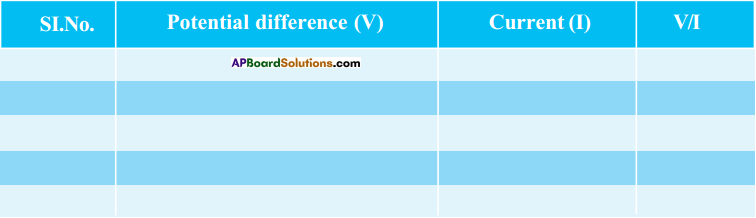
Questions:
1. Who made the classification?
2. What are the advantages of classification?
3. What are the recent developments being done?

Question 5.
How do monocots differ from dicots? (AS 1)
Answer:

Monocotyledons Dicotyledons
1. In the seed embryo bears a single cotyledon. In the seed, embryo bears two cotyledons.
2. Monocots have parallel venation. Dicots have reticulate venation.
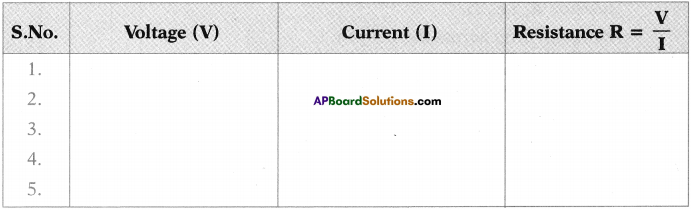
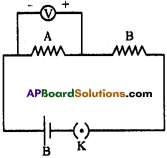
3. Monocotyledons have fibrous root system. Dicotyledons have Tap root system.
4. Examples are wheat, paddy etc. Examples are Mango, Apple, Neem, etc.

Question 6.
One day Kavita soaked seeds of green grams, wheat, maize, peas, and tamarind. After they became tender, she tried to split the seed. Name which would split, which would not, and identify them according to the characters. (AS 4)
Answer:
AP Board 9th Class Biology Solutions Chapter 5 Diversity in Living Organism 3

Question 7.
Make a flow chart of invertebrates in the kingdom Animalia, based upon their characteristic features. (AS 4)
Answer:
AP Board 9th Class Biology Solutions Chapter 5 Diversity in Living Organism 4

Question 8.
Write some common characters of Pisces, Reptilia, and Aves. (AS 1)
Answer:

  1. Pisces, Reptilia, and Aves belong to vertebrate.
  2. All these animals lay eggs.
  3. All these animals possess vertebral column.

Question 9.
Name the kingdom to which these organisms belong according to Whittaker. (AS 1)
AP Board 9th Class Biology Solutions Chapter 5 Diversity in Living Organism 1
Answer:
a) Protista
b) Animalia
c) Fungi
d) Monera

Question 10.
Explain how animals in vertebrata are classified into further subgroups. (AS 1)
Answer:

  • Vertebrata can be further classified into sub groups on the basis of simple to complex body structures and their functions.
  • For example, fishes have two chambered hearts, amphibians have three chambered hearts while in birds and mammals have four chambered hearts to keep the oxygenated and deoxygenated blood separate.
  • The following characteristic features are considered for classifying vertebrate into the further sub groups.
Class pisces: Characteristics: Exoskeleton of scale, endoskeleton of bone, cartilage, breaths through gills.
Class Amphibia Gills in larva, lungs in most adults, slimyskin.
Class Reptilia Exoskeleton of scales, laying eggs on land only.
Class Aves Exoskeleton of feathers, lay eggs outside water, flight possible.
Class Mammals Exoskeleton of hair, external ears, mostly giving birth to live young ones.

Question 11.
Platypus or Echidna is a group that forms a link between reptiles and mammals. Think and write about some characteristic features that these would have. (AS 4)
Answer:

  • The platypus and echidna both belong to the group of animals known as monotremes.
  • These two are characterised by the feature of egg laying mammals. Yet they are not birds or reptiles.
  • Both creatures hatch their young from eggs, yet the mother of each species feeds her babies with milk from milk glands.
  • These two are found in Australia and Tasmania.
  • One of the characteristics of platypus is that it has an unusual duck like bill and does not have teeth an unusual characteristic for a mammal.
  • Echidna, the spiny ant eater also does not have teeth. Tongue helps in feeding.
  • Echidna and platypus young stay in burrow after they are hatched. Echidna develops a rudimentary pouch during breeding season.
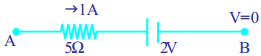
  • Both creatures have sharp claws for burrowing.
  • Both the platypus and echidna like the water. Platypus hunt food in the water. Echidna regulates its temperature through swimming.

AP Board 9th Class Biology Solutions Chapter 5 Diversity in Living Organism

Question 12.
Sujata says Bat is not a bird but a mammal. How can you support Sujata’s statement?
Answer:

  • Sujata’s statement that bat is not a bird but mammal is correct
  • Like other mammals, including ourselves bats have hair or fur on their bodies.
  • They are warm blooded animals.
  • A baby bat that feed on its mother milk after it is born.
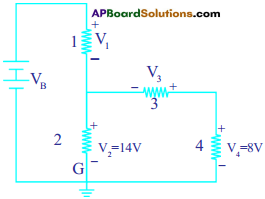
  • Bats are the only mammals that can fly.
Question 13.
Which Phylum do I belong to? (AS 1)
a) My body is made of pores. I live in water. I do not have backbone also ……………….. .
b) I am an insect. 1 have jointed legs …………………. .
c) I am a marine living animal with spiny skin. My body is radially symmetrical ……………….. .
Answer:
a) Porifera
b) Arthropoda
c) Echinodermata

Question 14.
How can you appreciate the effort of scientists in classifying a wide range of organisms? (AS 6)
Answer:

  • Classification makes the study of wide variety of organisms easy.
  • It is essential to understand the inter-relationships among different groups of animals and plants.
  • Classification gave us an idea of evolution of organisms from simple to complex ones.

9th Class Biology 5th Lesson Diversity in Living Organism InText Questions and Answers

9th Class Biology Textbook Page No. 59

Question 1.
Why do you think classification system has undergone changes over the years?
Answer:
Classification system has gone changes over the years due to the new discovered organisms, advancement in genetic science invention of powerful microscope.

AP Board 9th Class Biology Solutions Chapter 5 Diversity in Living Organism

Question 2.
If you were asked to classify organisms what would be your basis of classification?
Answer:
Our basis of classification would be whether the organism.

  1. Has a prokaryotic or eukaryotic cell
  2. Is unicellular or multicellular
  3. Is autotrophic or heterotrophic
  4. Mode of reproduction.
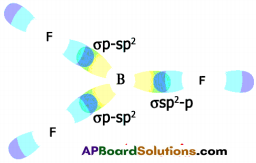
    Like that, I classify the organism in an orderly manner.

9th Class Biology 5th Lesson Diversity in Living Organism Tissues Activities

Question 1.
Collect leaves from different plants, observe them carefully and fill the table.
AP Board 9th Class Biology Solutions Chapter 5 Diversity in Living Organism 5

a) Could you find any two leaves which are similar with respect to any of the characters, size, shape, colour or any other as mentioned in the table?
Answer:
No. Every leaf has its size, shape and colour are same in many of the leaves.

b) Note down the differences you observed in the sample of leaves collected by you.
Write two such characters that differed most.
Answer:
1. Length and breadth of the leaves are different for each leaf.
2. Most of the leaves have reticulate venation but only in plantain parallel venation is present.

Question 2.
Collect 5 different plants from your surroundings and observe them carefully. Write your observations in the table given below.
AP Board 9th Class Biology Solutions Chapter 5 Diversity in Living Organism 6
a) Which characters given above varied most?
Answer:
Length of stem, Inter nodal distance, venation in leaves, and in type of root system.

b) Select a character mentioned above which shows minimum diversity.
Answer:
Flower shows least diversity arrangement of flowers in bunches.

c) Did you find any similarities? What were they?
Answer:
Yes. Similarity in venation, number of sepals and petals, and in type of root system.

d) Did you find patterns like plants with fibrous roots had flowers borne in groups? Note the other patterns that you observed.
Answer:
Yes. The flowers are borne in groups, reticulate venation.

e) Carefully observe the plants collected by you and note down some other characters not mentioned in the table.
Answer:
Spine are present in rose plants whereas they are absent in other plants.

f) Did you notice any two plants which were alike with regard to the above characteristics? If not, note down what differences you found?
Answer:
No. Venation, root system are the differences.

AP Board 9th Class Biology Solutions Chapter 5 Diversity in Living Organism

Question 3.
How do you observe the number of cotyledons in different seeds? Write your findings in the table.
Answer:
Observing cotyledons in seeds :

  1. Collect seeds of plants from green gram, red gram, bengal gram, wheat, paddy, groundnut, maize and soak them for a day.
  2. Take a maize seed and press it between fingers.
  3. A small whitish structure come out of the maize seed.
  4. Whitish structure is known as embryo/baby plant.
  5. The portion left in our hand within the seed coat has a single cotyledon.
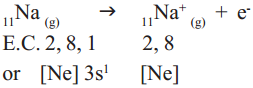
  6. Repeat the activity with soaked seeds by pressing them with fingers.
  7. Observe the pressed seeds with the help of a hand lens and fill the table.

AP Board 9th Class Biology Solutions Chapter 5 Diversity in Living Organism 7

Activity – 4

Question 4.
Collect the plants or pictures of the plants to complete the following table.
Answer:
AP Board 9th Class Biology Solutions Chapter 5 Diversity in Living Organism 8

Activity – 5

Question 5.
Collect housefly, mosquito, ant, dung beetle, butterfly, moth and cockroach from your surroundings. Observe them with magnifying glass and fill the table.
Answer:
AP Board 9th Class Biology Solutions Chapter 5 Diversity in Living Organism 9

a) What differences did you observe with regard to legs?
Answer:
In some insects legs are large in size whereas in some like Cockroach, Butterfly the legs are big in size.

b) What differences did you observe with regard to wings?
Answer:
In ant, housefly, mosquito and in dungbeetle a pair of wings are present whereas in butterfly, moth and cockroach 2 pairs of legs are present. In some like ant, housefly, mosquito the wings are small whereas in others they are big in size.

c) Is there any relationship between the number of wings and legs?
Answer:
As the size of the wings increases the length of legs decreased. The number of legs in all the insects are 3 pairs whereas the wings are one or two pairs.

Activity – 6

Question 6.
In order to observe diversity in animals select 10 children from your class and fill the following table with their data.
Answer:
AP Board 9th Class Biology Solutions Chapter 5 Diversity in Living Organism 10

a) Which character helps you to make a group with maximum individuals?
Answer:
Height helps us to a group with maximum individuals.

b) Which character helps you to have just a single individual in a group?
Answer:
Thumb impression.

c) Compare your group table with that of other groups and note down the differences you found.

Answer:
Student’s activity.

d) Did you find same observations of any two students in your class?
Answer:
No.

Activity – 7

Question 7.
Collect two small almost equal sized neem plants from your surroundings observe them and fill the table.
AP Board 9th Class Biology Solutions Chapter 5 Diversity in Living Organism 11

a) What differences did you find in the similar neem plants?
Answer:
The differences are in length of the stem and number of leaves.

b) Why do such differences present in nature?
Answer:
Every plant has got its own characteristics. The age of the plants also responsible for diverse characters.

Activity – 8

Question 8.
How do you observe moss plant through hand lens or dissection microscope? Draw the diagram and write the characteristics of moss plants.
Answer:

  • Collect mosses from the greenish velvety growth on bricks during rainy season.
  • Scrap a bit of the greenish velvety over a slide and observe under a dissection microscope.

AP Board 9th Class Biology Solutions Chapter 5 Diversity in Living Organism 12

Observations :

  1. The structure that are seen in moss plants are not flowers but they are spores.
  2. Spores are formed in Sporangium.
  3. Spores contain very little amount of food.

Lab Activities

9th Class Biology Textbook Page No. 67

Question 1.
Observe slide of Hydra under a microscope. Draw the diagram and write your finding.
Observations :
AP Board 9th Class Biology Solutions Chapter 5 Diversity in Living Organism 13
a) Is the body made of single cell or a group of cells?
Answer:
The body of Hydra is made up of number of cells.

b) Did you find any hollow structure inside the body?
Answer:
The hollow structure found inside the body is called coelom or body cavity.

c) Did you find any other characters in it?
Answer:

  • The proximal or aboral end is drawn into a slender stalk on the end of which is the basal disc for attachment.
  • The free distal end or oral end bears the mouth which is situated on hypostome.
  • The hypostome is encircled by 6 -10 tentacles.
  • Bud is present at side with a mouth or tentacles like the parent.

Question 2.
Observe slide of tape worm (Taenea Solium) under microscope and write its external characters. Draw diagram of it.
Observations :
AP Board 9th Class Biology Solutions Chapter 5 Diversity in Living Organism 14
a) How does the body look like?
Answer:
1) The body of Taenia Solium (Tape worm) is long, dorso- ventrally, flattened, narrow, ribbon like.
2) Body consists of scolex or head, neck and strobila or body segments.

b) Did you see a body cavity in it?
Answer:
There is no true internal body cavity or coelom.

c) How does the anterior and posterior look like?
Answer:
The anterior (head) is smaller than the head of a pin. The posterior (tail) is very long and bigger than head and neck.

AP Board 9th Class Biology Solutions Chapter 5 Diversity in Living Organism

Question 3.
Observe slide of round worm (Ascaris) and write the characters of it by drawing the figure.
Observations :
a) Does the body look like the same as in the platyhelminthes?
Answer:
The body is round and cylindrical but not flat as in tape worm.

b) What are the differences you observed between tape worm and round worm?
Answer:
AP Board 9th Class Biology Solutions Chapter 5 Diversity in Living Organism 15
Pseudocoelom is present, whereas it is absent in Tape worm. The head and tail are tapering at the ends.

Question 4.
Observe the specimen of earthworm and draw the diagram. Write its characters you have observed.
Observations :
AP Board 9th Class Biology Solutions Chapter 5 Diversity in Living Organism 16
Answer:

  1. The body of earthworm is bilaterally symmetrical and extensively segmented.
  2. The anterior end is tapering while posterior end is more less blunt.

a) Touch the skin of the earthworm and say how do you feel?
Answer:
The skin of earthworm is moist.

b) What is the colour?
Answer:
The colour of earthworm is dark brown in colour.

c) Are there any differences you observed in its body colour and among the body parts?
Answer:
The dorsal surface is darker than the ventral surface.

d) How does it move?
Answer:
Earthworm moves by alternate contractions of circular and longitudinal muscles.

e) Are there any ring like structures seen in its body?
Answer:
Ring like segments are present in earthworm.

9th Class Biology Textbook Page No. 68

Question 5.
Observe the specimen of Cockroach. Draw its diagram and write its characteristics.
Observations :
a) How does the skin look like? Did you observe any hard layer on the skin?
Answer:
AP Board 9th Class Biology Solutions Chapter 5 Diversity in Living Organism 17
The entire body of cockroach is covered by a hard brown Coloured chitinous exoskeleton.

b) How many parts is the body divided into?
Answer:
The body is segmented and distinctly divisible into three parts

  1. Head
  2. Thorax
  3. Abdomen.

c) Observe the legs and says how does it look like.
Answer:
Three pairs of legs are present. Each leg consists of five segmented. Jointed legs are present.

d) Name some more animals whose legs are jointed as seen in Cockroach.
Answer:
Prawn, scorpion, grasshopper, ant, mosquito have jointed legs.

Question 6.
Observe the snail by keeping inside a glass beaker and observe its characters.
Observations :
AP Board 9th Class Biology Solutions Chapter 5 Diversity in Living Organism 18
a) How does the outer body look like?
Answer:
The outer body is covered with shell.

b) Keep the snail unmoved for sometime and when it starts moving observe its body.
Answer:
The animal creeps by its ventral muscular foot. The movement is gliding movement.

c) Is the body soft or hard?
Answer:
The body of the snail is soft.

d) Did you find any antennae like structure in it?
Answer:
Yes, Tentacles are present.

Question 7.
Observe specimen of starfish and write your observations.
This specimen belongs to Phylum echinodermata.
Observations :
a) What do you find on the skin of the starfish?
Answer:
AP Board 9th Class Biology Solutions Chapter 5 Diversity in Living Organism 19
Spines are present on the skin of the starfish.

b) Are there any arms and ray shaped structure in it?
Answer:
Most of them are pentamemal, it means they have five fold symmetry with rays of arms in fives.

c) Do you find a small hole in the middle of the starfish?
Answer:
In the middle of starfish a small whole is present which is the mouth of it.

Question 8.
Collect a fish from a fish monger and observe its external characters.
External characters of fish :
AP Board 9th Class Biology Solutions Chapter 5 Diversity in Living Organism 20
a) Observe the skin of the fish. How does it look like?
Answer:
Body is covered with scales.

b) Write the body parts of the fish where scales are not present.
Answer:
On the head, on the tail, fins and on the lower side of the fish.

c) Open the mouth of the fish. What do you seen in it ?
Answer:
Teeth are present in the mouth. Tongue is also present.

Activity – 9

Question 9.
Try to find out the scientific names of at least 10 organisms that you see around you.
Answer:
Scientific names of plants around us :

Name of the plant Scientific name
1. Mango Mangifera indica
2. Coconut Cocos nucifera
3. Thati Borassus flabellifer
4. Garika gaddi Cynodon dactylon
5. Paddy Oryza sativa
6. Plantain Musa paradisica
7. Banyan Ficus bengalensis
8. Indian Goose berry (Pedda Usiri) Emblica Officinalis
9. Thotakura Amaranthus gangeticus
10. Tulasi Ocimum sanctum
11. Teak Tectona grandis
12. Kanakambaram Crossandra infundibuliformis
13. Brinjal Solanum melongena
14. Sapota Achras zapota
15. Gaddi chamanthi Tridax procumbens
16. Dhaniyalu Coriandrum sativum
17. Guava Psidium guajava
18. Rose Rosa grandiflora
19. Chinta (Tamarind) Tamarindus indica
20. China rose Mandara Hibiscus rosa-sinensis

Scientific names of animals around us :

Name of the animal Scientific name
1. Crow Corvous splendens
2. Sparrow Passer domesticus
3. Frog Rana Tigrina
4. Dog Canis familiaris
5. Cat Felis domesticus
6. Chimpanzee Anthropithecus troglodytes
7. Chicken Gallus domesticus
8. Pigeon Columbialivia
9. Buffalo Bubalus bubalis
10. Honey bee Apis indica
11. Earthworm Pheretima posthuma
12. Cockroach Periplanata Americana
13. Leech Hirudinaria granulasa
14. Prawn Palaemon malcolmmsonii
15. Housefly Musca nebulo
16. Snail Pila globosa
17. Owl Bubo bubo
18. Indian cobra Naja naja
19. Domestic horse Equus cabalus
20. Green parrot Psittacula Krameri

AP Board 9th Class Biology Solutions

AP SSC 10th Class Chemistry Solutions Chapter 10 Chemical Bonding

AP State Board Syllabus AP SSC 10th Class Chemistry Solutions Chapter 10 Chemical Bonding Textbook Questions and Answers.

AP State Syllabus SSC 10th Class Chemistry Solutions 10th Lesson Chemical Bonding

10th Class Chemistry 10th Lesson Chemical Bonding Textbook Questions and Answers

Improve Your Learning

Question 1.
List the factors that determine the type of bond that will be formed between two atoms. (AS1)
(OR)
How can you identify the type of bond formation between two atoms?
Answer:

  • The strength of attraction or repulsion between atoms.
  • Electrons in valence shell (valence electrons).

Question 2.
Explain the difference between the valence electrons and the covalency of an element. (AS1)
(OR)
How are valence electrons different from the covalency of element? Explain with examples.
Answer:
Valence electrons :

  • Number of electrons in the outermost orbit or an atom is called its valence electrons.
  • Ex: Na (Z = 11). It has 2e in I orbit, 8e in II orbit and 1e in III orbit.
  • So number of valence electrons in Na atom are ‘l’.

Covalency of an element:

  • Number of valance electrons which are taking part in covalent bond is called covalency.
  • The electron configuration of Boran is 1s² 2s² 2p¹.
  • It has three valance electrons.
  • So its covalency is 3.

AP SSC 10th Class Chemistry Solutions Chapter 10 Chemical Bonding

Question 3.
A chemical compound has the following Lewis notation : (AS1)
a) How many valence electrons does element Y have?
b) What is the valency of element Y?
c) What is the valency of element X?
d) How many covalent bonds are there in the molecule?
e) Suggest a name for the elements X and Y.
AP SSC 10th Class Chemistry Solutions Chapter 10 Chemical Bonding 5
Answer:
a) 6
b) 2
c) 1
d) two
e) X – is hydrogen and Y – is oxygen. The formed molecule is H2O.

Question 4.
Why do only valence electrons involve in bond formation? Why not electron of inner shells? Explain. (AS1)
(OR)
Which shell electrons involve in bond formation? Explain. What is the reason behind it?
Answer:

  • The nucleus and the electrons in the inner shell remain unaffected when atoms come close together.
  • But the electrons in the outermost shell (valence shell) of atoms get affected.
  • The inner shell electrons are strongly attracted by the nucleus when compared to the valence electrons.
  • So electrons in valence shell (valence electrons) are responsible for the formation of bond between atoms.

AP SSC 10th Class Chemistry Solutions Chapter 10 Chemical Bonding

Question 5.
Explain the formation of sodium chloride and calcium oxide on the basis of the concept of electron transfer from one atom to another atom. (AS1)
(OR)
Explain the formation of any two compounds according to Kossel’s theory.
Answer:
I. Formation of sodium chloride (NaCl) :
1) Sodium chloride is formed from the elements sodium (Na) and chlorine (Cl).

2) Cation formation:
i) When sodium (Na) atom loses one electron to get octet electron configuration, it forms a cation (Na+).
ii) Now Na+ gets electron configuration that of Neon (Ne) atom.
AP SSC 10th Class Chemistry Solutions Chapter 10 Chemical Bonding 1

3) Anion Formation :
i) Chlorine has shortage of one electron to get octet in its valence shell.
ii) So it gains the electron that was lost by Na to form anion and gets electron configuration of Argon (Ar).
AP SSC 10th Class Chemistry Solutions Chapter 10 Chemical Bonding 2

4) Formation of NaCl :
i) Transfer of electrons between ‘Na’ and ‘Cl’ atoms, results in the formation of ‘Na+‘ and ‘Cl’ ions.
ii) These oppositely charged ions get attracted towards each other due to electrostatic forces and form the compound sodium chloride (NaCl).
Na+(g) + Cl(g) → Na+Cl(s) or NaCl

II. Formation of calcium oxide (CaO) :
1. Calcium (Ca) reacts with oxygen (0) to form an ionic compound calcium oxide (CaO).

2. Atomic number of Calcium is 20. Its electronic configuration is 2, 8, 8, 2.
3. AP SSC 10th Class Chemistry Solutions Chapter 10 Chemical Bonding 3

4. Atomic number of Oxygen is 8. Its electronic configuration is 2, 6.

5. AP SSC 10th Class Chemistry Solutions Chapter 10 Chemical Bonding 4

6. These oppositely charged ions get attracted towards each other due to electrostatic forces and form the compound calcium oxide (CaO).
Ca2+ + O2- → Ca2+O2- (or) CaO

AP SSC 10th Class Chemistry Solutions Chapter 10 Chemical Bonding

Question 6.
A, B and C are three elements with atomic number 6, 11 and 17 respectively.
i) Which of these cannot form ionic bond? Why? (AS1)
ii) Which of these cannot form covalent bond? Why? (AS1)
iii) Which of these can form ionic as well as covalent bonds? (AS1)
Answer:
i) ‘A’ cannot form ionic bond. Its valence electrons are 4. It is difficult to lose or gain 4e to get octet configuration. So it forms covalent bond [Z of A is 6 so it is carbon (C)].

ii) ‘B’ cannot form covalent bond. Its valence electrons are 1 only. So it is easy to donate for other atom and become an ion. So it can form ionic bond [Z of B is 11, so it is sodium (Na)].

iii) Element C can form ionic as well as covalent bonds. Atomic number of Cl is 17. It is able to participate with Na in ionic bond and with hydrogen in HCl molecule as covalent bond.

Question 7.
How do bond energies and bond lengths of molecule help us in predicting their chemical properties? Explain with examples. (AS1)
(OR)
How can you explain with examples that bond energies and bond lengths are used to recognise chemical properties?
Answer:
1. Bond length :
Bond length or bond distance is the equilibrium distance between the nuclei of two atoms which form a covalent bond.

2. Bond energy :
Bond energy or bond dissociation energy is the energy needed to break a covalent bond between two atoms of a diatomic covalent compound in its gaseous state.

3. If the nature of the bond between the same two atoms changes the bond length also changes. For example, the bond lengths between two carbon atoms are C – C > C = C > C = C.

4. Thus the various bond lengths between the two carbon atoms are in ethane 1.54 Å, ethylene 1.34 Å, acetylene 1.20 Å.

5. The bond lengths between two oxygen atoms are in H2O2 (O – O) is 1.48 Å and in O2 (O = O) is 1.21 Å.
6. Observe the table.
AP SSC 10th Class Chemistry Solutions Chapter 10 Chemical Bonding 6

7. When bond length decreases, then bond dissociation energy increases.

8. When bond length increases, then bond dissociation energy decreases.

9. Bond length of H – H in H2 molecule is 0.74 Å and its bond dissociation energy is 436 KJ/mol, whereas bond length of F – F in F2 molecule is 1.44 Å and its bond dissociation energy is 159 KJ/mol.

10. Melting and boiling points of substances also can be determined by this bond energies and bond lengths.

Question 8.
Predict the reasons for low melting point for covalent compounds when compared with ionic compounds. (AS2)
(OR)
“Covalent compounds have low melting point.” What Is the reason for this statement? Explain.
Answer:
They are covalent compounds.

  • The melting point is low due to the weak Vander Waal’s forces of attractions between the covalent molecules.
  • The force of attraction between the molecules of a covalent compound is very weak.
  • Only a small amount of heat energy is required to break these weak molecular forces, due to which covalent compounds have low melting points and low boiling points.
  • Please note that some of the covalent solids like diamond and graphite have, however very high melting points and boiling points.

AP SSC 10th Class Chemistry Solutions Chapter 10 Chemical Bonding

Question 9.
Collect the information about properties and uses of covalent compounds and prepare a report. (AS4)
(OR)
Generally these compounds are non-polar in nature. What are those compounds? Explain their properties and uses.
(OR)
Write any two uses and two properties of covalent compounds.
Answer:
The compounds are covalent.
Properties of covalent compounds :

  1. Covalent compounds are usually liquids or gases, only some of them are solids.
  2. The covalent compounds are usually liquids or gases due to the weak force of attraction between their molecules.
  3. Covalent compounds have usually low melting and low boiling points.
  4. Covalent compounds are usually in soluble in water but they are soluble in organic solvents.
  5. Covalent compounds do not conduct electricity.

Uses of covalent compounds :

  1. Covalent compounds form 99% of our body.
  2. Water is a covalent compound. We know its many uses.
  3. Sugars, food substances, tea and coffee are all covalent compounds.
  4. Air we breathe in contains covalent molecules of oxygen and nitrogen.
  5. Almost everything on earth other than most simple in organic salts are covalent.

Question 10.
Draw simple diagrams to show how electrons are arranged in the following covalent molecules : (AS5)
a) Calcium oxide (CaO)
b) Water (H2O)
c) Chlorine (Cl2)
Answer:
a) Calcium oxide (CaO) :
AP SSC 10th Class Chemistry Solutions Chapter 10 Chemical Bonding 7

b) Water (H2O):
AP SSC 10th Class Chemistry Solutions Chapter 10 Chemical Bonding 8

The formation of water molecule can be shown like this also
AP SSC 10th Class Chemistry Solutions Chapter 10 Chemical Bonding 9

c) Chlorine (Cl2):
AP SSC 10th Class Chemistry Solutions Chapter 10 Chemical Bonding 10

We can explain the formation of Cl2 molecule in this way also.
AP SSC 10th Class Chemistry Solutions Chapter 10 Chemical Bonding 11

Question 11.
Represent the molecule H2O using Lewis notation. (AS5)
(OR)
How can you explain the formation of H2O molecule using dot structure?
Answer:
One atom of oxygen shares its two electrons with two hydrogen atoms to form a water molecule.
AP SSC 10th Class Chemistry Solutions Chapter 10 Chemical Bonding 12

Question 12.
Represent each of the following atoms using Lewis notation : (AS5)
a) Beryllium
b) Calcium
c) Lithium
Answer:
AP SSC 10th Class Chemistry Solutions Chapter 10 Chemical Bonding 13

Question 13.
Represent each of the following molecules using Lewis notation : (AS5)
a) Bromine gas (Br2)
b) Calcium chloride (CaCl2)
c) Carbon dioxide (CO2)
d) Which of the three molecules listed above contains a double bond?
Answer:
a) Bromine gas (Br2) :
AP SSC 10th Class Chemistry Solutions Chapter 10 Chemical Bonding 14
b) Calcium chloride (CaCl2)
AP SSC 10th Class Chemistry Solutions Chapter 10 Chemical Bonding 15
c) Carbon dioxide (CO2) :
AP SSC 10th Class Chemistry Solutions Chapter 10 Chemical Bonding 16
d) CO2, contains double bond in above list. Its structure is like this : O = C = O.

AP SSC 10th Class Chemistry Solutions Chapter 10 Chemical Bonding

Question 14.
Two chemical reactions are described below. (AS5)
♦ Nitrogen and hydrogen react to form ammonia (NH3).
♦ Carbon and hydrogen bond to form a molecule of methane (CH4).
For each reaction give :
a) The valency of each of the atoms involved in the reaction.
b) The Lewis structure of the product that is formed.
Answer:
a) ♦ Nitrogen and hydrogen react to form ammonia (NH3):
i) The valency of nitrogen is 3 and hydrogen is 1.
ii) The chemical formula of the product is NH3

♦ Carbon and hydrogen bond to form a molecule of methane (CH4):
i) The valency of carbon is 4 and hydrogen is 1.
ii) The chemical formula of the product is CH4.

b) ♦ The Lewis structure of the product that is formed (: NH3)
AP SSC 10th Class Chemistry Solutions Chapter 10 Chemical Bonding 17

♦ The Lewis structure of the product that is formed (CH4)
AP SSC 10th Class Chemistry Solutions Chapter 10 Chemical Bonding 18

Question 15.
How does Lewis dot structure help in understanding bond formation between atoms? (AS6)
(OR)
What is the use of Lewis dot structure in bond formation? Explain.
Answer:

  1. Only the outermost electrons of an atom take part in chemical bonding.
  2. They are known as valence electrons.
  3. The valence electrons in an atom are represented by putting dots (•) on the symbol of the element, one dot for each valence electron.
  4. For example, sodium atom has 1 valence electron in its outermost shell, so we put 1 dot with the symbol of sodium and write Na• for it.
  5. Sodium atom loses this 1 electron to form sodium ion.
  6. By knowing the valence electrons of two different atoms by Lewis dot structure, we can understand which type of bond is going to establish between them and forms corresponding molecule.

Question 16.
What is octet rule? How do you appreciate role of the ‘octet rule’ in explaining the chemical properties of elements? (AS6)
(OR)
Which rule decides whether given element is chemically stable or not? Appreciate that rule.
Answer:
Octet rule decides whether given element is stable or not.
Octet rule :

  • ‘The atoms of elements tend to undergo chemical changes that help to leave their atoms with eight outer shell electrons.”
  • It was found that the elements which participate in chemical reaction get octet (or) ns2 np6 configuration similar to that of noble gas elements.

Role of octet in chemical properties of elements :

  1. Except He remaining inert gas elements have 8 electrons in their outermost orbit. Since these elements are having stable octet configuration in their outermost orbit, they are very stable.
  2. They do not allow the outermost electrons to take part in chemical reactions.
  3. So by having octet configuration for these elements we can conclude these are chemically inertial.
  4. If any group of elements (take halogens) which contain 7 electrons in their outermost orbit, they require only 1 e to get octet configuration.
  5. So they try to participate in chemical reaction to get that 1 difference electron for octet configuration.
  6. Similarly, Na contains 2, 8, 1 as its electronic configuration.
  7. So it loses le from its outermost shell; it should have 8e in its outer shell and get the octet configuration.
  8. Thus the octet rule helps in explaining the chemical properties of elements.

AP SSC 10th Class Chemistry Solutions Chapter 10 Chemical Bonding

Question 17.
Explain the formation of the following molecules using valence bond theory.
a) N2 molecule
b) O2 molecule
(OR)
Write the formation of double bond and triple bond according to valence bond theory.
(OR)
Who proposed Valence Bond Theory? Explain the formation of N2 molecule by using this theory.
Answer:
Linus Pauling was proposed valence bond theory.
Formation of N2 molecule :

  1. Electronic configuration of Nitrogen is 1s² 2s² 2px¹ 2py¹ 2pz¹.
  2. Suppose that px orbital of one Nitrogen atom overlaps the px orbital of other ‘N’ atom giving σ px – px bond along the inter nuclear axis.
  3. The py and pz orbitals of one ‘N’ atom overlaps with the py and pz orbital of other ‘N’ atom laterally giving π py – py and π pz – pz bonds.
  4. Therefore, N2 molecule has a triple bond between two Nitrogen atoms.

AP SSC 10th Class Chemistry Solutions Chapter 10 Chemical Bonding 19

Formation of O2 molecule :

  1. Electronic configuration of ‘O’ is 1s² 2s² 2px² 2py¹ 2pz¹.
  2. If the Py orbital of one ‘O’ atom overlaps the py orbital of other ‘O’ atom along inter- nuclear axis, a σ py – py bond is formed.
  3. pz orbital of oxygen atom overlaps laterally, perpendicular to inter nuclear axis giving a π py – pz bond.
  4. So O2 molecule has a double bond between the two oxygen atoms.

AP SSC 10th Class Chemistry Solutions Chapter 10 Chemical Bonding 20

Question 18.
What is hybridisation? Explain the formation of the following molecules using hybridisation.
a) BeCl2
b) BF3
Explain the formation of sp and sp² hybridisation using examples.
(OR)
What is the name given to inter mixing of atomic orbitals to form new orbitals. Explain the formation of following molecules by using that process,
a) BeCl2
b) BF3
Answer:
This process is called hybridisation.
Hybridisation :
It is a phenomenon of inter mixing of atomic orbitals of almost equal energy which are present in the outer shells of the atom and their reshuffling or redistribution into the same number of orbitals but with equal properties like energy and shape.

a) Formation of BeCl2 (Beryllium chloride) molecule :

  1. 4Be has electronic configuration 1s² 2s².
  2. It has no unpaired electrons.
  3. It is expected not to form covalent bonds, but informs two covalent bonds one each with two chlorine atoms. „
  4. To explain this, an excited state is suggested for Beryllium in which an electron from ‘2s’ shifts to 2px level.
  5. Electronic configuration of 4Be is 1s² 2s¹ 2px¹].
  6. Electronic configuration of 17Cl is 1s² 2s² 2p6 3s² 3px² 3py² 3pz¹.
  7. If Be forms two covalent bonds with two chlorine atoms, one bond should be σ 2s-3p due to the overlap of ‘2s’ orbital of Be, the ‘3pz‘ orbital of one chlorine atom.
  8. The other bond should be σ 2p-3p due to the overlap of ‘2px’ orbital of Be atom the 3p orbital of the other chlorine atom.
  9. As the orbitals overlapping are different, the bond strengths of two Be-Cl must be different.
  10. But, both bonds are of same strength and Cl[latex]\hat{\mathrm{Be}}[/latex] Cl is 180°.

The Hybridisation of BeCl2 can be explained in this way also :
a) Be atom in its excited state allows its 2s orbital and 2px orbital which contain unpaired electrons to intermix and redistribute to two identical orbitals.
b) As per Hund’s rule each orbital gets one electron.
c) The new orbitals based on the types of orbitals that have undergone hybridisation are called sp orbitals.
d) The two sp orbitals of Be get separated by 180°.
e) Now each chlorine atom comes with its 3pz¹ orbital and overlaps it the sp orbitals of Be forming two identical Be-Cl bonds (σ sp-p bonds).
Cl[latex]\hat{\mathrm{Be}}[/latex] Cl = 180°.
AP SSC 10th Class Chemistry Solutions Chapter 10 Chemical Bonding 21
f) Both the bonds are of same strength.

b) Formation of BF3 molecule :
AP SSC 10th Class Chemistry Solutions Chapter 10 Chemical Bonding 22

  1. 5B has electronic configuration 1s² 2s² 2pxh
  2. The excited electronic configuration of 5B is 1s² 2s¹ 2px¹ 2py¹
  3. As it forms three identical B-F bonds in BF3.
  4. It is suggested that excited ‘B’ atom undergoes hybridisation.
  5. There is an intermixing of 2s, 2px, 2py orbitals and their redistribution into three identical orbitals called sp² hybrid orbitals.
  6. For three sp² orbitals to get separated to have minimum repulsion the angle between any two orbitals is 120° at the central atom and each sp² orbital gets one election.
  7. Now three fluorine atoms overlap their 2pz orbitals containing unpaired electrons (F9 1s² 2s² 2px² 2py² 2pz¹) the three sp² orbitals of ‘B’ that contain unpaired electrons to form three σsp²-p bonds.

Fill in the Blanks

1. Electrons in the outermost orbit are called …………………… .
2. Except …………………… gas all other noble gases have octet in their valence shell.
3. Covalency of elements explains about member of …………………… formed by the atom.
4. Valence bond theory was proposed by …………………… .
5. In …………………… bonding the valence electrons are shared among all the atoms of the metallic elements.
Answer:

  1. valence electrons
  2. Helium
  3. covalent bonds
  4. Linus Pauling
  5. covalent

Multiple Choice Questions

1. Which of the following elements is electronegative?
A) Sodium
B) Oxygen
C) Magnesium
D) Calcium
Answer:
B) Oxygen

2. An element 11X23 forms an ionic compound with another element ‘Y’. Then the charge on the ion formed by X is
A) +1
B) +2
C) -l
D) – 2
Answer:
A) +1

AP SSC 10th Class Chemistry Solutions Chapter 10 Chemical Bonding

3. An element ‘A’ forms a chloride ACl4. The number of electrons in the valence shell of ‘A’
A) 1
B) 2
C) 3
D) 4
Answer:
D) 4

10th Class Chemistry 10th Lesson Chemical Bonding InText Questions and Answers

10th Class Chemistry Textbook Page No. 153

Question 1.
How do elements usually exist?
Answer:
They may exist as a single atom or as a group of atoms.

Question 2.
Do atoms exist as a single atom or as a group of atoms?
Answer:
Atoms exist as a single atom, sometimes as a group of atoms also.

AP SSC 10th Class Chemistry Solutions Chapter 10 Chemical Bonding

Question 3.
Are there elements which exist as atoms?
Answer:
Yes. There are elements which exist as atoms.

Question 4.
Why do some elements exist as molecules and some as atoms?
Answer:
By following different laws of chemical combination the chemical compounds take place as a result of combination of atoms of various elements in different ways.

Question 5.
Why do some elements and compounds react vigorously while others are inert?
Answer:
1) Number of electrons in their outermost shell.
2) Bond strength between the atoms in compound.

Question 6.
Why is the chemical formula for water H2O and for sodium chloride NaCl, why not HO2 and NaCl2?
Answee:
Valencies of the atoms participating in the molecules.

Question 7.
Why do some atoms combine dille tl do not?
Answer:
1) Atoms which have 8e“ in their outer shell will not combine.
2) Atoms which have more than or less than 8e“ in their outer shell will combine.

Question 8.
Are elements and compounds simply made up of separate atoms Individually arranged?
Answer:
No. Elements and compounds are not simply made up of separate atoms individually arranged.

AP SSC 10th Class Chemistry Solutions Chapter 10 Chemical Bonding

Question 9.
Is there any attraction between atoms?
Answer:
Yes. There is some attraction betwen atoms.

Question 10.
What is that holding them together?
Answer:
Force of attraction between them.

10th Class Chemistry Textbook Page No. 155

Question 11.
Why is there absorption of energy in certain chemical reactions and release of energy in other reactions?
Answer:’
Because of bond energy between the atoms in a molecule.

Question 12.
Where does the absorbed energy go?
Answer:
For breaking chemical bonds between atoms in a molecule.

Question 13.
Is there any relation to energy and bond formation between atoms?
Answer:
Yes. There is some relation to energy and bond formation between atoms.

AP SSC 10th Class Chemistry Solutions Chapter 10 Chemical Bonding

Question 14.
What could be the reason for the change in reactivity of elements?
Answer:
Number of electrons in their outermost orbit.

Question 15.
What could be the reason for this?
Answer:
They have 8 (e) electrons in their outermost orbit.

10th Class Chemistry Textbook Page No. 157

Question 16.
What did you notice in Lewis dot structure of noble gases and electronic configurations of the atoms of these elements shown in table – 1?
Answer:
Except He remaining Ne, Ar, Kr have 8 electrons in their outermost orbit.

10th Class Chemistry Textbook Page No. 158

Question 17.
What have you observed from the above conclusions about the main groups?
Answer:

  1. Number of gained electrons of non-metals in their valency.
  2. Number of lost electrons of metals in their valency.

AP SSC 10th Class Chemistry Solutions Chapter 10 Chemical Bonding

Question 18.
Why do atoms of elements try to combine and form molecules?
Answer:
To attain stable electronic configuration.

10th Class Chemistry Textbook Page No. 159

Question 19.
Is it accidental that IA to VIIA main group elements during chemical reactions get eight electrons in the outermost shells of their ions, similar to noble gas atoms?
Answer:
No, it cannot be simply accidental.

Question 20.
Explain the formation of ionic compounds NaCl, MgCl2, Na2O and AlCl3 through Lewis electron dot symbols (formulae).
Answer:
1) Lewis electron dot symbol for NaCl:
AP SSC 10th Class Chemistry Solutions Chapter 10 Chemical Bonding 24
Formation of sodium chloride (NaCl) :
Sodium chloride is formed from the elements sodium and chlorine. It can be explained as follows.
Na(s) + ½Cl2(g) → NaCl2

Cation formation :
When sodium (Na) atom loses one electron to get octet electron configuration it forms a cation (Na+) and gets electron configuration that of Neon (Ne) atom.
AP SSC 10th Class Chemistry Solutions Chapter 10 Chemical Bonding 25

Anion formation :
Chlorine has shortage of one electron to get octet in its valence shell. So it gains the electron from Na atom to form anion and gets electron configuration as that of argon (Ar).
AP SSC 10th Class Chemistry Solutions Chapter 10 Chemical Bonding 26

Formation of the compound NaCl from its ions :
Transfer of electrons between ‘Na’ and ‘Cl’ atoms, results in the formation of ‘Na+‘ and ‘Cl‘ ions. These oppositely charged ions get attracted towards each other due to electrostatic forces and form the compound sodium chloride (NaCl).
Na+(g) + Cl(g) → Na+Cl(s) or NaCl

2) Lewis electron dot symbol for MgCl2:
MgCl2
AP SSC 10th Class Chemistry Solutions Chapter 10 Chemical Bonding 27

Formation of magnesium chloride (MgCl2):
Magnesium chloride is formed from the elements magnesium and chlorine. The bond formation MgCl2 in brief using chemical equation is as follows :
Mg(s) + Cl2(g) → MgCl2(g)
Cation formation:
AP SSC 10th Class Chemistry Solutions Chapter 10 Chemical Bonding 28

Anion formation :
AP SSC 10th Class Chemistry Solutions Chapter 10 Chemical Bonding 29
The compound MgCl2 formation from its ions :
Mg2+ gets ‘Ne’ configuration and
Each Cl gets ‘Ar’ configuration
Mg2+(g) + 2 Cl(g) → MgCl2(s)
One ‘Mg’ atom transfers two electrons one each to two ‘Cl’ atoms and so formed Mg2+ and 2Cl attract to form MgCl2.

3) Lewis electron dot symbol for (Na2O) :
AP SSC 10th Class Chemistry Solutions Chapter 10 Chemical Bonding 30

Formation of di sodium monoxide (Na2O):
Di sodium monoxide formation can be explained as follows:
Cation formation (Na+ formation):
AP SSC 10th Class Chemistry Solutions Chapter 10 Chemical Bonding 31

Two ‘Na’ atoms transfer one electron each to one oxygen atom to form 2 Na+ and O2-
Each Na+ gets ‘Ne’ configuration and O2- gets ‘Ne’ configuration.
These ions (2Na+ and O2-) attract to form Na2O.

4) Lewis electron dot symbol for (AlCl3):
AP SSC 10th Class Chemistry Solutions Chapter 10 Chemical Bonding 32

Formation of aluminium chloride (AlCl3):
Aluminium chloride formation can be explained as follows:
Formation of aluminium ion (Al3+), the cation:
AP SSC 10th Class Chemistry Solutions Chapter 10 Chemical Bonding 33

Each aluminium atom loses three electrons and three chlorine atoms gain them, one electron each.
The compound AlCl3 is formed from its component ions by the electrostatic forces of attractions.
Al3+(g) + 3 Cl(g) → AlCl3(s)

10th Class Chemistry Textbook Page No. 163

Question 21.
How do cations and anions of an ionic compound exist in its solid state?
Answer:
Ionic compounds exist in crystalline state.

Question 22.
Do you think that pairs of Na+ Cl as units would be present in the solid crystal?
Answer:
Yes. I think that pairs of Na+ Cl as units would be present in the solid crystal.

10th Class Chemistry Textbook Page No. 164

Question 23.
Can you explain the reasons for all these?
Answer:
Ionic bond is formed between atoms of elements with electronegativity, difference equal to or greater than 1.9.

10th Class Chemistry Textbook Page No. 165

Question 24.
Can you say what type of bond exists between atoms of nitrogen molecule?
Answer:
Triple bond exists between atoms of nitrogen molecule.

10th Class Chemistry Textbook Page No. 168

Question 25.
What do you understand from bond lengths and bond energies?
Answer:
Bond lengths and bond energies are not same when the atoms that form the bond are different.

AP SSC 10th Class Chemistry Solutions Chapter 10 Chemical Bonding

Question 26.
Are the values not different for the bonds between different types of atoms?
Answer:
Yes. The values are not different for the bonds between different types of atoms.

10th Class Chemistry Textbook Page No. 170

Question 27.
What is the bond angle in a molecule?
Answer:
It is the angle subtended by two imaginary lines that pass from the nuclei of two atoms which form the covalent bonds with the central atom through the nucleus of the central atom at the central atom.

10th Class Chemistry Textbook Page No. 172

Question 28.
How is MCI molecule formed?
Answer:
The ‘1s’ orbital of ‘H’ atom containing unpaired electron overlaps the ‘3p’ orbital of chlorine atom containing unpaired electron of opposite spin.

10th Class Chemistry 10th Lesson Chemical Bonding Activities

Activity – 1

1. Write the Lewis structures of the given elements in the table. Also, consult the periodic table and fill in the group number of the element.
Answer:
AP SSC 10th Class Chemistry Solutions Chapter 10 Chemical Bonding 23

AP Board 9th Class Biology Solutions Chapter 7 Animal Behaviour

AP State Syllabus AP Board 9th Class Biology Solutions Chapter 7 Animal Behaviour Textbook Questions and Answers.

AP State Syllabus 9th Class Biology Solutions 7th Lesson Animal Behaviour

9th Class Biology 7th Lesson Animal Behaviour Textbook Questions and Answers

Improve Your Learning

Question 1.
What is the advantage of reflex action? (AS 1)
(a) It has to be learned
(b) It happens differently each time
(c) It does not have to be learned
(d) None of them
Answer:
(c) It does not have to be learned.

AP Board 9th Class Biology Solutions Chapter 7 Animal Behaviour

Question 2.
If a rat is given a mild electric shock when it goes to a certain part of its cage, it eventually avoids going there. This is because of- (AS 1)
(a) Imitation
(b) Conditioning
(c) Instinct
(d) Imprinting
Answer:
(b) Conditioning

Question 3.
Describe all types of behaviour discussed in the lesson with appropriate examples. (AS 1)
(OR)
Describe different types of animal behaviours discussed in the classroom with suitable examples.
Answer:
Scientists categorize animal behaviour into different categories like instinct, imprinting, conditioning, imitation.
1) Instinct:
A) Instinctual behaviours are behaviours that need not be learned.
B) They are inborn behaviours and can be complex like making nest by birds, choose mates and forming into groups for protection.
C) Reflexes are also a type of instinct behaviour.

2. Imprinting:
A) Chickens and ducklings are able to walk almost immediately after hatching from the egg.
B) Duckling can even swim after a few days.
C) They recognise their mother because of a behaviour type called imprinting.
D) Imprinting lets young animals recognise their mother from a young age. They can follow her for food and protection.

3. Conditioning:
A) Conditioning is a type of behaviour involving a response to a stimulus that is different from the natural one.
B) It is a type of learned behaviour.
C) If we take ringing of school bell as an example, student shows different types of conditioning to a school bell as per the time.

4. Imitation:
A) It is a type of behaviour where one animal copies another animal.
B) Kohler conducted experiments on imitation in chimpanzees.
C) One chimpanzee tried to take a fruit from a tree. But it failed in reaching the fruit.
D) Later chimpanzee used sticks to reach the fruit. This time it succeded in reaching the fruit.
E) Chimpanzee used sticks to spear juicy grubs to eat.
F) Other chimpanzees copy this behaviour.

AP Board 9th Class Biology Solutions Chapter 7 Animal Behaviour

Question 4.
Differentiate between (AS 1)
Answer:
a) Imitation and Imprinting.

Question 5.
How human behaviour is different from behaviour of other animals? Explain with an example. (AS 1)
Answer:

  • Humans show many of the same types of behaviour as other animals.
  • But human behaviour is often more complex because we are more intelligent and aware of ourselves.
  • For example, hungry persons might want to start eating immediately when they sit down at the dining table.
  • But the humans have learned that good manners mean they should wait until everyone is seated and ready to eat.
  • But animals eat food whenever they find it.

Question 6.
Observe ants going on a line. Ask your teacher how they communicate and write a note on this. (AS 4)
Answer:

  • Ants talk to each other using chemical signals called pheromones that they detect with antennae.
  • Ants use their antennas to pick up smells.
  • For example, when ants find food they have a pheromone trail from the food soure to the colony.
  • Other ants follow this trial. As the other ants follow the trial, the pheromone scent becomes stronger.
  • The paired antennas of ants provide information about the direction and intensity of scents.
  • Since most ants live on the ground, they use the soil surface to leave pheromene trail that may be followed by other ants.
  • Some ants produce sounds using gaster segments and their mandibles.
  • Sounds may be used to communicate with colony members or with other species.

AP Board 9th Class Biology Solutions Chapter 7 Animal Behaviour

Question 7.
“Understanding of animal behaviour creates positive attitude towards animals”. How do you support this statement? Explain with suitable examples. (AS 6)
Answer:

  • I support the above statement that understanding of animal behaviour creates positive attitude towards animals.
  • Animals usually make sounds depending upon their needs. They show different facial expressions.
  • For example, cattle make sounds whenever they need food and water.
  • After giving food and water by the master they calmdown.
  • When a crow dies, all the other crows come around making sounds ‘kaww, kaww’ shows their sadness, we have to understand nature of the crows in this situation.
  • We have to identify the unity and integrity among the ants when they go in line in search of food.
  • When dogs bark during nights, we should understand that they are doing that for our safe.
  • We have to show positive attitude towards animals who are useful in our daily life. Live and let live should be our motto.

Question 8.
Look at this picture. How do you feel about sibbiling care nature of animals. Have you ever seen such kind of situations in your surroundings? Explain in your own words. (AS 7)
AP Board 9th Class Biology Solutions Chapter 7 Animal Behaviour 1
Answer:

  • Sibbiling care nature of animals are animals with instinct behaviour.
  • Every animal take care of their young ones until they are grown adults.
  • I observed sibbiling care situations in my surroundings.
  • The newly hatched chickens are taken by their mother to surrounding places to feed them.
  • Whenever the chicks faces danger mother brings them under her wings.
  • When the eagle tries to take away the chicks the mother attacks the eagle to save its chickens.
  • Chicken feeds and protect young ones until they are able to collect their own food.
  • A new born kitten is born blind. Its eyes normally do not open until it is 10 to 12 days.
  • Finding the milk source is accomplished with help from mom, who encourages young kittens to feed a few minutes after birth.
  • Cat often changes its living place by transfering young kitten. It does so to protect kittens from enemies.

9th Class Biology 7th Lesson Animal Behaviour Activities

Lab Activity

Question 1.
Behaviour of Cockroach : For this we need a choice box and calcium chloride.
Answer:
Making of Choice box :

  • Take a box, and divide it into four chambers with the help of a card board.
  • Make tiny holes in any two chambers of one side so that light can pass through these holes into the chambers.
  • Let other two chambers as it is (dark).
  • Now create humid environment with help of moist cotton wool in one of the lightened and one of the dark chambers.
  • Create dry atmosphere with help of calcium chloride in one of the lightened and one of the dark chambers.

AP Board 9th Class Biology Solutions Chapter 7 Animal Behaviour 2

  • So, the box has been divided into four chambers with different conditions i.e., light and dry, light and humid, dark and dry, dark and humid.
  • Make four groups in class. Each group will put several cockroaches into a choice of chamber with four different conditions.
  • Cover the box and leave the setup for 15-20 minutes.
  • Count the number of cockroaches in each chamber.

Observations :

  1. Cockroaches prefer dark and damp conditions.
  2. The quarter of the choice chamber with these conditions contains most or all of the cockroaches.

Activity – 1

Question 2.
Observe the following behaviours of different animals. Identify their instinct, imprinting, conditioning or imitation.
a) Our pet dog barks only on strangers. If is not stopped, how would it behave?
Answer:
Conditioning.

b) Ants which usually go in a line reach sweet kept in tin. How do they know the way to reach the tin?
Answer:
Conditioning.

c) Mosquitoes, cockroaches come out of their places only when it is dark. How do they know the difference between light and dark?
Answer:
Instinct.

d) Bats and owl move and search for food during night only. How could they know what is a day what is a night?
Answer:
Instinct.

e) When you untie the neck of your bull at the time of ploughing, it moves towards plough without any instructions. In the same way, it moves towards tub at the time of feeding. How does the bull respond differently?
Answer:
Conditioning.

f) Birds collect material which is soft, strong to build its nest. How do they know the quality of material?
Answer:
Instinct.

g) Puppies, kitten fight each other when they saw a piece of cloth. They try to tare it off why?
Answer:
Imitation.

h) In a particular season some birds in our surroundings migrate from long distances. . How do they know their way?
Answer:
Instinct.

Activity – 2

Question 3.
Select any one of the animals in your surroundings. Observe it how it behaves in the following situation.
Answer:
1) Name of the animal:
Crow (corvus species)

2) Place where it lives :
They live in nests build on trees. Usually, they build nest where they feel safe from predators.

3) How it builds its place :
Crow builds its nest using tree branches, small sticks, hay etc.

4) Way of collecting food/prey:
Crows go around places where food is available. Crows are omnivorous and they eat almost everything.

5) External characters :
Crows are usually black in colour or black with little white plumage.

6) Expressions :
A) Crows make a wide variety of calls or vocalizations.
B) In many species the pattern and number of numerical vocalizations have been observed in response to events in the surroundings like arrival or departure of crows.
C) Crows show their happiness, Jadness, fear, threat by making sounds like ‘KOWWS’.

7) Group behaviour:
A) If one crow finds food it call others to join.
B) If one crow dies, all the other crows make ‘KOWWS’ continuously without interference.

AP Board 9th Class Biology Solutions Chapter 2 Plant Tissues

AP State Syllabus AP Board 9th Class Biology Solutions Chapter 2 Plant Tissues Textbook Questions and Answers.

AP State Syllabus 9th Class Biology Solutions 2nd Lesson Plant Tissues

9th Class Biology 2nd Lesson Plant Tissues Textbook Questions and Answers

Improve Your Learning

Question 1.
Define the terms (AS 1)
A) Tissue
B) Meristematic tissue
C) Dermal tissue.
Answer:
A) Tissue :
Tissue is a group of cells similar in structure and performing similar functions.

B) Meristematic tissue :
Meristematic tissue is the dividing tissue present in the growing regions of the plant.

C) Dermal tissue :
Tissues that form outer coverings are called as dermal tissues. It gives protection to the plant.

AP Board 9th Class Biology Solutions Chapter 2 Plant Tissues

Question 2.
Differentiate the following. (AS 1)
A) Meristematic tissue and Ground tissue :

Meristematic tissue Ground tissue
1. Cells divide continuously. 1. Cells do not divide and cannot derived from the meristem.
2. It is a simple tissue. 2. It is a simple or complex tissue.
3. Cells are living. 3. Cells may be living or dead.
4. Dense cytoplasm is present in the cell. 4. Thin cytoplasm is present in the cell.

B) Apical Meristem and Lateral Meristem :

Apical Meristem Lateral Meristem
1. Apical meristem is found in growing tips of root stem and apices of leaves. 1. Lateral meristems are present around the edges in a lateral manner.
2. It brings about growth in length of stems and roots. 2. It rise the growth in diameter of the stem and root.

C) Parenchyma and Collenchyma :

Parenchyma Collenchyma
1. The cells of parenchyma are soft, thin walled and loosely packed. 1. The cells of collenchyma are thick walled and compactly arranged.
2. They store food, bears chloroplasts and contain larger cavities. 2. They give mechanical strength in young tissue of stem.
3. Cell wall is primary made up of cellulose. 3. Cell wall has deposition of extra cellulose.
4. Cells are oval, round and rectangular in shape. 4. Cells are elongated, round and spherical in shape.

D) Sclerenchyma and Parenchyma :

Sclerenchyma Parenchyma
1. It is a dead tissue. 1. It is a living tissue.
2. Cells are thick walled. 2. Cells are thin walled.
3. Inter cellular spaces are absent. 3. Inter cellular spaces are present.
4. It provides mechanical strength. 4. It stores food, bears, air cavities and chloroplasts.

E) Xylem and Phloem :

Xylem Phloem
1. Xylem conducts water and mineral salts from the roots to the leaves. 1. Phloem conducts food from the leaves to the growing parts of plants.
2. Xylem consists of trachieds, vessels, fibres and parenchyma. 2. Phloem consists of sieve cells, sieve tubes, companion cells, fibres and parenchyma.
3. Only xylem parenchyma is living. 3. Only phloem fibres are nondiving.

F) Epidermis and Bark :

Epidermis Bark
1. It is the outermost layer of roots, 1. Several layered bark tissue is present
stems and leaves. above the epidermis.
2. Epidermis is a living tissues. 2. Bark is a dead tissue.

Question 3.
Name the following. (AS 1)
A) Growing tissue, which causes growth in the length of the plant.
Answer:
Apical Meristem

B) Growing tissue, which causes growth in the girth (diameter) of the plant.
Answer:
Lateral Meristem.

C) Large air cavities in the aquatic plants.
Answer:
Arenchyma.

D) Food material in parenchyma.
Answer:
Storage tissue

E) Pores essential for gaseous exchange and transpiration.
Answer:
Stomata

AP Board 9th Class Biology Solutions Chapter 2 Plant Tissues

Question 4.
Compare and contrast the following. Xylem and Phloem. (AS 1)
Answer:

Xylem Phloem
1. Xylem transports water and minerals from roots to the apical parts of the plant. It transports food material from the leaves to growing parts of the plant.
2. Xylem consists of trachieds, vessels, xylem fibres and xylem parenchyma. Phloem consists of sieve tubes, sieve cells, companion cells, phloem fibres and parenchyma.
3. Only xylem parenchyma is living. Sieve tubes, sieve cells, companion cells and phloem parenchyma are living.
4. Trachieds, vessels, xylem fibres are dead tissues. Phloem fibres are dead tissue.
5. Xylem gives mechanical strength to the plant. Phloem does not give mechanical strength to the plants.
6. Conduction of water by xylem is unidirectional i.e., from roots to apical parts of the plant. Food material conduction is bidire­ctional i.e., from leaves to storage organs or growing points or from storage organs to growing parts of plants.

Meristematic tissue and Dermal tissue :
Answer:

Meristematic tissue Dermal tissue
1. Cells are small having thin cell wall. 1. The walls of the cells are thicker.
2. They are capable of dividing. 2. They are not capable of dividing.
3. This is present at shoot tip, root tip and where branches arise. 3. It is present as epidermis, mesodermis and endodermis.
4. It helps in the growth of the plant. 4. It protects the plant from water loss due to transpiration.

Question 5.
Give reasons to the following. (AS 1)
A) Xylem is a conductive tissue.
Answer:

  1. Xylem conducts water and mineral salts from the soil to the apical parts of the plants.
  2. It transports materials away from the root.
  3. Conduction of water by xylem is unidirectional i.e., from roots to apical parts of the plants.

B) Epidermis gives protection.
Answer:

  1. Epidermis usually consists of a single layer of cells.
  2. The walls of the cells of epidermis are thicker.
  3. The epidermis protects the plants from loss of water, mechanical damage, and invasion by parasitic and disease causing organisms.

AP Board 9th Class Biology Solutions Chapter 2 Plant Tissues

Question 6.
“Bark cells are impervious to gases and water”. What experiment will you perform to prove this? (AS 3)
Answer:

  • In big trees dermal tissue forms several layers above the epidermis. It is called Bark.
  • The several layers of bark does not allow any things like gases and water to pass through it.
  • Hence bark cells are impervious to gases and water.

Question 7.
Though Chlorenchyma, Arenchyma, and storage tissues are parenchyma in nature, why do they have different (specific) names? (AS 1)
Answer:

  • Chlorenchyma, Arenchyma and storage tissue are parenchymatous tissues,
  • These three parenchymatous tissues are modified to perform various functions.
  • The parenchyma which contains chloroplasts is called chlorenchyma. It performs photosynthesis.
  • The parenchyma which contain large air cavities or spaces is called Arenchyma. It helps the plant to float.
  • The parenchyma which stores water or food or waste products is called storage tissue.

Question 8.
Draw and label the diagram of the T.S of stem. (AS 5)
Answer:
AP Board 9th Class Biology Solutions Chapter 2 Plant Tissues 1

Question 9.
Describe the functions of Meristem, Xylem and Phloem. (AS 1)
Answer:
1. Functions of Meristem:

  1. It is a dividing meristematic tissue. It divides continuously. The cells formed from meristems later they differentiated as components of other tissues.
  2. It brings about overall growth and repair.

2. Functions of xylem :

  1. It conducts water and mineral salts from the root to apical parts of the plant like stems and leaves.
  2. It gives mechanical support to the plant.

3. Functions of phloem :
Phloem conducts food material from the photosynthetic parts of the plants to other parts.

AP Board 9th Class Biology Solutions Chapter 2 Plant Tissues

Question 10.
While observing internal parts of plants, how do you feel about its structure and functions? (AS 6)
Answer:

  • While observing the internal parts of plants I felt that there are different types of tissues to perform various functions.
  • For examples xylem and phloem of stem and stomata present on the outer layers of leaf are mend for performing different functions.
  • Hence 1 felt that cells are organised from tissues and tissues are organised to perform various functions making the plant alive.

Question 11.
If you want to know more about tissues in plants, what questions you are going to ask? (AS 2)
Answer:
i) Which plant tissue provides both mechanical strength and flexibility?
ii) Which structure protects the plant body against the invasion of disease causing organisms?
iii) What will happen if apical meristem is destroyed or cut?
iv) What is the tissue present in the husk of coconut?
v) Why plants need different types of tissues?

AP SSC 10th Class Physics Solutions Chapter 12 Electromagnetism

Question 12.
Collect information about dermal tissues of plants in what way they help to them? Display it on wall magazine. (AS 4)
Answer:

  • Dermal tissue usually consists of a single layer of tissues showing variations in the types of cells.
  • On the basis of their location and function dermal tissues are studied as three different types epidermis (outer layer), mesodermis (middle layer) and endodermis (inner- most layer).
  • Small pores are seen in the epidermis of the leaf called stomata.
  • Cells of the roots have long hair like parts, called root hairs.
  • Gum is secreted from the dermal layer of gum tree.
  • The dermal layer protects the plants from loss of water, mechanical damage and invasion by parasitic and disease causing organisms.

9th Class Biology 2nd Lesson Plant Tissues Activities

Activity – 1

Question 1.
Parts of the plants and their functions.
Fill in the table.

Function Name of the parts
Absorption of water from soil
Exchange of gases
Photosynthesis
Transpiration
Reproduction

Answer:

Function Name of the parts
Absorption of water from soil Roots
Exchange of gases Stomata of leaf
Photosynthesis Leaf
Transpiration Stomata of leaf
Reproduction Flower

Activity – 2

Question 2.
How do you observe the cells in onion peel under microscope? Draw and label the diagram. Write your observations.
Answer:
Observing cells in onion peel:
Take a piece of onion peel. Place it on the slide.

Put a drop of water and then a drop of glycerine on it. Gently cover it with a cover slip. Observe it under microscope.
AP Board 9th Class Biology Solutions Chapter 2 Plant Tissues 3

Observations:

  1. All the cells are similar in shape and structure.
  2. Intercellular spaces are present.
  3. Cells are arranged in rows.
  4. Each cell has cell wall, nucleus and cytoplasm.

Activity – 3

Question 3.
Observe the Cells in a leaf peel.
Answer:

  • Take a betel leaf or a Tradescantia leaf.
  • Tear it with a single stroke. So that a thin edge be seen at the torn end.
  • Observe the thin edge where the leaf has been torn under the microscope in the” same manner as you had observed the onion peel.

Draw a diagram what you have observed and compare it with figure.
AP Board 9th Class Biology Solutions Chapter 2 Plant Tissues 4

Observations:
We may have observed that the cells are present in groups with certain arrangement. With the help of following activities, we shall try to find out whether these arrangements have special roles to play in the plant body.

a) Are all the cells similar?
Answer:
All the cells are not similar in shape and size.

b) Is there any difference in their arrangement?
Answer:
They are arranged compactly living the small gaps called stomata. Stomata are surrounded by bean shaped cells (Guard cells).

c) What can we infer from the above activities?
Answer:
From the above activities it infers that some of the cells may modify or arranged in a different way to perform specific functions.

d) Have you noticed that the cells are in groups in both the activities?
Answer:
The cells are arranged in groups.

e) Compare and write a note on the arrangements of the cells that you have observed in both of the activities.
Answer:
In the second activity cells are almost of same size and shape but in this activity cells shape and size varies from one another depending on their function.

Activity – 4

Question 4.
How do you observe root tips of onion? Draw the diagram you observe under microscope. Write your observations.
Answer:
AP Board 9th Class Biology Solutions Chapter 2 Plant Tissues 5 AP Board 9th Class Biology Solutions Chapter 2 Plant Tissues 6

  1. Take a transparent bottle filled with water. Take the onion bulb slightly larger than the mouth of the bottle.
  2. Put the onion bulb on the mouth of the bottle.
  3. Observe the growth of roots for few days till they grow to nearly an inch.
  4. Take the onion out and cut some of the root tips.
  5. Take an onion root tip. Place it on the slide. Put a drop of water and then a drop of glycerin on it.
  6. Cover it with a cover slip. Put the 2-3 layer of filter paper on the cover slip.
  7. Tap the cover slip gently press with the blunt end of the needle or brush to spread the material.
  8. Observe under the microscope.

Observations:

  1. All the cells are not similar in shape and structure.
  2. Cells are arranged in rows.
  3. Meristems are present below the root cap.

Activity – 5

Question 5.
Observe the roots of onion which had been cut off? Write your findings.
Answer:

  • Take the onion and cut the end of the roots. Mark the cut end of roots with a permanent marker.
  • Put the onion bulb on the mouth of the bottle.
  • Leave the set up aside at least four to five days.
  • Take care that there is enough water in the glass so that the roots are submerged.

AP Board 9th Class Biology Solutions Chapter 2 Plant Tissues 7
Observations :

  1. By removing the tip of the onion root, having a particular arrangement of cells, the growth of the root in length is stopped.
  2. Cells are present in groups.

Activity – 6

Question 6.
Write down the arrangement of cells in the given table :
Answer:

Arrangement of the cells (Tissues) Shoot tip Root tip
1. At the tip Apical meristems are present. Meristems below the root cap are present.
2. At the lateral side Lateral meristems are present. Lateral meristems are present.
3. At the point of branching Intercalary meristems are present. Meristems are absent.

Activity – 7

Question 7.
Observe temporary mount of T.S of Dicot stem under microscope and draw, label the diagram. Write your findings.
Answer:
Observing mount of T.S of Dicot Stem : Prepare a temporary mount of the T.S of dicot stem observe it under microscope.
AP Board 9th Class Biology Solutions Chapter 2 Plant Tissues 8

Findings :

  1. In the T.S of dicot stem meristematic tissue, vascular tissue, dermal tissue and ground tissue are present.
  2. All the cells are not similar in shape and structure.

Activity – 8

Question 8.
Observe Rheo leaf peel under microscope. Draw and label the parts. Write your findings.
Answer:

  1. Take a fresh leaf of Rheo leaf.
  2. Tear it with a single stroke, so that a thin whitish edge can be seen at torn end.
  3. Slowly remove it and observe the peel under microscope.

AP Board 9th Class Biology Solutions Chapter 2 Plant Tissues 9
Findings:

  1. Cells are structurally similar. They are compactly arranged without intercellular.
  2. It is the dermal tissue of the plant.
  3. It has an stomatal opening.

Activity – 9

Question 9.
Observe some tissues.
Answer:
Take permanent slides of Chlorenchyma, Arenchyma, Storage Tissue from your laboratory and observe them under the microscope. Find out the characteristics and differences and record them in your notebook.
AP Board 9th Class Biology Solutions Chapter 2 Plant Tissues 10

AP Board 9th Class Biology Important Questions Chapter 2 Plant Tissues

AP State Syllabus AP Board 9th Class Biology Important Questions Chapter 2 Plant Tissues.

AP State Syllabus 9th Class Biology Important Questions 2nd Lesson Plant Tissues

9th Class Biology 2nd Lesson Plant Tissues 1 Mark Important Questions and Answers

Question 1.
What are the functions of stomata?
Answer:

  • These are essential for exchange of gases with the atmosphere.
  • During transpiration loss of water takes place in the form of water vapour through stomata.

Question 2.
How many types of elements together make up the xylem tissue?
Answer:
Xylem tissue consists of four types of elements. They are trachieds, vessels, xylem parenchyma and xylem fibres.

AP Board 9th Class Biology Important Questions Chapter 2 Plant Tissues

Question 3.
What are the constituents of phloem?
Answer:
Phloem is made up of five types of elements. They are sieve tubes, sieve cells, companion cells, phloem fibres and the phloem parenchyma.

Question 4.
How can the plants perform all the life processes?
Answer:
Different parts of the plant having specific tissues perform specific function.

Question 5.
Meristematic tissue present at the tips of root and shoot is called as?
Answer:
Apical meristem.

Question 6.
Which portion of the plant is responsible for transport of water, minerals and food materials?
Answer:
Stele

AP Board 9th Class Biology Important Questions Chapter 2 Plant Tissues

Question 7.
What is the other name for stomata?
Answer:
Airpores

Question 8.
Name the cells which divide continuously.
Answer:
Meristematic cells.

Question 9.
Which tissues makes up the husk of coconut?
Answer:
The husk of coconut is made of sclerenchyma tissue.

Question 10.
What is the role of epidermis in plants?
Answer:
Cells of epidermis form a continuous layer without intercellular spaces. It protects all the parts of the plants.

Question 11.
What are guard cells? What is their function?
Answer:
Each stomata is bound by a pair of specialised epidermal cells called guard cells. They control the opening and closing of the stomata.

Question 12.
How many types of elements together make up the xylem tissue? Name them.
Answer:
Xylem is made up of vessels, trachieds, xylem fibres and xylem parenchyma.

Question 13.
What are the constituents of Phloem?
Answer:
Phloem constitutes the sieve tubes, companion cells, phloem parenchyma and phloem fibres.

AP Board 9th Class Biology Important Questions Chapter 2 Plant Tissues

Question 14.
What is a vascular tissue?
Answer:
Any tissue which contain vessels through which fluids are passed is called a vascular tissue.

Question 15.
Identify the given tissues.
Answer:
AP Board 9th Class Biology Important Questions Chapter 2 Plant Tissues 1

Question 16.
Name the branch of science that deals with the study of tissues.
Answer:
Histology

Question 17.
Name the scientist who coined the term ‘Parenchyma’.
Answer:
Nehamiah Grew

AP Board 9th Class Biology Important Questions Chapter 2 Plant Tissues

Question 18.
Name the plants that are possessed with Arenchyma.
Answer:
Water plants like Pistia, Eichornia.

Question 19.
Name the tissue that protects the trees from strong winds.
Answer:
Collenchyma gives flexibility and tensile strengh to the branches of the trees and protect them from strong winds and make them to bend. So, the branches won’t break up when they are exposed to the strong winds.

Question 20.
Where do you find sieve cells? What is their function?
Answer:
Sieve cells found in phloem helps in the transportation of materials.

Question 21.
What are companion cells and state their function?
Answer:
Companion cells are the parts of phloem aiding in transport of materials.

Question 22.
Where do you find vessels? Write their function.
Answer:
Vessels are found in xylem helps in conduction of nutrients. They also give mechanical support to the plant.

Question 23.
Name the tissue that is present in root tips.
Answer:
Meristematic tissue.

AP Board 9th Class Biology Important Questions Chapter 2 Plant Tissues

Question 24.
What is meant by differentiation?
Answer:
The process of taking up a permanent shape, size and function is called differentiation.

Question 25.
What happens to the plant if the vascular bundles are destroyed?
Answer:
The transportation of water, nutrients and food in that plant is totally stopped. Hence, the plant will die.

Question 26.
Name the tissue, that brings about overall growth and repair in plants.
Answer:
Meristematic Tissue.

Question 27.
Name the tissue, that form the bulk of the plant body, helping in packing other tissues.
Answer:
Ground Tissue.

AP Board 9th Class Biology Important Questions Chapter 2 Plant Tissues

Question 28.
Name the parts of the plant that helps in reproduction.
Answer:
Flowers

9th Class Biology 2nd Lesson Plant Tissues 2 Marks Important Questions and Answers

Question 1.
Name the different elements of xylem. Collect information about the uses of the elements of xylem.
Answer:

  • Xylem consists of trachieds, vessels, xylem parenchyma and xylem fibres.
  • Trachieds and vessels are tubular structures. This allows them to transport water and minerals vertically.
  • The parenchyma stores food and helps in the sideways conduction of water.
  • Fibres are mainly supportive in function give mechanical support to vascular bundles.

Question 2.
What are the differences between the plant tissues and animal tissues?
Answer:

Plant Tissues Animal Tissues
1. Most of the tissues are dead. 1. Most of the tissues are living.
2. Plants need less maintenance energy. 2. Animals need more maintenance energy.
3. Tissues organisation is to support fix habitat. 3. Tissues organisation help the organism for locomotion.

Question 3.
What are the differences between simple tissue and complex tissue?
Answer:

  • Simple tissues are composed of one type of cells which are structurally and functionally similar.
    e.g. : Parenchyma, Collenchyma and Sclerenchyma.
  • Complex tissues consists of more than one type of cells which perform a common function.
    e.g.: Xylem and phloem.

Question 4.
What are the characteristic features of cells in meristematic tissue?
Answer:
Cells in the meristematic tissue are

  1. Small and having thin cell wall.
  2. Living with prominent nucleus and abundant cytoplasm.
  3. Compactly arranged without intercellular spaces.
  4. Continuously dividing cells.

AP Board 9th Class Biology Important Questions Chapter 2 Plant Tissues

Question 5.
Differentiate between Parenchyma, Collenchyma and Sclerenchyma on the basis of their cell walls.
Answer:

Parenchyma Collenchyma Sclerenchyma
The cell walls are thin and made of cellulose. The cell walls are thick due to cellulose and pectin formation in some places on the walls. Due to lignin deposition cell walls are thick.

Question 6.
Complete the following flow chart.
Answer:
AP Board 9th Class Biology Important Questions Chapter 2 Plant Tissues 2

  1. Parenchyma
  2. Sclerenchyma
  3. Collenchyma
  4. Xylem
  5. Phloem
  6. Chlorenchyma
  7. Arenchyma

Question 7.
Write down the arrangement of cells in the given table :
Answer:

Arrangement of the cells (Tissues) Shoot tip Root tip
1. At the tip Apical meristems are present. Meristems below the root cap are present.
2. At the lateral side Lateral meristems are present. Lateral meristems are present.
3. At the point of branching Intercalary meristems are present. Meristems are absent

Now answer the following questions.
1) Where do you find meristems in the root tip?
Answer:
Below the root cap.

2) Where do you find intercalary meristems in the shoot tip?
Answer:
At the point of branching

AP Board 9th Class Biology Important Questions Chapter 2 Plant Tissues

Question 8.
Draw a neat and labelled diagram of stomata.
Answer:
AP Board 9th Class Biology Important Questions Chapter 2 Plant Tissues 5

Question 9.
a) Identify the given structures.
b) State the role performed by the two structures.
AP Board 9th Class Biology Important Questions Chapter 2 Plant Tissues 6
Answer:
a) A is trachied
B) B is vessel
Both help in transporting water and minerals vertically.

Question 10.
Observe the diagram of location of meristematic tissue in plant body. Identify the types of meristematic tissue found in the labelled regions and write their functions.
Answer:
AP Board 9th Class Biology Important Questions Chapter 2 Plant Tissues 7

  1. Apical meristems are found in the A region
  2. Lateral meristems are found in the B region.
  3. Apical meristem increases the length of the stem and the root.
  4. Lateral meristem (cambium) increases the growth of the stem and root.

Question 11.
How does the cork act as protective tissue?
Answer:

  • Cork has dead cells and compactly arranged without intercellular spaces.
  • They have deposition of suberin on the walls that make them impervious to gases and water.

AP Board 9th Class Biology Important Questions Chapter 2 Plant Tissues

Question 12.
How do you appreciate the functions of vascular tissue in plants?
Answer:

  • Vascular tissues carry water to a great heights in the plant body.
  • It is upto nearly 200ft in Eucalyptus plants and upto nearly 330ft in the Redwood trees.
  • It is an amazing factor of nature. I appreciate the functions of vascular tissue which carry water up to a greater heights.

Question 13.
Write a note on Arenchyma.
Answer:

  • Air spaces are present in this type of Parenchyma.
  • This type of Parenchyma is seen in plants which float on water, such plants are called hydrophytes.
    Ex : Pistia, Eichornia, Hydrilla.

9th Class Biology 2nd Lesson Plant Tissues 4 Marks Important Questions and Answers

Question 1.
Draw a flow chart for plant tissues.
Answer:
AP Board 9th Class Biology Important Questions Chapter 2 Plant Tissues 8

Question 2.
What are meristems? Write the types of meristems.
Answer:
1. Tissues that bring about overall growth and repair are called meristems.

2. Meristems are of three types.

  1. Apical meristems
  2. Intercalary meristems
  3. Lateral meristems.

3. Meristems at the growing tip that bring about growth in length are apical meristems.
e.g. : Stem and Root tips.

4. Meristems present around the edges in a lateral manner and giving rise to growth in diameter or girth of the stem are called lateral meristems.

5. Meristems present at the branching takes place or a leaf or a flower stalk grows are known as intercalary meristems.

AP Board 9th Class Biology Important Questions Chapter 2 Plant Tissues

Question 3.
Describe the structure of parenchyma, collenchyma and sclerenchyma with the help of a diagram.
Answer:
1) Structure of Parenchyma :
AP Board 9th Class Biology Important Questions Chapter 2 Plant Tissues 9

  1. The cells of parenchyma are soft thin walled and loosely packed.
  2. The parenchyma which contains chloroplasts is chlorenchyma, parenchyma which contains air spaces is arenchyma and the parenchyma which stores food or water is storage tissue.

2) Structure of Collenchyma :
AP Board 9th Class Biology Important Questions Chapter 2 Plant Tissues 10

  1. Collenchyma tissues have thicker walled longer cells.
  2. They give mechanical support to plant.
  3. Intercellular spaces are present.

3) Structure of Sclerenchyma :
AP Board 9th Class Biology Important Questions Chapter 2 Plant Tissues 11

  1. In the sclerenchyma the cells are thick walled and compactly arranged withtiearly no spaces between them.
  2. They give mechanical strength to the plant.

Question 4.
Draw the diagram showing different types of ground tissue in plants.
Answer:
AP Board 9th Class Biology Important Questions Chapter 2 Plant Tissues 12

Question 5.
Draw the diagram showing different cells of xylem and phloem.
Answer:
AP Board 9th Class Biology Important Questions Chapter 2 Plant Tissues 13

Question 6.
Draw and label the diagram of L.S. of shoot tip.
Answer:
AP Board 9th Class Biology Important Questions Chapter 2 Plant Tissues 14

Question 7.
If you want to know more about Xylem and phloem, what questions will you ask?
Answer:
I will ask the following questions to know more about xylem and phloem.

  1. What is the economic importance of xylem and phloem?
  2. What are the factors that are helpful to vascular tissue in conducting water?
  3. How do plants get water in the higher mountains?
  4. What is the commercial importance of bast fibres?

9th Class Biology 2nd Lesson Plant Tissues Important Questions and Answers

Question 1.
What will happen if stomata are absent in the leaves of the plant
Answer:

  1. Gaseous exchange will not takes place in leaves.
  2. Transpiration does not take place.

Question 2.
What are the different types of ground tissues in plants
Answer:

  1. Parenchyma
  2. Collenchyma
  3. Sclerenchyma

AP Board 9th Class Biology Important Questions Chapter 2 Plant Tissues

Question 3.
Give reasons.
a) Xylem is a conductive tissue.
b) Adipose tissue acts as an insulator of heat.
c) Cardiac muscle works without rest.
d) Epidermis provides protection to plants.
Answer:
a) Xylem acts as conducting tissue as it transports water and minerals from the roots to the top of tree.

b) Fat in our body is stored in adipose tissue. It is found below the skin and between internal organs. They act as insulators.

c) i) The muscles present in the heart are responsible for pumping of blood.
ii) The cells are long, branched and have nuclei.
iii) Cardiac muscles have striations. Though they have striations, they are involuntary muscles.

d) i) Dermal tissue (Dermis) usually consists of a single layer of tissues showing variations in the types of cells on the basis of their functions and location.
ii) The dermal tissue protects the plants from loss of water, mechanical damage like breaking and cleaning of branches and invasion of parasites and disease causing organisms.

Question 4.
Read the following paragraph and answer the following questions :

The cells of the parenchyma are soft, thin walled and loosely packed. The parenchyma which contains chloroplast is called Chlorenchyma. The parenchyma which contains large air spaces are called Aerenchyma and which store water or food is called storage tissue. Collenchyma have thicker walls and longer when compared to Parenchyma. In the sclerenchyma the cells are thick walled and compactly arranged with nearly no spaces between them.

a) What does the paragraph denote?
b) What function does chlorenchyma perform and why?
c) In which plants do you find Aerenchyma abundantly and why?
d) Give some examples of plants where storage tissue is commonly seen.
Answer:
a) Ground tissue in plants.
b) Chlorenchyma has chloroplasts, which are capable of trapping solar energy. Hence, they perform photosynthesis.
c) Aerenchyma is found in water plants [Hydrophytes], Aerenchyma enables the water plant to float on water.
d) Potato, Carrot, Raddish.

AP Board 9th Class Biology Important Questions Chapter 2 Plant Tissues

Question 5.
a) Kshitija selected a plant and took out a thin section of its stem. She observed it under powerful compound microscope. Draw a diagram of what she observed and label it.
b) Add a note on Vascular bundle.
Answer:
a)
AP Board 9th Class Biology Important Questions Chapter 2 Plant Tissues
b)

  1. Xylem and phloem are collectively called as Vascular bundle.
  2. They are called as conducting tissue or vascular tissue.
  3. Xylem is responsible for transportation of water and salts.
  4. Phloem is responsible for transportation of food materials prepared by photosynthesis in other parts of the plants.

WorkBook Part

1. Take permanent slides of chlorenchyma, arenchyma, storage tissue in your labora-tory. Observe them under microscope and write their characters and differences.
2. Draw and label the diagram of the T.S. of stem.
3. How many basic types of tissues are there in plants? What are they?
4. Write the name of the following picture and write its parts.

AP Board 9th Class Biology Important Questions Chapter 2 Plant Tissues